

Most radio amateurs have heard about the requirement for equipment grounding. After all, many manuals for commercial equipment mention this right on the first pages. Why?
In the article you will read
Protection by earthing
As protection against dangerous touch voltage, earthing protection is used - the metal casing of the device is connected to the earth wire. In case of a failure in the device, the operator of the device cannot be endangered by dangerous voltage.
TVI
However, the metal parts of the device are in a strong RF field during transmission.. Even the power supply can transmit HF voltage to the ground of the device. Why are they not at ground potential? The zeroing wire usually has a considerable length, so its resistance due to the effect of the skin effect (we ground the HF) is high and does not sufficiently perform the function required by us. This is why we need a quality RF ground. Underestimation can be a source of various problems in the device, including TVI..
Even the shortest grounding has a few meters. Since every conductor through which current flows creates an electromagnetic field around it, it may happen that we 'bring' RF close to another device that cannot handle it. In addition, we may hit an odd multiple of ¼ wavelength, which will manifest itself in such a way that the device will be RF isolated from the ground. Current flows through the path of least resistance, and such a long line exhibits a high, almost infinite, resistance.
Coaxial grounding
A very good solution is coaxial grounding.. Its advantage is that the electromagnetic field around the central conductor is not radiated into space, but conducted between this conductor and the sheath of the coaxial cable, and then conducted into the ground. The capacitor at the end of the coax is supposed to conduct the current from the coax jacket back to the live conductor.
In my case, the grounding is implemented with a 2m long rod. It is buried by the wall of the house. The coaxial cable is RG-213 about 10.5m long. It is also possible to use another quality coaxial cable. Its impedance does not matter. The connection between the grounding rod and the coaxial cable is precisely protected against weather influences. The termination in the ham shack is with a PL connector. The capacitor is mica, for high voltage. Its capacity is 3.3nF. Perhaps even better results could be achieved with an 'artificial ground' - a tuner that optimally tunes the grounding on each band. I have nothowever, tried.
Return currents
As a prevention against back currents from the coaxial cable, I have snap-on ferrites at the balun on the antenna.. In addition, such ferrites are also on the connecting cables between TRCV – PA – lower pass. They 'cut' the ground loops in grounding and connections of devices.
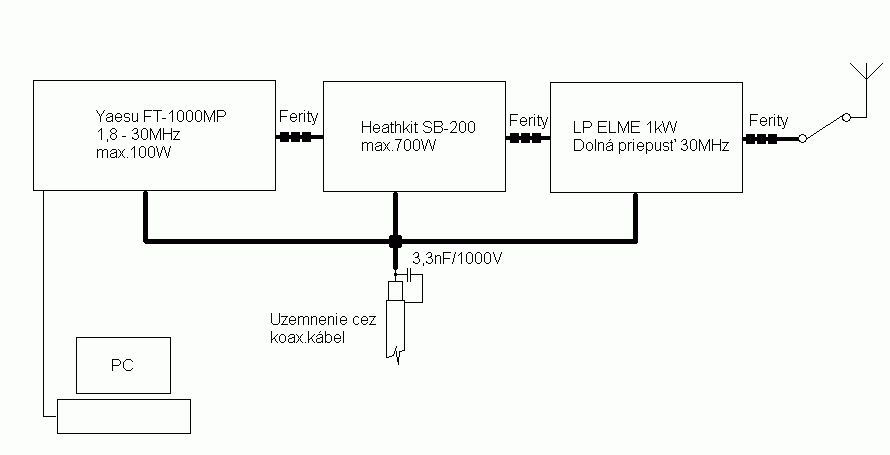
Despite this, I did not escape problems with TVI.. It started a few weeks ago when a neighbor got a digital satellite. Interference also occurred at 5W power. Every radio amateur who has encountered a similar problem will confirm that it is an unpleasant situation. Despite good relations with the neighbor, he insisted on repairing my equipment or stopping the broadcast. He refused help in the form of adding filters to the TV or ferrites.
In this deadlock situation, I turned to OŠD TÚSR. They promptly came, conducted measurements, and together with the neighbor found out a faulty SCART cable between the satellite and the TV.. I have to say here that this was above and beyond their call of duty, which I really appreciate. Now with 700W there is not even a trace of interference on the TV.
Literature:
[1] https://www.remeeus.eu/english/hamradio/artificial_ground.htm
[2] www.radioworks.com/nbgnd.html