
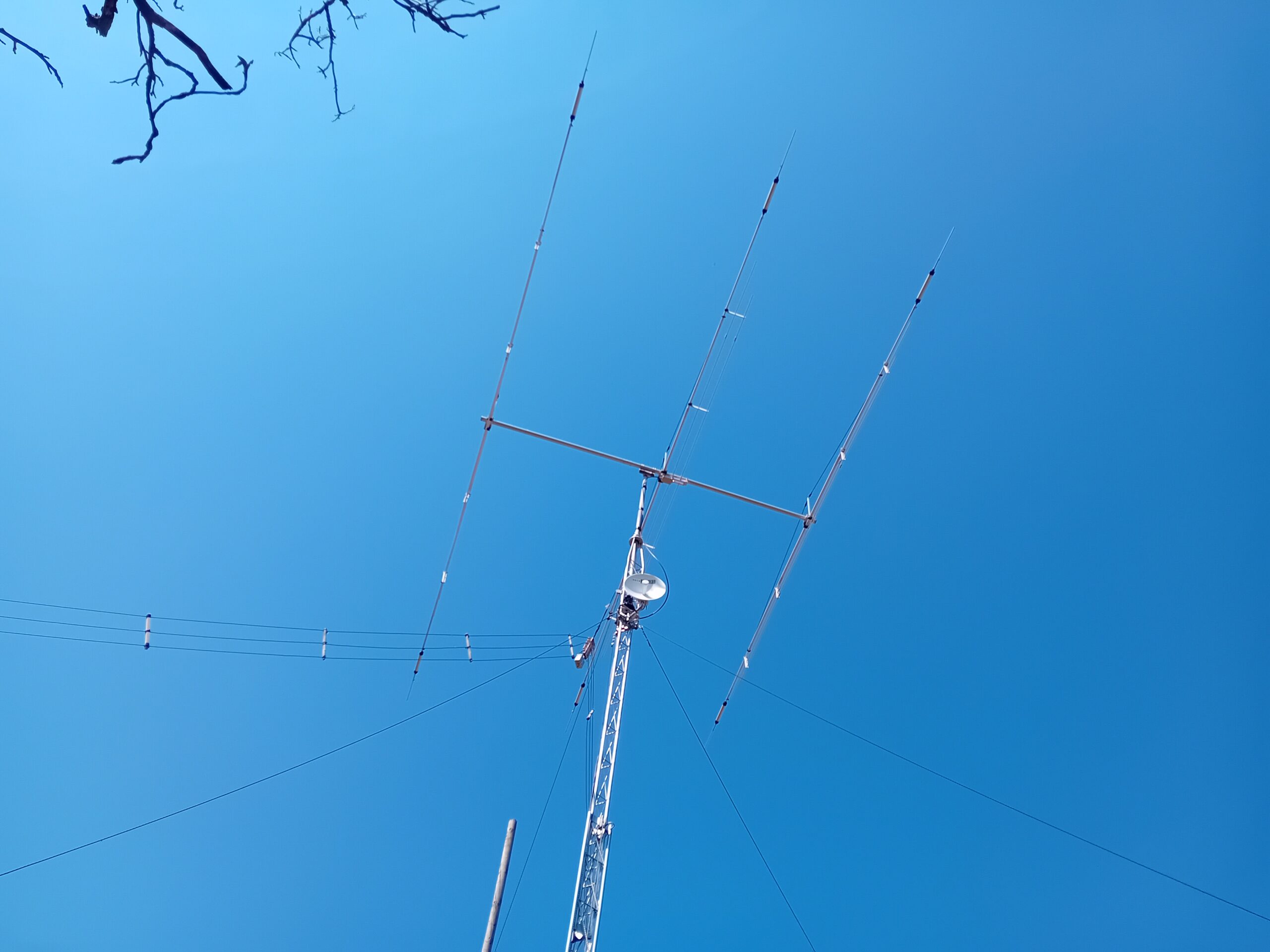
In the amateur radio community, there is an old saying that the antenna is the best high-frequency amplifier. You can own the most modern transceiver with perfect filters, but without a quality antenna system, your potential in amateur radio bands will remain untapped. Among European manufacturers who have built an unshakable reputation over the last decades, the Polish brand GXP stands out, behind which is designer Waldemar Święch, known by the call sign SP7GXP. His antennas are not just technical devices, but the result oflong-term testing in real conditions and constant improvement of mechanical durability.
In the article you will read about
Construction philosophy and materials used
Waldemar SP7GXP focuses on two key aspects when designing his directional antennas (yagi) focuses on two key aspects: electrical efficiency and extreme mechanical durability. Poland, like Slovakia, faces strong wind gusts, icing, and heavy snow loads during winter months. These conditions were the fundamental parameters in the choice of materials.
The basis of every GXP antenna is dural (most often alloy 6063 T66), which offers an ideal balance between weight and strength. Unlike many commercial manufacturers who save on the thickness of the tube walls, GXP uses thick-walled materials where it is critical – primarily in the middle of the radiators and on the boom. Connectors, clamps, and screws are exclusively made of stainless steel (inox), ensuring that even after ten years in an aggressive outdoor environment, the antenna can be disassembled or adjusted without damaging the joints.
Mechanical integrity is also enhanced by the absence of rivets in critical joints. Waldi SP7GXP prefers screw connections with lock washers, which eliminates play due to vibrations caused by the wind. Plastic components, such as insulators and trap covers, are made from materials with high UV resistance, preventing them from becoming brittle and subsequently allowing water to seep into the antenna's electrical circuits.
Multiband directional antennas: GXP flagship

The most popular category in the SP7GXP portfolio is multiband directionals. These antennas are designed to cover all major amateur radio bands from 20 meters to 10 meters, and in the case of special models, also WARC bands (12m, 17m, 30m) and even the 40-meter band.
The uniqueness of GXP antennas is their feeding. Most multiband models use a single feed point with an impedance of 50 ohms, which significantly simplifies the installation of the coaxial cable. Electrical matching is designed so that the antenna exhibits low PSV (SWR) in a wide frequency range without the need for frequent use of an antenna tuner.
The GXP 7-band model (also known as D3W) represents the pinnacle of engineering effort. This antenna allows operation on seven bands (40, 30, 20, 17, 15, 12, and 10 meters) while maintaining relatively compact dimensions compared to monoband systems. The use of traps (wave traps) is optimized in the GXP to minimize losses in coils, which is often a weakness of cheaper trapped antennas.
Monoband antennas for demanding DXers
Hoci sú viacpásmové antény praktické, rádioamatéri zameraní na špičkový výkon v contestoch alebo pri love vzácnych DX staníc často siahajú po monobandových verziách. GXP ponúka širokú škálu monobandových yagi antén pre pásma od 40 metrov až po 6 metrov.
These antennas are characterized by a clean radiation pattern, high front-to-back ratio, and maximum gain. In monoband designs, Waldi SP7GXP uses long elements that allow optimal spacing between components. The spacing between elements is what defines the characteristics of the antenna – whether it will have a narrow radiation angle suitable for DX or a wider spectrum with balanced gain across the entire band.
For the 6-meter band (50 MHz), which is referred to as the 'Magic Band' in amateur radio circles, GXP offers high-performance directional antennas with multiple elements that can utilize even the faintest signals from the sporadic E layer or propagation through the aurora borealis.
GXP vertical antennas: Solution for limited spaces

Not every amateur radio operator has the option to build a tower and mount a large directional antenna. For those who struggle with limited space, SP7GXP has developed a series of vertical antennas. The GP7DX model is already a legend today. It is a 7-band vertical that does not require an extensive system of ground radials, which is a huge advantage when installing on the roofs of apartment buildings or in small gardens.
GXP vertical antennas utilize the principle of resonant radiators and electrical counterweights that are part of the construction. Their low radiation angle makes them suitable for long-distance connections, although compared to directional antennas, they naturally lack the ability to suppress interference from unwanted directions. The mechanical design of the verticals is as robust as that of the directional antennas, with the lower insulator designed to withstand pressure at the base of the antenna even in strong winds.
Overview of antennas offered in the SP7GXP portfolio
The table below summarizes selected models and their basic technical parameters. It should be noted that Waldemar SP7GXP often customizes antennas to individual requirements, so parameters may vary slightly depending on the specific version.
| Antenna model | Antenna type | Operating bands (m) | Boom length (m) | Max. element length (m) | Weight (kg) |
| 2-el yagi 40m | Monoband | 40 | 5.5 | 15.2 | 45 |
| 3-el yagi 20m | Monoband | 20 | 6.0 | 11.0 | 25 |
| 5-el yagi 10m | Monoband | 10 | 7.5 | 5.3 | 18 |
| GXP 7-band (D3W) | Multiband Yagi | 40, 30, 20, 17, 15, 12, 10 | 5.5 – 7.0 | 11.5 | 40 – 55 |
| 5-band yagi | Multiband Yagi | 20, 17, 15, 12, 10 | 4.5 | 8.5 | 28 |
| 3-band yagi | Multiband Yagi | 20, 15, 10 | 3.8 | 8.2 | 22 |
| GP7DX | Vertical | 40, 30, 20, 17, 15, 12, 10 | – | 7.5 (height) | 12 |
| 6-el 50 MHz | Monoband | 6 | 6.5 | 3.0 | 10 |
| Rotary Dipole 40/30 | Rotary dipole | 40, 30 | – | 12.0 | 15 |
Technical challenges and installation

The installation of GXP antennas, especially multiband directional antennas, requires thorough preparation. Due to their robust construction and weight, it is essential to use a quality rotator (for example, Yaesu G-1000DXA models or more powerful ones, or AlfaSPID). For models with a 40-meter band, where the length of the longest element exceeds 11 meters, it is necessary to account for a large turning radius and significant wind load.
Waldi SP7GXP supplies antennas with detailed instructions, but the radio amateur should have basic experience working at heights and setting up antenna systems. The advantage is that most components are pre-prepared and labeled, which minimizes the risk of error during assembly. After assembling the antenna on the ground, it is recommended to check the resonance at a low height using an antenna analyzer, although final parameters will only manifest after raising to working height (at least half the wavelength of the lowest band).
Why choose GXP?
There are many global manufacturers on the market, such as OptiBeam, SteppIR, or Cushcraft. So why do radio amateurs from Slovakia and neighboring countries increasingly choose Polish GXP?
-
Price/performance ratio: Pri zachovaní kvality materiálov porovnateľnej s najdrahšími nemeckými značkami sú GXP antény cenovo dostupnejšie, čo je dané nižšími logistickými nákladmi a efektívnou rodinnou výrobou.
-
Mechanical oversizing: Waldi SP7GXP does not build antennas 'on the edge'. Each element is designed to withstand extreme weather fluctuations, which is crucial in our latitudes.
-
Service and support: Direct communication with the designer is a great advantage. In case of antenna damage during a storm, it is possible to order a specific replacement part that fits perfectly.
-
Skúsenosti z contestov: You can find GXP antennas at many successful Polish and international contest stations. The results in the logs of these stations are the best proof of the electrical efficiency of these antennas.
Conclusion and evaluation
Antennas from Waldemar SP7GXP represent a solid European school of amateur radio construction. They are proof that even in the era of digital modes and software-defined radios, a solid piece of aluminum at the top of the mast remains the most important element of the station. Whether you choose the universal vertical GP7DX or the monumental 7-band directional antenna, with GXP products you will gain a reliable partner for making the toughest DX connections.
It is important to emphasize that investing in a quality antenna is an investment in the joy of the hobby. GXP antennas will not only allow you to be heard on the other side of the globe, but thanks to their low self-noise and good directivity, they will also allow you to hear those stations that would remain hidden in noise on regular wire antennas. If you are planning to upgrade your antenna farm for 2026 and beyond, portfolio from the workshop of SP7GXP should definitely be part of your shortlist.