

WSPR-TX XP Plus is a standalone WSPR transmitter covering bands from 136 kHz to 70 MHz, equipped with integrated GPS module, which provides accurate time and Maidenhead locator calculation without the need for manual adjustment.
In the article you will find out
How to determine propagation conditions using WSPR?
Determination of propagation conditions using WSPR is very effective and simple. Here's how to do it:
🔍 What is WSPR?
WSPR (Weak Signal Propagation Reporter) is a digital mode developed for monitoring and mapping the propagation of radio waves. Each WSPR signal is:
- very narrow (6 Hz),
- transmitted with low power (typically 0.1–5 W),
- decodable down to -28 dB SNR.
Using a network of receivers around the world, we can track, where and how the signals spread, on which band a at what time.
🧭 How to determine propagation conditions via WSPR

1. Visit the WSPRnet.org website
Go Displays the map and table of captured WSPR transmissions.
- Displays the map and table of captured WSPR transmissions.
- Filter by callsign, bands, times a locator.
2. Track propagation from a specific station
- Search for your own callsign or callsign of another WSPR TX station.
- You will see, where your station was received (so-called “spots”)
- Suitable for monitoring band openings – for example, when new connections appear on 10 m, you know the band is opening.
3. Use the tool from HB9VQQ
-
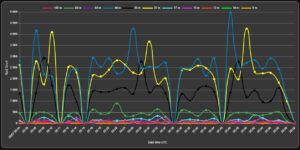
WSPR propagation conditions analysis by HB9VQQ Through https://WSPR.hb9vqq.ch data can be processed and analyzed in a clear form

4. Use software like WSPR in the WSJT-X package
- You can receive WSPR signals with your own RX and upload spots to WSPRnet.
- Alternatively, you can also transmit and track where you were received.
📈 How to evaluate propagation?
- Daily graphs (e.g. number of spots per hour) will show, when the band is open.
- Direction and distance of spots show, what type of propagation occurred (e.g. F2, sporadic E, tropo…).
- Comparing multiple bands (e.g. 20 m vs. 10 m) helps to understand, ako sa mení MUF.
🛠 Example of practical use
You have a WSPR transmitter (e.g. from ZachTek, Low power operation Labs or PC + SDR) on 20 m:
- You start transmission every 2 minutes.
- At WSPRnet.org you monitor where you are heard.
- You gain an overview of current conditions – e.g. that signals are going to JA, ZL, or just in Europe.
✳️WSPR-TX XP Plus Transmitter
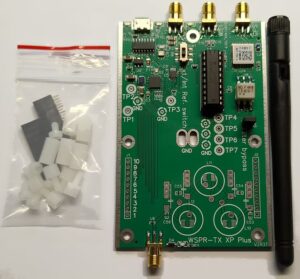
🔧 Key features
- Works completely autonomously after configuration (you only set the callsign via PC once) – no computer is needed after turning on.
- Powered by 5 V USB power supply, with a power consumption of approx. 250 mA during transmission (100 mA in standby mode) – suitable for mobile use with a power bank or USB charger.
- RF output approx. 250 mW, ideal for continental to intercontinental WSPR connections dependent on propagation conditions.
- Dimensions of the compact module ~100 × 66 × 20 mm, weight approx. 40 g.
➕ Extended version 'Plus'
The “Plus” model adds to the basic XP:
- Wi-Fi connectivity (currently without functional firmware, but potentially for NTP synchronization or remote configuration).
- Input for external frequency reference signal (eg 10 MHz OCXO), which increases frequency accuracy if the reference signal is in the range of 8-18 dBM.
🛠 Open development and expandability
- Software and schematics are open-source and available on GitHub, allowing for custom enhancements and experimentation.
- The module is supplied already assembled, except low-pass filter, which the user can purchase or assemble separately according to the desired band - the filter is not included in the basic package, but is sold separately (if needed for functional RF output).
- An optional is available for convenient band switching Mezzanine LP4 card, which allows controlling up to four filters (band-hopping).
⚙ Usage and function
-
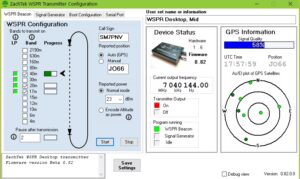
Zachtek WSPR-TX XP Plus Transmitter configurator Connect an external GPS antenna (3 m cable, part of the package).
- Set the call sign via USB configurator.
- Connect the antenna and power supply - TX will start transmitting autonomously in a random WSPR frequency 'slot' at a 2-minute interval.
- GPS will take care of time and position synchronization - the module automatically generates the correct Maidenhead grid.
💵 Price and accessories
- Base model price WSPR-TX XP Plus is (excluding VAT for EU customers)).
- Low-pass filters and Mezzanine accessories are sold separately, prices are listed in the ZachTek store
🧭 Who is it for?
WSPR-TX XP Plus is ideal for radio amateurs, experimenters, and mobile stations who want to transmit to the WSPR network simply, reliably, and minimally without unnecessary settings. Thanks to open firmware and compact design, it is an accessible and flexible tool for modern QRP WSPR experiments.