
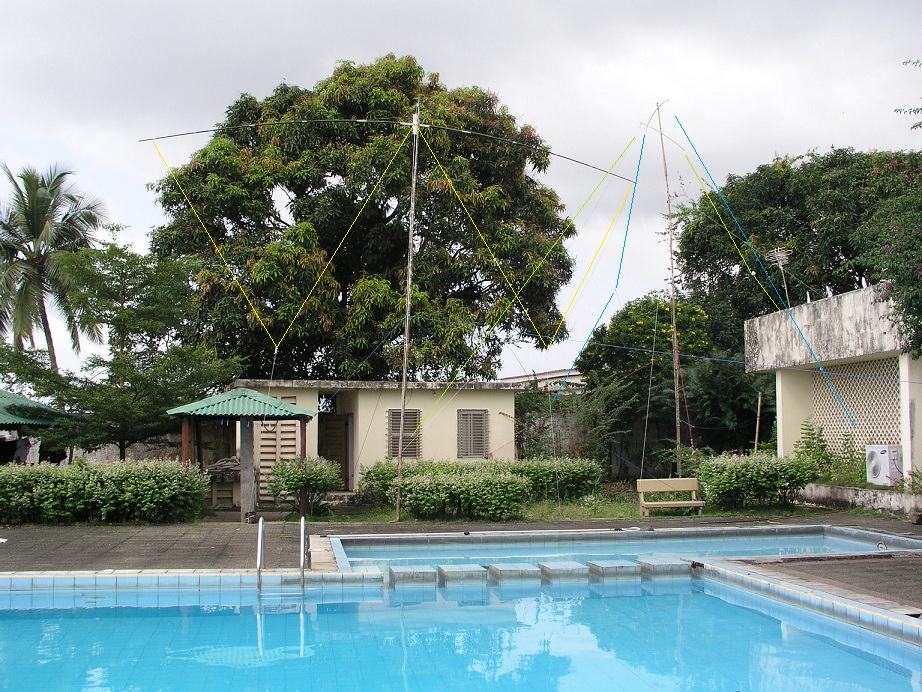
We talked about the DL-Special DX antenna once with Vilo, OM3CAQ. In amateur radio operation, we are constantly looking for solutions that offer a good compromise between performance, ease of construction and low costs. One such solution is an antenna DL-Special DX, which he designed and practically tested Georges ON6WG/F5VIF. This special configuration of two phase-connected delta loops (collinear delta loops) offers directional radiation, high gain and a low radiation angle, making it ideal for DX operation.
You will read in the article
Origin of the antenna and first experiences
The concept of the antenna was created in 1992, when ON6WG was preparing for a difficult "pile-up" from the anticipated FOØCI DXpedition from Clipperton Island. Without access to a profitable directional antenna, he decided to create an antenna that would be simple to manufacture, cheap and effective. He found inspiration in books Low Band DXing (ON4UN) a The Radio Amateur Antenna Handbook (W6SAI, W2LX). The result was an antenna that allowed him to connect with FOØCI on the third call without any problems, thus confirming its qualities.
DL-Special DX antenna concept
This antenna consists of two of triangular delta loops, which are suspended with the point down (double "V" shape). They are located in the same vertical plane a phase connected in the upper corners, where the power coaxial cable is also connected. Thanks to this configuration, the antenna behaves like a phased array, which increases the gain and improves the directivity of the radiation.

It is a big advantage resonant resistance close to 50 ohms, which means that the antenna does not need any tuning element (tuner). After correct setting, it is effective PSV very low (close to 1:1), which allows efficient operation without losses.
Calculation and construction
The total length of the conductor for one delta loop is determined according to the relationship:
-
in feet: λ = 1005 / f(MHz)
-
in meters: λ = 300 / f(MHz)
Subsequently, the conductor is cut to 1.06 λ, which is the optimal loop length for resonance. For two loops (DL Special DX), the total length of the conductor is doubled. The antenna can be made as simple wire construction with several insulators, mounted on a frame or between two masts.
On bands VHF or higher, the antenna can be placed on a frame (e.g. made of PVC) and even attached to a window or balcony. On the KV bands, even if it is only placed at a height of 1/4 λ, it offers a lot low beam angle, which is ideal for long distance connections.
Power supply and balun
DL-Special DX is symmetrical antenna, and therefore it is appropriate to use 1:1 balun (eg "choke balun"). In practice, this means stringing several together ferrite toroids to the coaxial at the power point. This avoids the post-shielding current and maintains the symmetry of the radiation.
Radiant properties and gain
Modeling in the 4nec2 software showed that the antenna has a 145 MHz band (VHF) placed at a height of 1/4 λ above the ideal ground surface:
-
Gain up to 11 dBi, which is comparable to four-element yagi antenna
-
Radiation angle is very low - ideal for DX operation
-
Horizontal radiation diagram shows directivity with a wide main lobe
On the KV bands, the antenna has similar characteristics. In practice, this means that even in low height (e.g. 5-6 meters above the ground) quality connections can be established over thousands of kilometers.
Bandwidth and SWR
Both measurements and modeling confirm that the antenna has wide range of applicability with a very low PSV. On the 28 MHz band, it covers the entire band with minimal reflection, which allows use without the need for tuning.
Polarization
One of the advantages of DL-Special DX is Dual polarization – both horizontal and vertical. On KV bands it helps to reduce the influence QSB. On VHF, it allows simultaneous communication with both horizontally and vertically polarized stations without switching the antenna.
Comparative tests
The DL-Special DX was tested against a four-element Yagi antenna on the 144 MHz band. In tests where both antennas were at the same height on separate masts, the quality of the received and transmitted signals was comparable. This is proof that this simple wire antenna can really match a more expensive directional solution.
Practical use – DXpedition 9L1BTB
An interesting application of the DL-Special DX is its use during a DXpedition SP5BTB as 9L1BTB in Sierra Leone in 2013. The antenna was made for the 15 meter band and placed on jediný stožiar. It worked great.


Advantages of DL-Special DX antenna and conclusion
DL-Special DX is a simple, cheap and light antenna suitable for DX operation. It is single band antenna, but thanks to the low material requirements, it can be built for several bands. A few main benefits:
-
High profit
-
Directional radiation with a low angle
-
50 ohm impedance – simple power supply
-
Wide band with low PSV
-
Dual polarization
-
Simple assembly and disassembly
-
Low price and easy availability of material
If you are looking for an original and efficient single-band solution - whether for home use, in the field or on a DXpedition - the DL-Special DX is an excellent candidate. With minimal effort and low costs, you will get an antenna with a performance that will surprise even the opposing stations.
Springs
[1] 9L1BTB – SIERRA LEONE 2013 DX-pedition
[2] https://on6wg-f5vif.online/Doc/DL-Special%20DX%20Antenna%20-%20Engl.pdf