
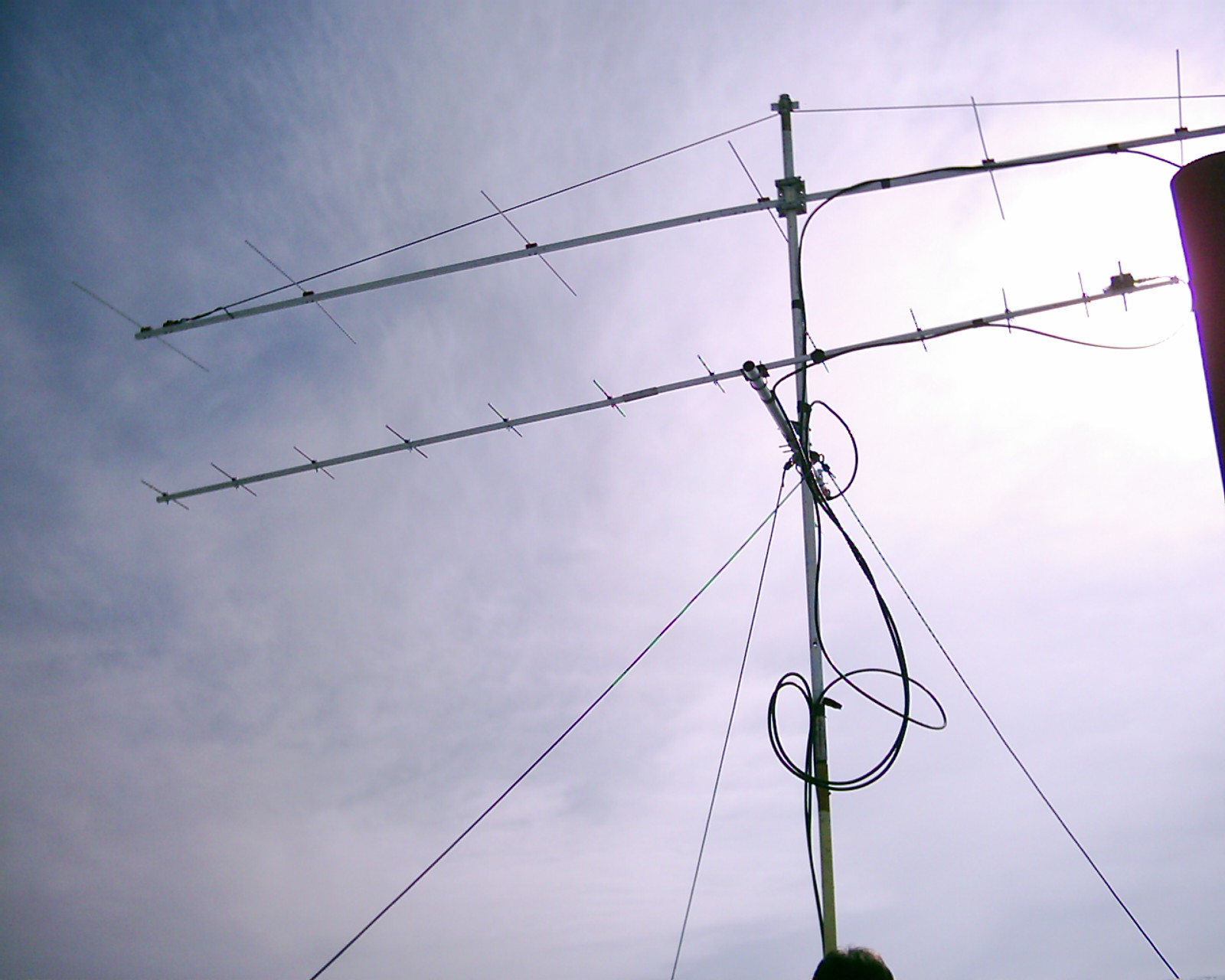
Basics of VHF/VHF operation is another article by Zoli, OM7AQ. It is an overview of DX operation methods on these bands, their characteristics and use. I supplemented the original article by mentioning the new types of WSJT and JT44 operation. We will return to these extremely progressive technologies in separate articles in the future.
DX operation on VHF/UKV bands is demanding not only from a technical point of view, but also places great demands on the operator's operational qualities. We use the following modes for DX operation on the VHF/UKV bands:

You will read in the article
Tropospheric propagation
It occurs most often in the autumn months. It differs from other types of spread in that it sometimes lasts several days. DX station signals are usually stable, but not extremely strong. We can use this propagation on VHF and UHF bands - 2m, 70cm, 23cm, 13cm...
Connections by reflection from sporadic layer E (ES)
The physical nature of the mechanism of this type of propagation has not yet been sufficiently clarified. It occurs mostly in the spring and summer months - from May to August. Es can be used in the 6m and 2m bands - of course, less often at higher frequencies - connections with a range of over 2000 km are not uncommon. The audibility of the signals is very good, but very often fluctuating, sometimes from 0 S to extreme strength above S 9. Propagation sometimes takes a very short time - several hours of band opening is rare. The requirements for the station's technical equipment are not high.

Connections by reflection from the aurora borealis (Aurora)
The aurora borealis is an atmospheric phenomenon that takes place at an altitude of 100 to 1000 km above the earth's surface. It is the ionization of the upper layer of the atmosphere caused by the passage of charged particles during a solar storm. The particles are "trapped" and directed by the Earth's magnetic field - so they follow the Earth's magnetic field lines towards the magnetic poles. Ionized places reflect VHF and VHF radio waves - all stations must have antennas directed to this place - to the north. The signals that are reflected from the aurora borealis have a characteristic sound - with CW we do not hear a tone, with SSB the signal is hoarse.

Connections by reflection from meteor trails (MS)
One of the most demanding types of DX operation on the VHF bands – radio waves are reflected from the ionized tracks that are created after meteorites ignite as they pass through the upper atmosphere. Reflections only last for a short time, so in telegraph operation it is transmitted at a high speed in order to transmit as much information as possible in a short time. We can use this propagation in the 50MHz, 144MHz and 432MHz bands. *Recently, a large number of VKV DX-men are dedicated to MS operation in WSJT mode. It allows even minimally equipped stations to establish long-distance connections.

Earth-Moon-Earth Connections (EME)
Určite najnáročnejší druh prevádzky, používa sa od 50 MHz až po 24 GHz. Pri EME spojeniach musia byť antény korešpondujúcich staníc nasmerované s veľkou presnosťou na Mesiac. Na nižších pásmach sa používajú anténne systémy z niekoľkých antén, na vyšších pásmach sa obvykle používajú paraboly. Pri spojeniach sú signály zvyčajne slabé, len niekoľko špičkovo vybavených staníc má silný signál. Pri prevádzke je nevyhnutné používať nízkošumový Predzosilňovač a čo najväčší výkon. *Vďaka novému módu JT44, ktorý umožňuje príjem extrémne slabých signálov nároky na vybavenie staníc poklesli.
gye@isternet.sk
http://om7aq.host.sk