
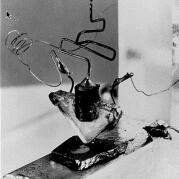
I decided to use this triac for my experiments with 230V. It was a used type from some facility. He already had short leads and certainly many hours of operation behind him. High time to retire… Instead he went to the eternal hunting grounds…..
I connected it to a universal board. I have not connected the voltage to the control electrode yet. He wanted to measure and adjust it first. I also measured whether by chance there is a connection between A1 and G. The alternating current should have gone to the control electrode through a 1uF/630V capacitor, a 100 ohm resistor, student, button and limiting diodes against ground.
After turning on the 230V, there was a flash, there was a bang and the circuit breakers in the main cabinet responded.... Now I'm wondering where the error was.... It could only be a tin bridge.... I'm currently fixing the fuse box so that my circuit breakers don't blow again. I have 230V on this box, I use it to power my 40W soldering iron, there is also a diode in the box that is bridged by a switch that switches the power to the soldering iron. I have another KT207/400, work on it will start when I find out some details of how the triac is powered. Alternating current? - that's probably why there's a student there...
In schemes where Tc is controlled, the G electrode is fed mostly to IO - I don't know what the voltage is there. Functionally, the triac is composed of two thyristors, and the thyristors are switched by direct current. Are two different thyristors NPNP and PNPN used in the triac? In my opinion, two identical thyristors connected in parallel would also work. These would then be switched with direct current. My brother showed me the triac switching diagram, it is powered by 230V directly to the control G through a diac, so it is AC after all.
The funeral ceremony is being held today, May 6, 2003
Honor to his memory.