

Behind the essence of this meteor shower is the wonderful interplay of the universe. Every 33 years, Comet Tempel-Tuttle comes close to the Sun, and the radiation releases a lot of cometary material, mainly dust, from its surface into the surrounding space. If it gets close to the Earth, the gravitational field will take care of capturing and pulling it, which will cause a unique meteor shower.
In the search for the history of the Leonids, we reach the year 902. The first scientific report was prepared in 1799 by the famous naturalist Alexander von Humboldt during an expedition in the Orinoco river basin. The most amazing experience, however, was prepared by the Leonids in 1966 again over North America. At its peak, a frequency of up to 100,000 meteorites per hour was recorded! According to eyewitnesses, meteors literally rained from the sky. But what can we expect this year?
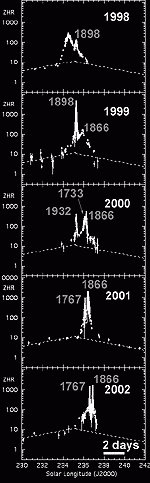
The expected activity this year will be from November 12 to 21. The speed of particle movement is relatively high, around 71 km/h, while there are few small particles in the swarm. Scientists expect two peaks, the first, sharp (lasting one to three hours) November 13 at 17.17 UTC with a frequency of 250 meteorites per hour, the second (lasting one day) November 19 at 7:28 UTC with a frequency of 100. Between the maxima, the expected frequency is 10-20 meteorites per hour. The most convenient connection times for these directions are: SW - NE: 01 - 05 UTC, E - W: 04 - 07 UTC, SE - NW: 06 -10 UTC and S - S: 23 - 04 and 07 - 11 UTC.
As for the visual observation in Europe, it is seasonal, because the moon will be full and the maximums come out more or less at the time of day. The chance is more for the second maximum, provided the weather is cloudless.
Good luck and nice connections!