
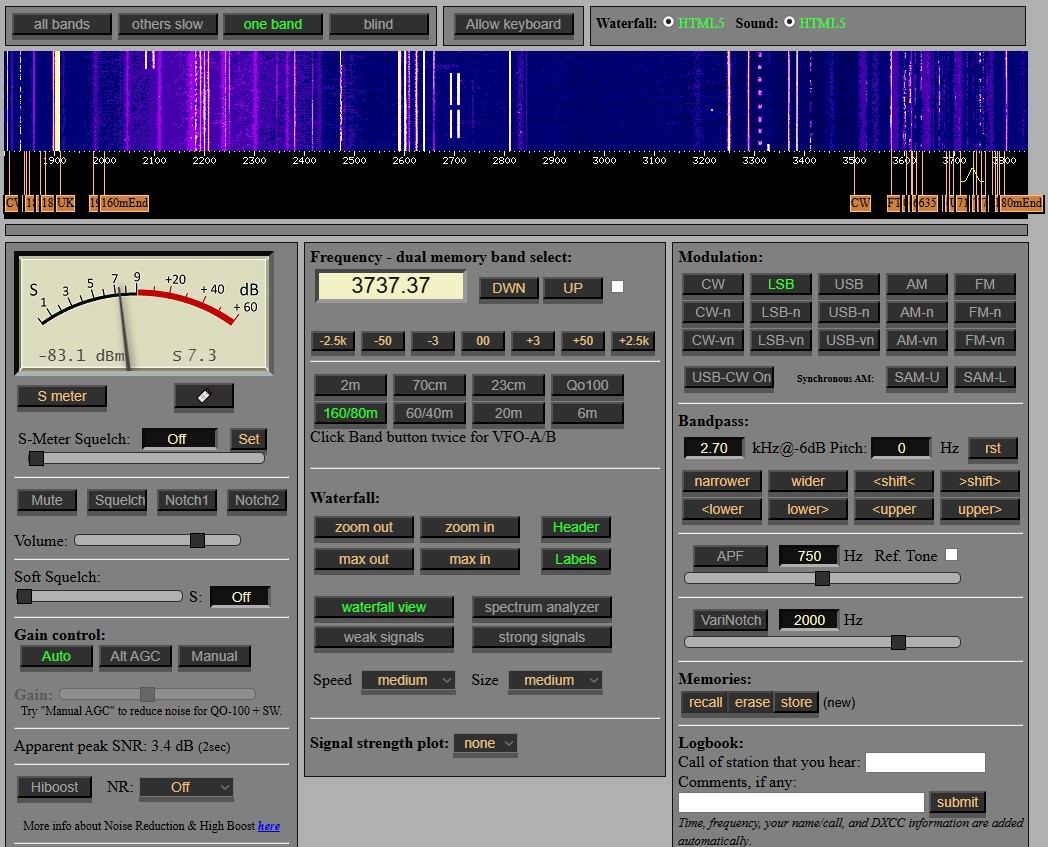
The amateur radio community has received a significantly improved WebSDR receiver at address http://SDR.homeip.net:8901/. After six weeks of intensive modifications and modernization, Mike introduced, DK1ML, a new system into operation.
The new WebSDR offers a combination of technical precision, rich functionality and wide band coverage - in short, a platform that combines all the essentials for monitoring current band activity and serious DX monitoring in one interface.
You will learn in the article
Ten bands - everything a radio amateur needs
The new WebSDR now includes 10 amateur bands, divided into eight selection sections, which is the maximum supported SDR server. These bands are available:
-
2 m
-
70 cm
-
23 cm
-
3 cm / QO-100
-
160 m
-
80 m
-
60 m
-
40 m
-
20 m
-
6 m
Thanks to this composition, the listener has practically the entire spectrum of key HF and vhf bands, including satellite reception via QO-100. The system is suitable for general monitoring, contesting and DXing.
Top-25 direct buttons: instant access to important frequencies
One of the most attractive additions is a set Top-25 “Direct Buttons”. Umožňujú rýchly výber najdôležitejších regionálnych frekvencií a prevádzačov bez nutnosti manuálneho nastavovania VFO či šírky pásma.
For mobile users or those who want to quickly orient themselves in local events, this is an extremely practical function.
Digital hub: DMR, C4FM and D-Star
An interesting novelty has also been added to WebSDR - Digital Hub in experimental operation. It allows you to listen to digital voice modes:
-
DMR
-
C4FM
-
D-Star
The receiver provides a quick overview of events in modern digital networks, without the need for any digital equipment.
Advanced DSP features for quality reception
Mike implemented extensive software enhancements that significantly improve comfort and cleanliness of reception:
-
DSP noise suppression
-
new notch filters
-
special features for CW operators
-
S-AM (synchronized AM) for stable reception during fading
-
manuálne AGC
-
Soft- Squelch a S-Meter Squelch
-
two VFO for simultaneous signal monitoring
-
plenty of other accessories
Also new is CAT-Sync, which allows connecting WebSDR with a transceiver - ideal for combined RX/TX operation on QO-100.
New antennas and better reception
Part of the modernization was a complete renewal of the antenna system. Two new antennas specially designed for WebSDR needs were added:
HiEndFed dipole for low bands (160/80/60/40 m)
Length 40 m, directed towards the forest - ensuring quiet reception even in urban environment, especially during night hours. Excellent for contesting and DX on low bands.
Wire 20 m beam at 40 m height
Total wire length 56 m in yagi “zig-zag” configuration.
Preferred directions:
-
USA
-
Canada
-
Asia and Pacific (including JA and VK)
Thanks to the omnidirectional side lobe, it achieves good reception from all DXCC entities.
Latest receivers and precise GPSDO stabilization
All receivers have been replaced with modern models. The latest are used for HF bands V4-SDR modules from USA, with:
-
integrated stable up-converter
-
input filters
-
precise TCXO oscillator for stable frequency in SSB modes
Reception for QO-100 is stabilized by GPSDO, while all other bands were frequency-tuned in the same way.
More powerful server and modern visual appearance
After 17 years of service, the server backend received completely new hardware with significantly higher performance. WebSDR now offers:
-
modern transceiver interface
-
parallel classic mode for users who prefer the original UI
-
new Enhanced-Waterfall display that reveals even very weak signals
There is a special version for mobile devices iOS and Android, optimized for small displays.
Conclusion
The new WebSDR DK1ML represents a big step forward: more stable reception, more bands, new antennas, modern SDR modules, and a rich set of features usually found only in professionally equipped transceivers.
Mike, DK1MLinvites radio amateurs to try out the new WebSDR and looks forward to feedback in the chatbox.
Link: http://SDR.homeip.net:8901/
73, Mike - DK1ML