
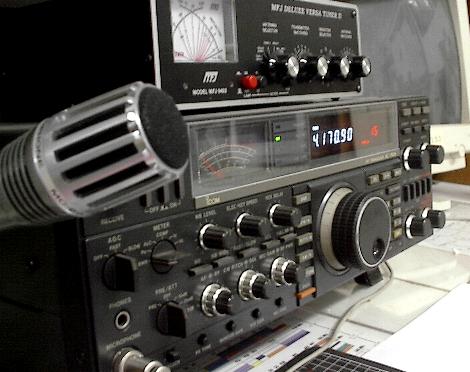
Various strange SSB signals across the band show that this setup causes problems at times. The decision of how much speech energy is converted into HF energy is not so simple. Although every transceiver manual talks about the setting, it is often a bit more complicated.
You will read in the article
So how do you set up an SSB transceiver?
Before we start working on the microphone, the high-frequency equipment must be in perfect order. The antenna should be as low as possible PSV on the frequencies used. A satisfactory PSV value is 2 or less. If it is not, the transmitted signal will be affected by ALC.
What is ALC?

ALC is a transmitter circuit whose function is to limit remodulation, the occurrence of interference in the vicinity of the transmitted signal (splashing) and the protection of the transmitter circuits. If the ALC detects overmodulation, it automatically reduces the gain of the transmitter amplifier stages. The second function of ALC is reflectometric protection, which will also reduce the gain of the amplifier stages of the transmitter so as not to damage the output circuits.
ALC thus creates some signal compression. This manifests itself in the fact that the hands of the power indicator are more to the right and the opposing stations say that the signal is stronger and stronger. That is until a nearby station starts complaining that your signal is wide. Do not under any circumstances use ALC to "amplify" the signal!
In order for the ALC circuits, and not only these circuits, to work properly, we must prevent unwanted RF energy from entering the transceiver. It means that we try to implement all the inputs with shielded cables and we do not skimp on blocking capacitors in the connectors. It is convenient to make a choke from the cable, for example by winding a few turns on ferrite with high permeability.
Quality grounding
The device must be at ground potential - i.e. grounded. Otherwise, the circuitry in the transceiver may not work properly. Some radio amateurs say they don't notice a difference whether the equipment is grounded or not. In certain lucky cases, there may not be much RF energy on the equipment frame. However, it is better not to leave it to luck.
Transceiver check
It is advantageous if you can at least once every few years check and adjust the quiescent currents in the transmitter. This is especially true for older devices where the current may have changed a lot over time. However, this check requires the device to be opened and measured inside. If you do not dare to do this, contact a professional company.
SSB transmitter setup procedure

If the first two conditions are met - suitable PSV and grounding of the device, we can start setting up the device.
For this, we will need an artificial load sized for the full power of the transmitter. If we want to "win" with modulation, its coloring and the like, a second receiver connected to the computer will do a good job, in case of need a colleague on the band.
We turn off all functions that affect modulation - compressor and equalizer. First we need to figure out "how to talk into the microphone". Some microphones are particularly sensitive and it is not possible to speak into them at close range (e.g. the standard microphone of the FT-950). We set the full power and during the broadcast we set the MIC GAIN so that the ALC indicator is at most half of the recommended range.
In this way, we will try several sessions with different distances of the microphone from the mouth. We always bring the MIC GAIN to the recommended ALC value and look for noticeable distortion in the modulation. This is how we determine the appropriate position of the microphone from the mouth.
Choosing the optimal microphone

We choose the type of microphone according to our requirements. Someone prefers a "sharp" sound, others a system with bass content. If you don't like the supplied microphone, buy another one. It can be from a device manufacturer that offers better microphones as an optional accessory, from a specialized manufacturer (MFJ, HEIL), or by yourself. Electret microphones for computers are suitable for this purpose. Their frequency response is usually very flat. However, it is not difficult to include an RC member in the modulation path, which will be used to modify it.
Setting the modulation level
If we have the first step - finding the optimal distance of the microphone from the mouth - solved, we can assign more modulation signal to the transmitter. Tune into the band on the frequency where the antenna has a worse PSV and try to speak into the microphone as in a race. Due to the racing tension, especially when we can't get through, the operator tends to raise his voice. In such a situation, the ALC indicator must not (!) exceed the limit recommended by the manufacturer. If you set the MIC GAIN lower, the signal will be even cleaner. You can then try retuning to a frequency where the antenna has a lower PSV and see how much the ALC indicator drops during transmission.
Compressor setting

After this setting, we can start working on the compressor. Practically, even the cheapest devices contain an LF compressor, the more expensive HF compressors. Neither NF nor HF compression needs to be overdone in order to reap its benefits. Make the optimal setting according to the recording from the other RX or according to the assessment of a colleague on the band where you have a strong signal. It is realistically possible to achieve compressions of 4 to 10dB, depending on the type of compressor, without distorting the signal.
Equalizer
However, turning on compression changes the timbre of the modulation. Again, it depends on your requirements whether the resulting signal is good. It is possible to use Equalizer and emphasize or suppress some frequency components of the modulation and achieve the signal as you want.
Final inspection
Finally, check that the ALC indicator does not exceed the recommended range during full remodulation. If so, reduce the MIC GAIN. However, reducing the MIC GAIN will also have a positive effect on the signals, so if you don't want to "squeeze" the transmitter to the maximum, but you care about clean signals, remove it.