
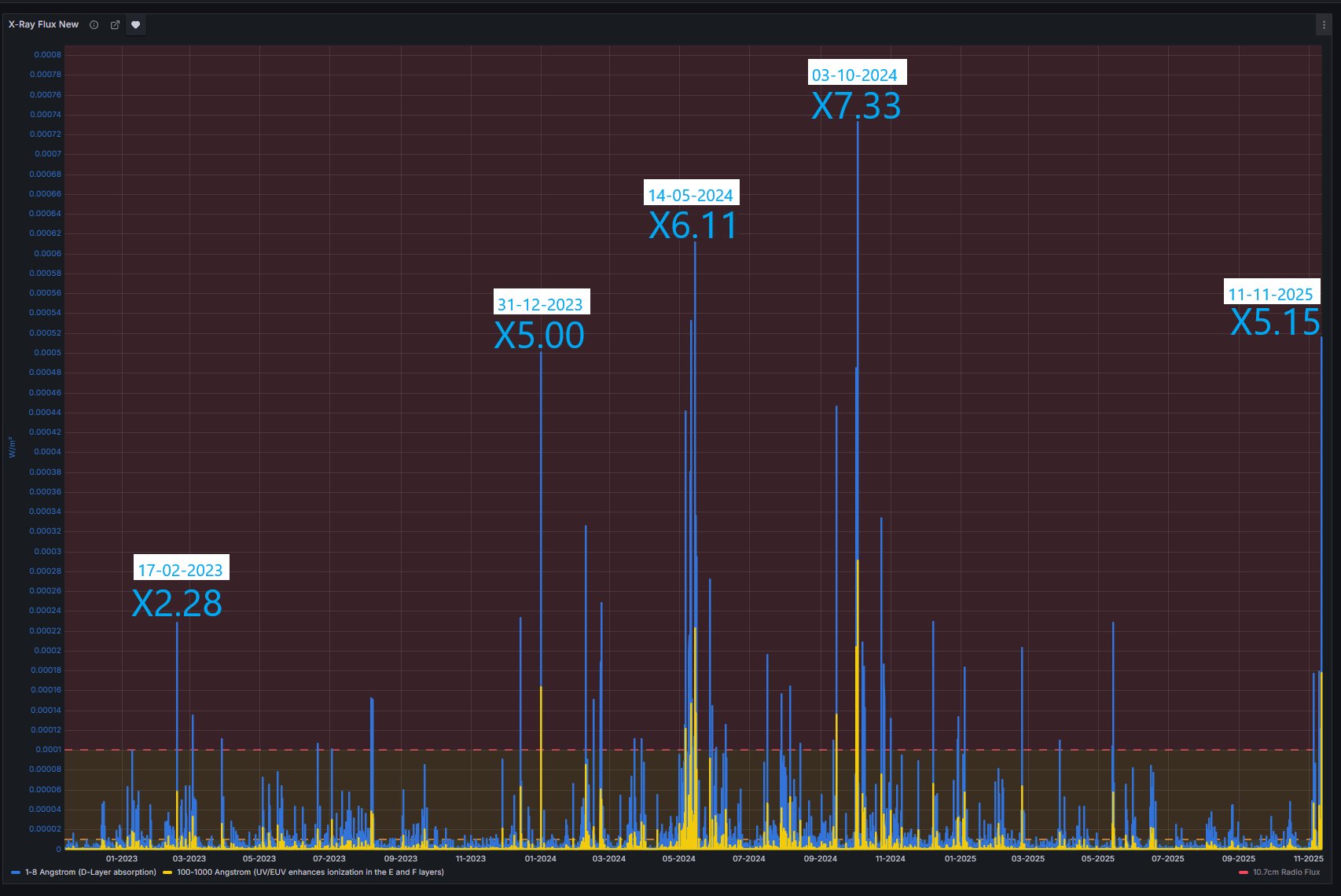
On November 11, 2025 around 10:04 UTC, an eruption classified as class X5.1 exploded on the Solar disk near sunspot AR 4274. This event is classified among the strongest eruptions of the current solar cycle and brought a range of spatial-temporal consequences.
You will learn in the article
How the eruption occurred
The eruption originated from the active region AR 4274, located on the 'Earth-facing' side of the Sun, thus oriented relatively towards Earth. In this area, due to a strong magnetic field, huge reserves of magnetic energy accumulated, which suddenly released - resulting in a violent emission in the form of X-ray radiation (typical for X-class eruptions) and the release of a coronal mass ejection (CME).
In addition to the eruption itself, extensive dimming of the corona was recorded in the images, which is an indicator of material leaving the core of the solar atmosphere - a typical accompanying phenomenon in large CMEs heading towards Earth. Type II radioelectric waves (designation of radio emissions associated with shock waves) recorded an estimated ejection speed of around 1,350 km/s.
Consequences and spread of effects
When this type of event occurs, there are several layers of impacts:
-
X-ray and UV radiationThe first wave of the eruption will affect the Earth (ionosphere) practically immediately (within minutes), which can cause short-term disruption of high-frequency radio communication, especially in the D-layer of the ionosphere.
-
Energetic protonsHigher layers and proton eruptions can reach Earth in tens of minutes to several hours and trigger the so-called space weather radiation (‘Radiation Storm’). In this case, an S2 state was declared.
-
Coronal Mass Ejection (CME) + Geomagnetic StormA CME heading towards Earth can cause a geomagnetic storm – in this case, the warning was extended to G4 (severe) level for mid-latitude regions.
Timeframe and duration
The eruption peaked around 10:04 UTC today and its direct effect (in the form of X-ray radiation) lasted only a few minutes. However, subsequent effects have a significantly longer duration:
-
Ionospheric radio wave disturbance: in the first hours after the eruption.
-
Proton storm: can last for tens of hours.
-
CME: arrival at Earth is estimated in this case for mid to late hours of November 12th (UTC) and the geomagnetic storm itself can last from a few hours to a full day or longer.
Significance for radio amateurs and satellite communication
For radio amateurs, such an eruption is important because it significantly increases the risk of interference with HF and VHF connections, ionospheric disruptions (especially in the lower ionosphere) and in extreme cases, it can lead to damage to satellites or flights at low altitudes. There is also an increased likelihood of observing auroras in mid to high latitudes.
Conclusion
The X5.1 class eruption originating from AR 4274 is classificationally one of the most significant events of the current solar cycle. It is characterized by high energy, fast CME, and a direct path to Earth, triggering a complex cascade of effects – from radio disruptions, through proton storms to possible strong geomagnetic activity. Radio amateurs, satellite operators, and observers of solar and geomagnetic activity should keep this event in mind as a significant example of ‘strong Sun’ and its impact on our technical infrastructure.