

In A Radio Practical Electronics Electus on p. 21, the connection of the level switch for the pump by Štepán Burda was published. I decided to build a similar circuit, but with fewer parts. A total of 3 transistors were used in the originals, 1x 7400, 1x78L05. I also used two level sensing positions. In my circuit there were 2 transistors, old germanium SFT125 and thyristor KT501. (I regret not using the Ge transistors and throwing them away).
The supply voltage can be increased, but the resistors and trans must be adjusted. they must be rated for this voltage.
 Furthermore, it is possible to insert an RC member in front of the relay, which limits the current. It is advisable to use a trimmer first and then replace it with a fixed resistor. The capacitor should have a capacity from 470n to 50uF according to the type of relay. Furthermore, it will be necessary to use a protective diode connected in parallel to the relay, so that the overvoltage pulse that occurs when the power supply for the relay is disconnected does not destroy Ty.
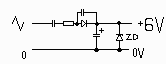 The power supply can also be temporarily via a capacitor connected to the phase conductor, a limiting resistor (220), a diode, a filter capacitor and a zener. The capacity of the capacitor (connected to the phase) should start from 1uF/250V (at 5uF it was already 250V!). All the components with which I tested the circuit were for 250V, even old stock in a drawer will suffice, in my case they were mostly Russian (because Russian ones have no steam!). Attention, working with a life-threatening voltage of 230V, so caution is never enough. It is convenient to use a spacer when setting transformer.
It may be necessary in some cases to use turn-off resistors in the bases of the transistors (connected between the base and +Ucc). A value from 10k to 100k should be enough. Furthermore, a filter capacitor with a value of 10nF can be installed on the rectifier diode due to the occurrence of interference - commutation on this diode.
I tried this connection only on the universal PCB, but in practice the connection was not tested even with the pump (we don't have water in the cellar yet...)
Goodbye Rado
* Rado and I did not quite agree on whether such a source complies with STN or not in this application. Can anyone answer this question responsibly? TNX, OM3-0122