

Choosing the optimal antenna is always a difficult compromise. Whether dimensional, type, material, financial... The beauty of amateur radio is that there is always something to invent, construct, improve.
The principle of increasing profit yagi antennas
Increasing the gain of the antenna consists in extending the boom and adding other elements. This is not always easy, it is often necessary to replace the original antenna with a completely new one. However, David Butler G4ASR has developed a two- to six-element yagi on 6m, which can be easily adapted to your needs at any time - from a small portable antenna to a decent antenna to an efficient DX antenna with a gain of over 10 dB.
Dimensions of the G4ASR two- to six-element yagi at 6m
| Number of elements | Reflector [mm] | Radius [mm] | D1 [mm] | D2 [mm] | D3 [mm] | D4 [mm] | Distance from the previous element [mm] | Boom [mm] | Gain [dBd] |
|---|---|---|---|---|---|---|---|---|---|
| 2 | 2819 | 2645 | 724 | 750 | 5 | ||||
| 3 | 3073 | 2819 | 2654 | 1124 | 2300 | 7 | |||
| 4 | 3073 | 2819 | 2654 | 2616 | 1124 | 3400 | 8 | ||
| 5 | 3073 | 2819 | 2654 | 2641 | 2616 | 1130 | 4600 | 9 | |
| 6 | 3061 | 2819 | 2629 | 2578 | 2527 | 2477 | 1092 | 5500 | 10 |
The table captures the dimensions of all designs. Although the lengths of the elements change, the spacing between them remains constant. In this way, after extending the boom and adding another element(s), it is possible to easily get a more profitable antenna. Anyone who dares can make a puzzle and change the antenna at will.
The two-element yagi consists of a radiator and a director, and is intended for a limited space where a larger antenna simply cannot fit. The three-element version has significantly better parameters. The four- and five-element versions are suitable for most hunters of DX connections. A six-element yagi with a gain of over 10 dB is a top antenna for the top DX-man on the "magic band".
Mechanical details
The antennas have a one-inch (25.4 mm) square boom profile and half-inch (12.7 mm) AlMg elements. Two- and three-element versions use a single boom, longer antennas have a boom divided into two or three parts. These are connected by a 200 mm square 7/8 inch profile, which is slid inside the boom and secured with self-tapping screws. Longer booms should be reinforced on the mast with nylon cables.
When measuring the spacing of elements, it is more advantageous to measure the distance from the reflector, which eliminates the accumulation of inaccuracies. Each element consists of a 380 mm AlMg tube with a diameter of 16 mm attached to the boom, into which a 12.7 mm diameter AlMg tube of the required length is telescopically inserted. Such a construction is strong and light at the same time.
Customizable gamma match
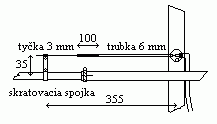
The antennas are designed for a center frequency of 50.5 MHz. Bandwidth s PSV<1.3 is 1 MHz. The fit is the gamma match that is pictured. In the pipe there is a 100 mm long PTFE dielectric from a coaxial cable into which the rod is inserted. The coaxial cable connection is in a waterproof box. The braid is attached in the middle of the boom as close as possible to the beam. While observing all dimensions, tuning is limited only to finding the place of the shortening coupling so that the PSV is as low as possible. In case of problems, the gamma match rod can be pushed in or out by a few millimeters.