

Another article from Ole OZ2OE is low noise preamplifier at 144 MHz with the BF981, which achieves a gain of 23 dB with a noise figure of around 1 dB.
You will read in the article
Introduction
Maybe someone will ask: why a preamplifier with a double-base MOSFET? It is of course possible to choose from several connections with GaAs FETs, but for 2m tropo operation there is no noticeable difference, while the MOSFET is much more durable - and cheaper!
Mechanical construction
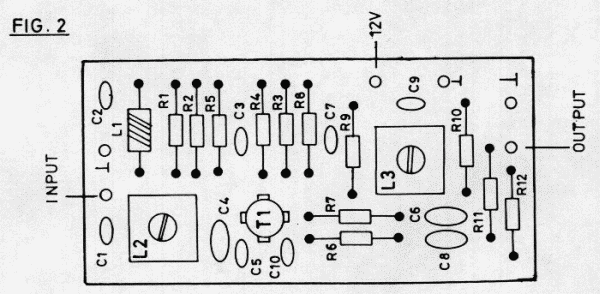
The preamplifier is constructed on a double-sided printed circuit board with dimensions of 25 x 50 mm. The upper side serves as the ground. The installed circuit board is in a small metal box terminated with BNC connectors.

Electrical connection of the OZ2OE preamplifier
It can be seen from the diagram that the input circuit is a series tuned circuit, the output "normal" parallel with capacitive coupling. Because the preamplifier has too much gain, there is an attenuator at the output. The bias voltage for the transistor is realized by voltage dividers in both G1 and G2. In this way, it is possible to precisely set the DC parameters of the preamplifier.
L2, L3: 5.25 threads of Cu wire with a diameter of 0.25 mm on Neosid body K3312, F100, etc.
Connection details
The input part is solved quite unconventionally with series inductance L2, which achieves the impedance conversion from 50 ohm to about 1600 ohm, which is the optimal impedance for noise matching. L2 resonates with C4 and G1 transistor capacitance.
This method minimizes the loaded Q of the circuit - important for low losses - and proper impedance (noise) matching.
The output parallel circuit consists of L3, C6 and C8. The capacitive divider C6 – C8 sets the impedance to about 2 kohms. This also affects the profit.
Tuning the preamplifier
The resuscitation starts first by checking the current drawn, which should be about 20 mA. After that, you only need to set L2 and L3 to the maximum signal.
The most advantageous is a weak unmodulated signal directly from the band, which we feed into the receiver in FM mode. Set L2 to the greatest noise reduction.
With an FM signal at noise level, the receiver's FM detector will amplify any improvement in the signal-to-noise ratio, meaning that your own ears will be sufficient for optimal tuning! Any change in preamplifier gain is eliminated by the FM receiver's limiter.
Attenuator
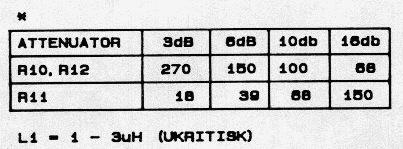
You can choose it according to your requirements - which should not be "more than necessary". The following table offers several options:
Features of the OZ2OE preamplifier
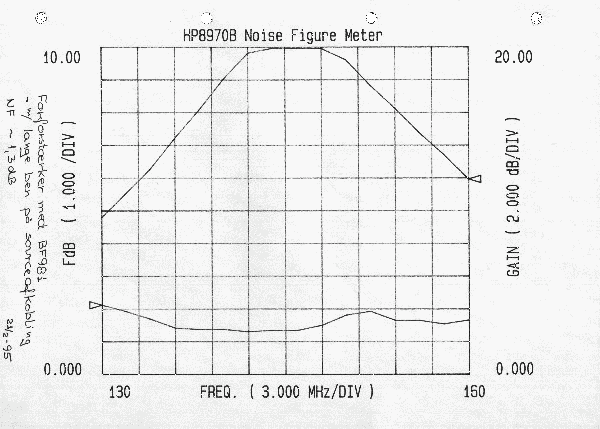
I've built and measured a number of these preamps and most had identical characteristics. Typical characteristics with a –3 dB attenuator are in the graph:
Circuit board and components
When I manage to convert the circuit diagram into a suitable format, I will post it here. Until then, the best I can offer is a scan of the original. If you are interested, please contact me.
I can also help with the mounting of the printed circuit board and special bones from Neosid.
Ole, OZ2OE