
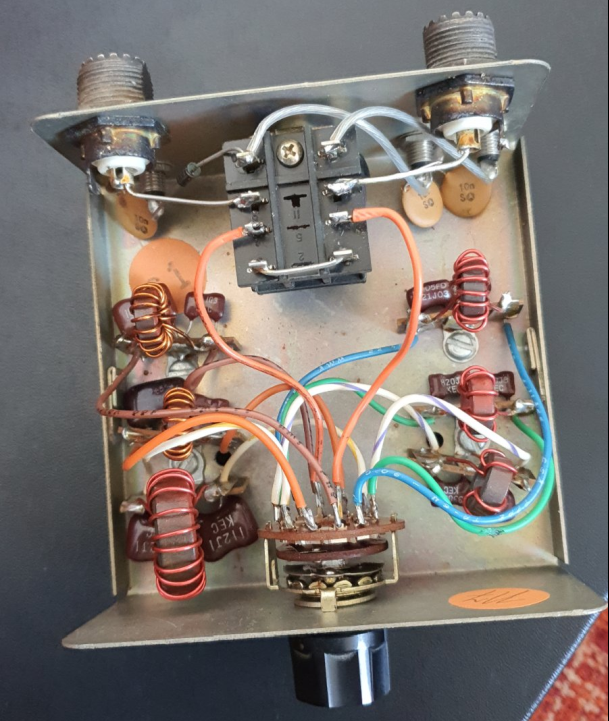
We received the following article from Mira OM3CKU for publication. MNI TNX!:
I managed to get several discarded (non-functional) power supplies from a PC with a power of about 250 to 300 W. In addition to some coolers, diodes and fans, I used cabinets. They were the initial impetus for finding these resources. As I was looking at the component board, I wondered if toroidal cores could also be used. With a transmitted power of around 250 W and relatively high switching frequencies, especially with a rectangular waveform, this must have toroid good vf properties. That's why I put them to the test.
You will read in the article
Determination of the Al constant of an unknown toroid
My first thought was to use them to construct a balun. The toroid was yellow, one side is white. The large diameter is 27 and the small 14 mm. I couldn't find any identifying information on it. I wound the toroid with a winding of 2 x 10 turns of 0.8mm PVC-insulated "bell" wire. As a first step, I measured the inductance, which for three pieces was around 30 to 35 microH. I calculated the Al constant from the inductance and the number of turns about 77.5. From this I concluded that it will be a material usable in the KV band.
Balun measurement
The next measurement was already like balun with 1:4 impedance conversion. I loaded it with a 220R / 2W metal oxide resistor and connected it to MFJ 269. PSW at 1.8 MHz was 1.6 minimum, 1.3 at 11 MHz and 1.7 at 30 MHz. For comparison, an unknown ferrite toroid with diameters of 61/36 mm without marking (supposedly Amidon) had PSW from 1.2 at 4.35 MHz to 1.8 at 30 MHz. Even better was the gray toroid from Pramet Šumperk with diameters of 25/15 mm, which had a PSW of 1.0 at 1.8 MHz and 1.5 at 30 MHz. A toroid from the same manufacturer with diameters of 40/24 mm had similar data. From this I found that, even if it is not optimal properties, the toroid is easily usable as a balun for the entire KV band up to a power of 150 W (I take into account higher losses at the upper end of the range).
Coil in the adapter link
Another possibility of use is for the coil in the adapter element. Here it is possible to use the 24-position switch and switch the branches after 1 thread. When using "bell" wire, a maximum of 21 turns can be wound in one layer. Then such inductance values come out, successively from one to 21 turns. 0.08, 0.31, 0.7, 1.24, 1.94, 2.8, 3.8, 4.96, 6.3, 7.75, 9.38, 11.2, 13.1, 15.2, 17.44, 19.8, 22.4, 25.11, 28.0, 31.0, 34.2 mH. In case someone needs higher inductances 22 z = 37.5, 23 z = 41.0 and 24 z = 44.5 microH. Here, however, it would be necessary to use a thinner wire or a wire with enamel insulation. The main advantage is that after soldering the leads to the individual threads, they can be easily connected to the switch and the toroid does not need to be fixed in any other way. By using small rotary capacitors, we get a miniature adjusting element suitable for powers up to 50 W, i.e. especially for QRP.
YOU 73 Miro OM3CKU