
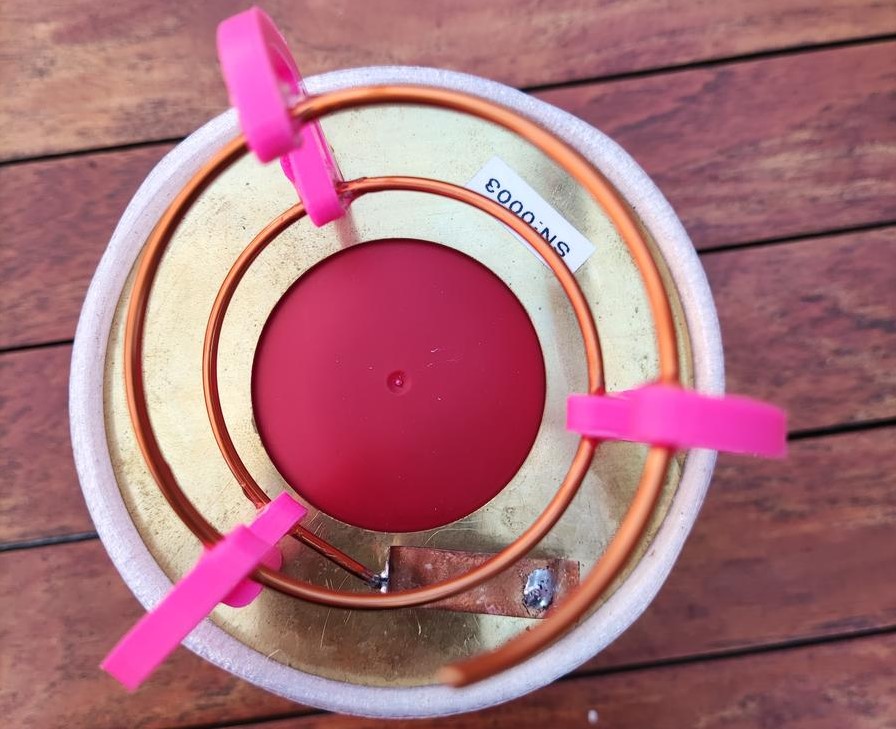
German radio amateur Andreas DL6YCL is known for its practical solutions for antenna systems for microwave bands, especially in connection with operation via a geostationary transponder QO-100 (Es'hail-2). Among his projects is also a modern 3D printed one YATT Helix irradiator for the 2.4 GHz band, which represents an easy-to-implement and powerful solution for a satellite uplink antenna. In short YATT in the name means Yet Another Two Turn, which refers to a compact but efficient design.
You will read in the article
Concept and determination
The YATT Helix irradiator was designed as irradiator (feed) for parabolic reflectors used in amateur satellite operation. It is optimized for uplink at a frequency of 2400 MHz, which corresponds to the transmitting part of the QO-100 transponder. The construction uses double helix antenna with circular polarization, located in front of the reflector, which ensures effective irradiation of the parabola with high efficiency and minimal gain attenuation.

Unlike some more complex irradiators, the YATT Helix is designed to be easily produced with home remedies. Most of the parts can be printed on a 3D printer, and the metal elements are supplemented with common components - such as brass screws, an SMA coaxial connector and a copper wire for the helix.
Mechanical construction according to DL6YCL
The design of the irradiator consists of several basic parts:
- Reflector board – a metal circular reflector with a diameter of approximately 70 mm, which ensures directionality and suppresses back radiation.
- 3D printed body – a plastic holder that serves as a supporting structure of the helix and at the same time as a cover for the coaxial connection. In the DL6YCL model, it is designed for easy mounting on the LNB (converter) holder so that the radiator can be placed with the receiving LNB in the common focus of the dish.
- Helix emitter – a double-stranded copper spiral with a diameter of approximately 40 mm, made of a solid copper wire with a diameter of 1.5-2 mm. The size and pitch direction of the winding is designed so that the antenna works with right-handed circular polarization (RHCP), compatible with the QO-100 transponder.
- Matching plate – a small triangular piece of sheet metal located near the feed point, which provides impedance matching to 50 Ω and improves the power transfer between the coax and the helix.
- Coaxial power supply – SMA or N-type coaxial connector, attached from the back of the reflector. The middle wire of the connector is connected directly to the beginning of the helix, the shielding wire is connected to the reflector.
Andreas DL6YCL designed the individual parts to make the whole irradiator possible print without the need for a support structure and even a less experienced constructor managed the assembly. STL files for 3D printing are available on Thingiverse, as well as assembly instructions and dimensions for connecting to the coax connector.
Electrical parameters and adaptation
The YATT Helix irradiator has been optimized for the operating frequency 2400 MHz, while the characteristic impedance is adjusted to 50 Ω. In the author's experiments, the antenna reached SWR below 1.2:1, which indicates a very good fit without the need for additional tuning.
Simulations and measurements show that the irradiator provides a gain of approx 11 dBi and the width of the main beam around 65°. These parameters are suitable for use with parabolic reflector with a diameter of 60-100 cm, while in combination with a suitable LNB it provides an ideal geometry for simultaneous reception and transmission via the QO-100.
Materials and production
DL6YCL recommends printing the radiator body from UV stable PETG or ASA filament, which better withstand the effects of the weather. For outdoor use, especially in winter, it is important that the material has low absorbency and high dimensional stability.
Helix is best made from copper wire (e.g. from solid electrical conductor CY 1.5 mm²). After winding on the template, it is important to maintain the exact distance between the turns, which determines the resonance and circular polarization. The reflector can be made of an aluminum sheet with a thickness of 1 mm or a copper disk.
Mechanical integration with LNB
One of the practical aspects of the DL6YCL design is possibility of direct attachment of the irradiator to the LNB holder, which achieves optimal alignment with the common focus of the parabola. This mounting method minimizes losses and facilitates polarization alignment.
The irradiator is mounted using a plastic adapter or sleeve that can be printed together with the body. The holder is designed for common LNBs with a diameter of 40 mm. In some cases, the radiator can be connected directly to the front cover of the LNB if a common bracket is used for a "dual-feed" configuration.

Operational experience
According to the experience of the author and several users published on portals Thingiverse a QRZ.com, YATT Helix offers stable performance, minimal SWR and reliable reproducibility of results. In combination with a 2.4 GHz power amplifier with a power of 2-5 W, it is possible to achieve a strong and clear signal on the QO-100 uplink even with smaller dishes (60 cm).
Several radio amateurs have confirmed that the radiator has proven itself even in more demanding weather conditions - after more than a year of outdoor use, it did not show deterioration in parameters, especially if it was printed from high-quality ASA filament.

Advantages and practical notes
The main advantages of the YATT Helix irradiator include:
- simple and fast production without special tools,
- the possibility of 3D printing from commonly available materials,
- excellent matching to 50 Ω,
- suitable characteristic for parabolic reflectors up to 1 m,
- easy integration with LNB for QO-100,
- low weight and compact dimensions,
- high resistance to weather effects.
DL6YCL recommends checking the SWR before final assembly with VNA analyzer, so that the distance between the helix and the reflector can be fine-tuned. Small deviations can affect impedance matching and polarization purity.
Conclusion
Project YATT Helix by DL6YCL is an excellent example of a practical combination of modern technologies such as 3D printing, with classic microwave antenna technology. Thanks to its simplicity, availability and proven functionality, it has become a popular solution among radio amateurs who want to build a reliable and efficient radiator for the QO-100 with their own hands.
Published 3D models and documentation available at Thingiverse allow anyone interested to make an irradiator exactly according to the original design. YATT Helix thus represents a modern, open and fully reproducible solution that combines the precision of the technical design with the creative approach of the radio amateur community.