
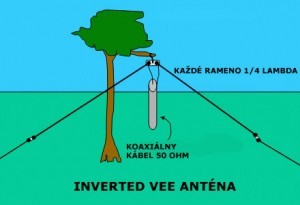
The proven wire antenna for KV bands is an inverted V-shaped antenna - Inverted Vee. It is actually a shape modification of a half-wave dipole, which brings the advantage of requiring one high support instead of two. At the same time, by reducing the angle of the arms, the impedance at the power supply point is reduced and thus enables a more appropriate adaptation to the 50-ohm power supply. The content of the vertical component in the radiation diagram is also an advantage, which we will appreciate with DX connections.
You will read in the article
How to make this antenna?
To make it, we need a wire of sufficient strength (diameter 1.5 mm or more) and conductivity (do not use PK!), a central insulator with a connector for connecting the power supply, two end insulators and several meters of auxiliary cable or wire.
We make a half-wave dipole from the wire, the length of which we calculate using the formula:
lambda = 300/f [m; MHz]
dipole = lambda/2[m; m]
dipole arm = (dipole/2) x 0.96 [m; m]
In the last formula, the constant is 0.96 – the shortening factor. Due to the influence of the thickness of the conductor and the effect of the surrounding environment on the antenna, the practical length of the arms is shorter than the theoretical one. This is at least approximately taken into account by this constant.
Angle of antenna arms Inverted V-shaped
The angle formed by the arms of the antenna is not critical, but it has an effect on the impedance of the antenna. A suitable angle is approx. 100 to 120 degrees.
Practical location of the antenna
After construction, the antenna is pulled up to the working height, for example using a pulley or a cable hung over a tree branch. By using PSV meter or antenna analyzer, we find out where the antenna is set. Fine-tuning is done by symmetrically shortening both arms of the antenna. Like any antenna, the inverted V-shaped antenna needs a working height. A very good height is lambda/4. Although the antenna works at a lower height, the impedance is lower and the antenna radiates energy at a high angle upwards.
Pay attention to the ends of the arms near the ground. There is high voltage, so we place them in such a way as to prevent people from accidentally touching them.
Like any symmetrical antenna, the inv.V should be fed through balun 1:1. You can also use a choke balun made of, for example, snap-on ferrites. We will place them immediately under the power point. The number should be such that the length of the choke is at least 20cm (6 to 7 pieces).