

Anténa Inverted Vee je veľmi populárny variant štandardného horizontálneho dipólu. V tomto článku sa pokúsim vyvrátiť niektoré mýty spojené s obráteným V a dipólmi. Tak, as an ordinary dipole may or may not always have a resonant length of 1/2 λ, nor may an inverted V be always resonant. However, the non-resonant variant is relatively less common, so in this article I will stick to the 1/2 λ resonant Inverted Vee antenna and leave the discussion of the non-resonant variant to another article. Many people may be inclined to think of the Inverted Vee as a separate array antenna with its own unique operating characteristics, but this is not the case. It is basically another dipole antenna that is physically oriented in a slightly different way than is customary.
The operating characteristics of an Inverted Vee antenna are not very different from a horizontal dipole. Therefore, I will not repeat what we have already discussed in the article entitled The ubiquitous dipole antenna. I encourage readers to read this article because virtually all of the concepts and properties discussed in connection with the standard dipole are also applicable to the inverted V. It is generally accepted that a dipole antenna will usually produce a bidirectional array of lobes in the azimuth plane, while the lobe pattern of an inverted V will be nearly omnidirectional. This notion certainly applies to these antennas either in free space or antennas located very high above the ground. But this may not be the case with most typical and purposefully placed antennas. This is one example of many myths that persist. In this article, we will discuss some of them and try to set things straight.
The truth is that for most antennas in operation, especially for 20m or lower frequency bands, any performance difference that might be expected compared to a textbook-style antenna construction gradually begins to diminish in the lower bands, or at low antenna heights above the ground. As a result, both the standard dipole and the inverted V generally begin to behave in a fairly similar manner. The difference in their lobe shapes and most other characteristics, including gain, starts to change.
You will read in the article
A brief overview of the properties and characteristics of the inverted Vee antenna
In this article, I will try to summarize various aspects of the half-wave resonant antenna with an inverted V dipole, including its geometry, characteristics, operational parameters, the influence of the external environment in which the antenna may be placed, as well as the power supply methods. In addition to all the variables that are applicable to the dipole, the Inverted Vee must account for the variation in peak angle between installations. This is the angle that ultimately determines the inclination of the arms of the inverted V dipole with respect to the plane. Before we continue, see a summary of these properties in the image below. The listed power is the gain in TX mode, which affects the overall radiation efficiency of the placed antenna. RDF is an abbreviation for Receive Directivity Factor and characterizes the performance of the antenna. The radiation efficiency takes into account all structural losses and possibly ground-reflection losses with absorption.

Based on the above summary, it is quite obvious that the half-wave resonant inverted V dipole is a potentially good antenna that offers high radiation efficiency and also considerable gain. Despite all these positives, most Inverted Vee antennas that do not perform satisfactorily are usually due to careless and thoughtless construction and placement. We will try to find the reasons why the performance of a relatively good antenna such as the Inverted Vee so often tends to be insufficient and what could be done to alleviate these problems.
Geometry of half-wave resonant inverted Vee dipole antenna

An important factor to keep in mind is the need for a balanced-to-unbalanced impedance transformation mechanism at the antenna feed point when fed by coaxial cable. This is important for optimal performance.
The inverted V antenna has a relatively simple design geometry. As already mentioned, this is just a variant of the standard horizontal dipole. The Inverted Vee antenna is a center-fed dipole antenna with a feed point that is at the highest point of the structure. From this central feed point, both arms of the dipole slope down at an angle, with the end points closer to ground level. The angle formed between the two inclined wire elements at the apex point is a parameter of the antenna design, which is designated as the apex angle. It might be noted that the standard dipole is actually a special case where the vertex angle is 180°.
Typically, most inverted V structures are designed to have a peak angle between 120° and 90°. However, in rare cases, versions with an angle of 150° to 75° can also be found. If the apex angle (Apex Angle) is reduced below 60°, the SWR will begin to rise rapidly, making such a configuration unsuitable. The 90° variant produces an SWR of 1:1 and an impedance of 50Ω, which cannot be achieved under any other peak angle conditions, but the trade-off is that there is a very slight reduction in gain compared to the horizontal dipole. We will explore all these factors in more detail in the next part of this article.
In the meantime, we must know that although the technical specifications of a standard dipole in free space (or very high above the ground) would indicate a slightly higher gain compared to an inverted V under similar conditions, let's understand that despite the lower gain, the Inverted Vee may not be a worse choice. Both the standard dipole and the Inverted Vee are typically fixed and non-rotating antennas, especially on the amateur radio bands. This is especially true for amateur radio bands with a wavelength of 20 m or more.
If the dipole is installed at a height of at least 1 λ, or preferably even more above ground level, it may show a slight additional gain at the top of the lobes, on the flat side of the antenna, but as we look in other directions the gain begins to decrease until there are significant zeros along the wire in the direction of the end radiation. On the other hand, although the wide peak gain may be slightly lower for the Inverted Vee antenna, the drop in gain when looking around the azimuth is relatively much smaller. The zero values of the terminal radiation direction are largely erased. However, this may not be entirely true if the dipole, or inverted V for the amateur radio bands, could be installed at much lower heights, as is the case with a large number of amateur radio designs. Under these circumstances, both of these antennas behave quite similarly.
As a consequence of the above, it is likely that the Inverted Vee fixed-pointing antenna offers a much more pleasingly satisfactory day-to-day performance compared to a standard dipole. Keep in mind that unlike point-to-point fixed direction where the dipole is carefully pointed to achieve optimum performance, ham radio requires one to listen and work with other stations that may be located in any azimuth direction. Therefore, a non-rotating antenna would certainly benefit from the relatively better (shallower null) azimuth pattern attributes of an inverted V antenna.
The Inverted Vee antenna is a good antenna. Don't dismiss it as trivial... A carefully and thoughtfully installed Inverted Vee antenna can prove to be a good part of a radio station. As in the case of a standard dipole, the Inverted Vee antenna can be designed as single-band or multi-band.
Characteristics and performance of a typical inverted Vee antenna
The basic trend of the characteristics of the Inverted Vee antenna is more or less in line with that of a typical standard dipole. Therefore, I will not deal with an in-depth explanation of the specifications, parameters and features that are used. For more information, see my article on dipole antennas titled The ubiquitous dipole antenna. In this article, I will focus on talking about the unique and special features of the Inverted Vee antenna.
Most of the differences in characteristics are due to the slanted elements of the Inverted Vee antenna. What are the effects of skewing wire elements? Let's explore it.
All differences in characteristics are proportional to the size of the apex angle. The more it deviates from 180°, as with a standard dipole, the greater the deviations in properties. Of primary importance are four characteristic attributes that vary with change in apex angle. We already know one of them. So far we have discussed the radiation lobe. There are three more. Let me list all four of these deviations below before we go into them one by one…
- The radiation pattern is changed, avoiding deep nulls to allow better azimuth coverage.
- Marginal reduction in peak gain with reduction in peak angle.
- Increasing the resonant frequency of the antenna with a lower peak angle, which requires slightly longer element lengths.
- Changes in the impedance of the feed point, which affects the lowest achievable SWR as the peak angle changes.
Take a look at the table below which illustrates the typical expected variation of the various performance characteristics as the apex angle of the inverted V antenna changes. Please note that in all of the inverted Vee cases below, the height of the antenna mount above the ground was constant at 1/2 λ. Only the slope of the elements changes in any case with the change of the apex angle...

The table summarizes the variations in several important parameters that affect the general performance of different Inverted Vee antennas with different apex angles and deployed at practical heights above ground level. This chart also dispels several popular myths about Inverted Vee antennas compared to dipoles.
Let's summarize what we see above. We compared five different scenarios. This includes one horizontal dipole (180° apex angle) and four inverted V configurations with different apex angles ranging from nearly horizontal 150° to 60° at the other extreme. We have investigated and summarized four antenna performance parameters in relation to peak angle variations. It is assumed that all antennas will be placed in similar environmental conditions and mounting heights.
Here is the result of our observations, which lead us to believe that perhaps once upon a time, concerns about the differences between dipole and inverted V antennas at different apex angles in practical conditions were exaggerated. In fact, they may not be as drastic as some would tend to believe.
1) SWR and impedance of the power point
The dipole has an impedance at the feed point of about 72 Ω and thus the best possible SWR (@50 Ω) would be around 1.4:1. However, as the apex angle decreases from the 180° dipole, to progressively lower angles, the impedance of the antenna feed point (which has now become an inverted V) begins to decrease. Therefore, the SWR also starts to decrease until the impedance of the supply point reaches 50 Ω. This happens at an apex angle of around 90°. SWR is now 1:1. Further reduction of the peak angle below 90° further reduces the impedance of the feed point. As a result, the SWR starts to rise again due to the increase in impedance mismatch. At peak angles below 60°, the SWR deteriorates quite rapidly as the impedance of the feed point drops drastically.
2) Antenna gain
If we were to compare the achievable gain of the dipole with the gain of the Inverted Vee antenna at different peak angles, we would realize that there is not much difference between them. For example, compared to a dipole, the peak gain of a 120° inverted V is only about 0.7dB less, while for a 90° peak angle of an inverted V, the gain reduction is only about 1.2dB... The above values are theoretically ideal antenna placement. In fact, the difference can be further reduced for other reasons.
3) Front-rear ratio (side zero depth)
Regarding the famous figure 8 of the azimuth lobe radiation pattern of the dipole, as opposed to the almost omnidirectional pattern achievable with an inverted V, we often encounter a lot of confusion among a significant portion of the ham radio community.
Oh! but, isn't that true? This is what we find in the textbooks… Sure, the textbooks actually say that. They are right, but our interpretation is mostly too simplified. We tend to ignore the conditions under which the classical 8-dipole lobe radiation pattern holds. We often tend to assume that the number 8 applies to all dipole installation and placement conditions. This is a mistake. It is absolutely true that a typical horizontal dipole in free space, or at a good height above ground level (AGL), will produce a textbook figure 8 azimuthal lobe pattern. The depth of the null on the sides (end radiation direction) will be quite sharp and can usually be as low as -40dB, or as low as -50dB if not more.
So far so good... We all know that any horizontal antenna that is mounted low above ground level tends to radiate more at higher elevation angles and the azimuth pattern gradually starts to become less directional as the nulls start to get shallower. Lowering the height beyond a certain point would ultimately result in a NVI (Near Vertical Incidence Skywave) antenna.
But the million dollar question is how low is low? How high above the ground should the antenna be mounted for acceptable all-round performance, including adequate DX radiation? The usual general answer would be the higher the better. Although there is no hard and fast rule for determining an acceptable height, quite often 1/2 λ above the ground is considered a quite acceptable height for most ham radio operations. Unless one wants to optimize the antenna for extremely low beam angle for (TOA) DX. This height of 1/2 λ AGL usually provides a nicely shaped primary elevation lobe that is wide and yet has a reasonably low TOA radiance that provides good overall performance.
Pre veľkú väčšinu rádioamatérov na celom svete je často problém nainštalovať antény vo veľmi vhodnej výške nad úrovňou zeme, najmä drôtové antény, pre ktoré by sa za normálnych okolností nedali postaviť špeciálne vysoké veže. Výška 9 – 12 m AGL je vo väčšine prípadov zvyčajne priemerná rádioamatérska výška dipólovej antény. Ďalším faktorom, ktorý treba mať na pamäti, je inštalácia antén na budovách v mestských a prímestských oblastiach. Napríklad, niekto by mohol umiestniť dipól vo výške 5 – 6 m na vrchol terasy vysokej budovy (povedzme 15 m) a potom očakávať, že anténa bude fungovať, ako keby bola vysoká 20 – 21 m, bolo by to úplne nesprávne. It would be a mythical assumption. Such a building will always have enough steel rods built into its concrete roof, along with additional horizontally laid water pipes and electrical cables, so that the terrace surface on top of the building acts as an effective secondary ground for the antenna, which is only 5-6m above it. For most practical purposes, this antenna will most likely behave like an antenna that is installed at 5-6m AGL… To find out more about this, see my article called The height of the city antenna above the ground - facts and myths.
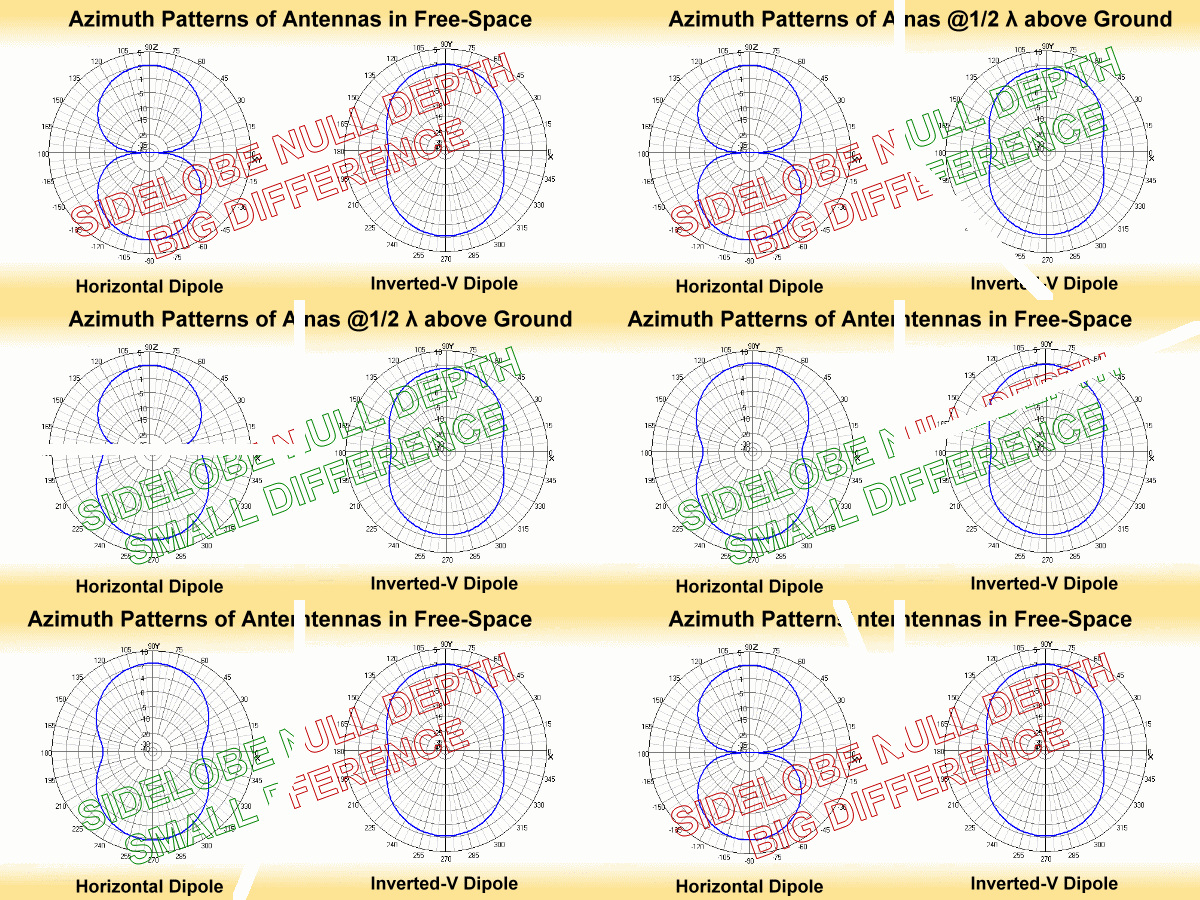
Comparative evaluation of the azimuth section of the radiation lobe patterns of a typical half-wave center-fed dipole with an inverted V antenna (90° peak) under two different conditions. One frame in the animation shows the patterns for the antennas in free space, while the other shows the results for the same antennas at 1/2 λ AGL. Note the remarkable loss of lateral null depth when the dipole is deployed at practical heights above the ground.
With everything we've discussed so far, let's take another look at the realistic scenarios of typical ham radio antennas at 9-12m AGL. Let us now make a comparative evaluation of the azimuthal radiation lobe pattern and the depth of the null for the 20 m horizontal dipole and the inverted V (apex angle is 90°). Look at the illustration above, which shows two comparative scenarios presented in the form, or two repeating self-looping frames.
In one case, we will take a textbook example where both the dipole and the inverted V are located in free space, or very high, at many wavelengths (λ) AGL. Here we see that the dipole azimuth pattern has very deep side nulls and thus creates a figure 8 radiation pattern as our textbooks tell us. On the other hand, the Inverted Vee does not produce such deep zeros in free space. The pattern is more like a rounded rectangle with very small dips on the sides.
V druhom prípade, ako je znázornené na druhej snímke, sme umiestnili dipól, aj obrátené V do používanej výšky asi 11 m AGL. Takže!… Azimutový vzor na obrázku s číslom 8 dipólu sa ignoruje. It now appears to be quite similar to the Inverted Vee pattern with a slight indentation on the sides. However, in the case of the Inverted Vee, this made negligible difference to its azimuth pattern, which remains almost similar to what it was in free space. The front-to-back ratio (Null Depth) for the dipole is about 10.9 dB and for the Inverted Vee it is 7.4 dB. The difference in Null depths is only 3.5dB, which doesn't really mean much.
The bottom line is that unless the wire antennas are installed at suitable heights above the ground, for most amateur radio antennas in use there is very little chance that you will notice any perceptible difference in azimuthal performance between a dipole or an inverted V. This will be truer when we switch the band from 20m to 40m and below. Don't obsess over one type of antenna over another. It really doesn't make any significant difference at operating altitudes. Feel free to position your dipole either horizontally or in an inverted V. It won't hurt either way.
4) Antenna length (variation with apex angle)
Before we end this part of the article, it might be worth noting that the lengths of the elements of the inverted V are always slightly larger than the lengths of the horizontal dipole. The size of the increase in length will be determined, among other things, by the apex angle of the antenna. The smaller the apex angle, the greater the required length of element wires. The expected increase in length with peak angle is shown in the table above. At 120° it is around +1%, while at 90° it is around +2%. Longer lengths are required for lower apex angles, but apex angles significantly below 90° are not recommended unless there is no other option. When installing the antenna, always start with a longer length than calculated. Then it can be shortened to the desired length.
Beware of widespread misinformation related to the length of the Inverted Vee antenna
You will find numerous posts and articles all over the internet that might tell you that the length of an Inverted Vee antenna element is typically 2-5% shorter than the length of a horizontal (flat top) dipole. There are also several Dipole/Inverted Vee antenna length calculators on the web that also do the same thing… Unfortunately, some of these websites are high in the results of Google, Bing and others. Many old and new ham radio operators rely on these sources to build their wire antennas, but it ends up being a mess... Unfortunately, the claim that the length of the Inverted Vee element is shorter than the length of a flat dipole is complete nonsense. This reckless disinformation has been spreading unabated for many years.
The fact is that when we bend the wire elements of the dipole to form an inverted V, then its resonant frequency rises. The greater the tilt, the greater the increase in resonant frequency. Therefore, in order to achieve the original desired resonant frequency in the case of inverted V, we would have to lengthen the element lengths, not shorten them.
Does the inverted Vee antenna produce both horizontal and vertical polarization?
Napriek skutočnosti, že mnohí rádioamatéri majú tendenciu tomu veriť, že je to pravda, kategorická odpoveď je VEĽKÉ NIE!… A symmetrical inverted-V antenna, which is a variant of the center-fed dipole with equal lengths of elements that are tilted downwards at equal and symmetrical angles from the vertex, will always produce only a horizontally polarized signal.
The exception would be if the inverted V were to be installed with asymmetrical angles of inclination relative to the horizontal. In other words, if the two sides of the dipole are hung vertically with respect to the horizontal at different angles, then the polarization becomes skewed to the extent determined by the angular asymmetry. Likewise, another exception is an asymmetrical wire antenna such as an OCFD. In this case, despite the symmetrical tilt angle on both sides, the antenna will create an oblique polarization.
Here is a fun fact that many of us may not even know. There is hardly any radio amateur literature on the web or off the web that talks about it. If the slopes of an OCFD antenna that may have been installed with inclined elements are asymmetrical to ensure that the endpoints of the elements form a horizontal line, then the polarization will be horizontal.
I won't go into the math at this point to prove the above point, but here's a rule of thumb... Draw an imaginary line between the end points on either side of the wire antenna. The orientation and angle of the imaginary line passing through the two endpoints of the wire antenna will determine its polarization. The geometric plane that would pass through the line quoted above and the propagation vector (propagation direction) will fully determine the plane of polarization of the propagating wave.
There is no such thing as mixed polarization. It's just a layman's way of describing oblique angle polarization. In fact, linear polarization can manifest itself as horizontal, vertical, or oblique. In the case of oblique polarization, the oblique vector can be divided into a set of vertical and horizontal vectors for the purposes of mathematical analysis. However, divided vectors are only a mathematical concept.
Effect on inverted Vee antenna performance due to placement in space
As we have discussed in previous sections of this article, it is true that a dipole and an inverted V in free space would perform differently with significantly different all-round coverage. However, we radio amateurs in our everyday lives would usually deal with these antennas under real site conditions. Consequently, the inverted V antenna can behave as a very close relative of the horizontal dipole when installed at low and medium heights above ground level.
Keďže sa hovorí, že obrázok vydá za tisíc slov, poskytujem you the following pictorial table of a simulated radiation pattern of a dipole, also an inverted V, installed at about 11m AGL. The radiation diagrams shown show Azimut, aj elevačné roviny rezu 3D vyžarovacieho diagramu pre 20 m a 40 m rádioamatérskeho pásma. Pozrite sa, aké podobné sú obe antény (35 Feet = 10.668 m):

In the original article, for a better understanding of the topic, there are animated images, graphs and more detailed information. I wish you a pleasant and especially informative reading about this antenna.
YOU 73! Villa, OM3CAQ
[1] https://vu2nsb.com/antenna/wire-antennas/inverted-v-antenna-dipole/ Autor Bass (VU2NSB)