
The question of the effectiveness of the antenna system is one of the oldest and at the same time the most complex topics in amateur radio. Every operator who has ever strung a wire between trees or built a vertical on a roof has asked themselves the same question: "How does my antenna actually perform compared to another?" Theoretical models in programs like EZNEC or 4NEC2 provide a valuable estimate, but in the real world, surrounding buildings, soil conductivity, and local obstructions come into play, which the simulation often fails to accurately capture.
Traditional comparison methods, based on subjective reports within radio amateur connections, suffer from considerable inaccuracy. Reports of the "five-nine" type are often affected by accidental signal leakage (QSB) or the different sensitivity of the receivers. A real breakthrough in this area was brought by digital traffic and protocol WSPR (Weak Signal Propagation Reporter), which collects a huge amount of data about signal propagation. It is on these data that he builds an innovative tool WSPR Antenna Lab, which is supported by Ondra, OK1CDJ.
You will read in the article
What is the WSPR Antenna Lab?
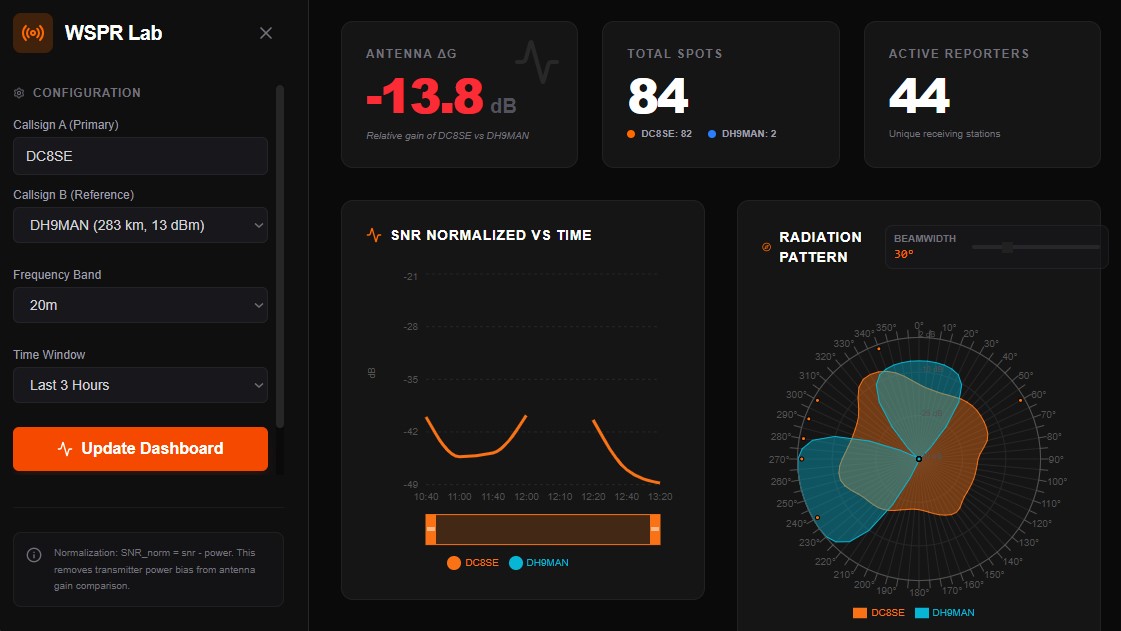
WSPR Antenna Lab is a specialized web tool designed for radio amateurs who want to turn a global network of monitoring stations into their own test field. The platform enables an exact comparison of the real performance of two antennas over time. Using data from the WSPRnet database, it provides the user with objective metrics about the antenna's gain and its radiation patterns, which are cleaned of random atmospheric effects.
Measurement methodology and technical principles
The key to accuracy https://wsprlab.ok1cdj.com is the mathematical normalization of data. If we compare two different stations with different transmission powers, a simple figure of the signal-to-noise ratio (SNR) would be misleading. The tool therefore uses the concept SNR Normalization.

An even more important element of the analysis is the concept of the so-called Matches. A match occurs when both compared stations (A and B) are picked up by the same receiver in the same two-minute time slot of the WSPR protocol. Since both stations transmit at the same time to the same receiver, the effect of current propagation conditions on the ionosphere is identical for both. These data have the highest statistical weight in determining the difference in antenna gain.
Practical analysis procedure
Používanie nástroja je intuitívne, no vyžaduje dodržanie určitej logiky, aby boli výsledky relevantné.
-
Setting the primary station (Callsign A): Here you enter the call sign of the station whose antenna you want to test. This can be your own brand after changing the antenna configuration, or the brand you use for testing purposes.
-
Selection of reference station (Callsign B): This is a critical step. The reference station should ideally be within 50 km of your position. The reason is to ensure the most similar conditions for signal propagation towards remote receivers. It is ideal if the reference station uses a well-known and proven antenna, for example a classic half-wave dipole.
-
Analysis parameters: The user selects a specific frequency band and time window. After clicking the Update button, the system processes the data and calculates Antenna Delta (Delta G). This value represents the average profit difference. For example, if the delta is +3 dB, it means that your antenna system is twice as efficient as the reference point.
Advanced visualizations and data interpretation

The WSPR Antenna Lab doesn't just end with a stark number. It offers an in-depth look at where and how your antenna is actually beaming:
-
Radiation Pattern (Radiation diagram): The tool generates a smoothed polar plot that shows gain versus azimuth. The user can adjust the smoothing sensitivity using the "Beamwidth" parameter. This chart is invaluable when tuning directional antennas or finding "dead spots" in a fixed wire antenna installation.
-
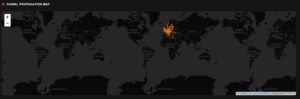
Propagation map for the OK2SAM signal Propagation Map: Real-time visualization shows the geographic distribution of stations that have picked up your signal. This helps identify whether your antenna is more efficient for intracontinental links (high beam angle) or DX links (low beam angle).

Why is this tool important to the community?
In an era where the radio amateur hobby is increasingly digitized, the WSPR Antenna Lab puts into our hands an instrument with scientific precision that in the past was only available to professional institutions with expensive equipment. It allows us to experiment with the height of antenna suspension, different types of counterweights for verticals or the influence of the surrounding terrain, with the certainty that the result is not just "feeling", but supported by thousands of reports from all over the world.
Ondru's project, OK1CDJ, is a prime example of how modern web technologies and Big Data processing can be used for the benefit of amateur radio research.
The tool is constantly being developed and the author is open to feedback at ondra@ok1cdj.com. Whether you're building a new HF antenna or just want to verify that your old dipole is still working as intended, this lab approach will give you answers you won't otherwise find on the airwaves.