

Reviews usually represent news on the market so that buyers can get the best idea of what's on offer. We will also deal with them, but very often there are "second hand" devices that were written about years ago. Often this literature is hard to come by, so let me introduce the Yaesu FT-757GXI first today.
You will read in the article
Yaesu FT-757GXI transceiver
It is a 100W allmode KV TCVR. Ranges of the pair VFO are from 0.5 to 30 MHz, 8 memories are available. Built-in SSB/CW/AM/FM filters, automatic key, NF speech processor, calibrator, IF shift and noise blanker.
Appearance

TCVR has a very pleasant appearance - the gray color of the cabinet matches well with the "aluminum" of the buttons and controls. The cast iron box enables excellent heat dissipation, which is helped by the increased temperature of the turbine. On the top panel there is a speaker and automatic key control (MAN/AUT, full/half-BK, speed). There are several controls and connectors on the back panel. There is a carrying holder on the side, small feet on the opposite side. There are legs and a folding backrest on the underside.
Blue LED display shows frequency, selected VFO, mode split, turning on RIT and the number of the selected memory. To the left of the display is the S/PWR/SWR/ALC meter. Below the display are the CLAR (RIT) and D-LOCK (tuning lock) buttons and a rubberized tuning knob with a finger hole. To the right of the display are six buttons: VFO A/B, SPLIT, MR/VFO, VFO/M, VFO>M, M>VFO.
Below them are the PMS (programmable scan) and 500kHz buttons (switching the step of UP/DWN buttons - after 500 kHz or after KV bands). On the right is a double MIC and DRIVE control (CW/AM/FM power adjustment). Below them is a pair of rotary controllers SHIFT + WIDTH (adjustment of the MF shift and its narrowing) and SQL + NB.

On the left side is a series of buttons: METER ALC/PO, RF AMP, ATT, PROC, NB, AGC-F. To the left of them is the main switch, above it MOX and VOX, below it is an 8-pin microphone connector and a 6.3″ headphone jack. To the right of them is a manual mode switch LSB/USB/CW-W/CW-N/AM/FM and dual AF/RF controller.
On the rear panel, in addition to the antenna and power connector, there are also CINCH connectors for NF input and output, ALC, keying, low-level RF signal for transverter, 6.3" jack for CW key and data connector for connecting to a PC. In addition, there are less used rotary controls for setting VOX, processor and turning on the calibrator.

Yaesu FT-757GXI in practical operation
When the switch is pressed, the TCVR comes to life. Compared to competing models, the receiver seems to be less sensitive, but the timbre of the NF signal is softer and bassier, which is very pleasant - the sound is not sharp. Tuning is very pleasant (the stiffness can also be adjusted), but the tuning step is constant and unchanging, which I consider the biggest minus of this device, since it is not possible to enter the frequency from the keyboard, as with other devices. Eight memories are quite a few for today, plus they are not tunable, that means if you want to tune you have to press the M>VFO button first and then tune. However, TCVR can be controlled from a PC via an interface.
Filtering
On CW, the FT-757 has two built-in filters, namely wide (2.7kHz/-6dB – SSB filter) or narrow (600Hz/-6dB – CW filter). Further narrowing of the band is possible using IF-SHIFT, but it is no longer the real nut. Reception of AM radio transmitters is pleasant (excellent sound), but the filter is quite wide and there is often a problem with QRM. There is a built-in filter on FM with a bandwidth of up to 15kHz, which is quite a lot. If you are interested in this type of operation, I would recommend replacing it with MF 455kHz.
Features
RX/TX switching can be done via PTT na mikrofóne alebo VOX-om. Modulácia aj pri použití procesora je výborná. So stolovým mikrofónom MD-1 tvrdia protistanice, že sa podobá na moduláciu FT-1000. Nastavenie rýchlosti kľúčovania malým ťahovým potenciometrom na vrchnom paneli je v contestoch dosť obtiažne. ALC napriek bohatej výkonovej rezerve koncových tranzistorov (výkon dá zvýšiť na 150-180W) relatívne skoro uberá výstupný výkon, odporúčam použiť ATU. Chladiaca turbína sa spúšťa iba pri zvýšenej teplote, je ale dosť hlučná (našťastie nikdy nebeží dlho).
Accessories

A wide range of accessories can be purchased for the FT-757: MD-1 desk microphone, some speaker cabinets from the SP-x series, FIF-232C (PC-TCVR interface), FTV-700 (transverter), FC-757AT (automatic tuner), FAS-1-4R (automatic switch of four antennas), FP-757HD (source), FP-757GX (switched source), or PA FL-7000.
Adjustments and modifications
TX 1.5-30 MHz unblocking
– disconnect the FT-757 from all cables
– open the TCVR as described in the manual
– on the "CONTROL UNIT" board, find jumper SW03 and switch it to the second position
– close the TCVR. When switched on, the TX will work from 1.5 to 30 MHz
Acceleration of SQ reaction
– just reduce the capacity of C158 (10uF) and C159 (4.7uF) to 1uF. You can find them near transistor Q22, solder them out or cut them out and solder new ones in their place.
Interface PC – TCVR (CAT)
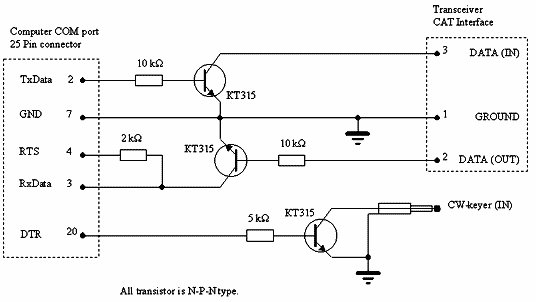
The diagram actually says it all, but I must note that it connects the PC and TCVR lands, which may not always be appropriate. But nothing prevents you from using optotransistors.
Parameters specified by the manufacturer
Frequency range: 0.5-30 MHz, TX amateur bands only
MF: 47.060MHz, 8.215MHz and 455kHz
SSB and CW sensitivity for s/w 10dB 0.5uV (0.5-1.5MHz) and 0.25uV (1.5-30MHz)
AM sensitivity for s/w 10dB 4uV (0.5-1.5MHz) and 1uV (1.5-30MHz)
FM sensitivity 0.5uV for 12dB SINAD
Dynamic range: better than 100dB
RIT: unlimited
NF power: 1.5W/4 ohm at 10% distortion
Selectivity (-6/-60dB): SSB and CW(W) 2.7/4.5kHz, CW(N) 0.6/1.3kHz, AM 6/18kHz and FM 15/30kHz
Output power: SSB 100W PEP, CW 100W and AM 25W PEP
Unwanted radiation: 40dB below output power
Power supply: 12 to 16V (nominal 13.8V)
Max. consumption: 1.5A RX, 19A TX
Dimensions: 238x93x238mm (w, h, d)
Weight: 5.2 kg
Overall, I would rate the FT-757GXI as a 2, but it provides an excellent price/performance ratio. I think it's a good choice for a beginner amateur.