How to add a CW filter to a receiver or transceiver? Older factory equipment (mainly on VHF) do not have a built-in intermediate frequency CW filter, or they do not even allow it to be built in. Thus, the CW bandwidth is determined by the width of the SSB filter, which is however too large. Nevertheless, it is possible to supplement such devices with a CW filter.
NF CW filter
We can also achieve relatively good results with the NF filter. There are various constructions, but none compare to this one in simplicity. It uses the characteristics of a parallel LC circuit, which is set to the required frequency and connected to the volume potentiometer. With the components shown in the example, it is approx. 800 Hz.
C1 is the decoupling capacitor behind the detector. If the switch S1 is open, the LC circuit is not connected and the signal goes through the volume potentiometer to the NF amplifier without change. If the switch S2 is closed, the signal reaches the parallel LC circuit. From it we take the signal for NF amplifier. Due to the properties of the parallel LC circuit, the highest voltage will be obtained at its resonance frequency, at other frequencies the output voltage will be lower, which will act as a normal filter.
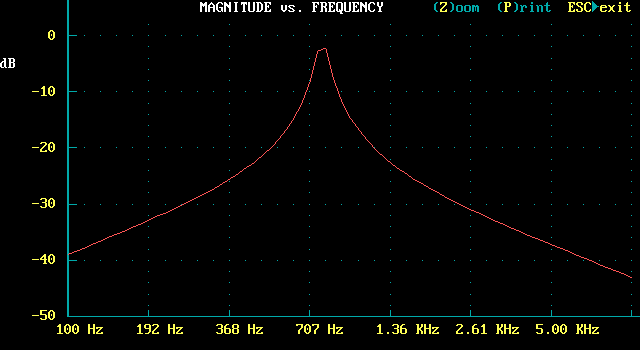
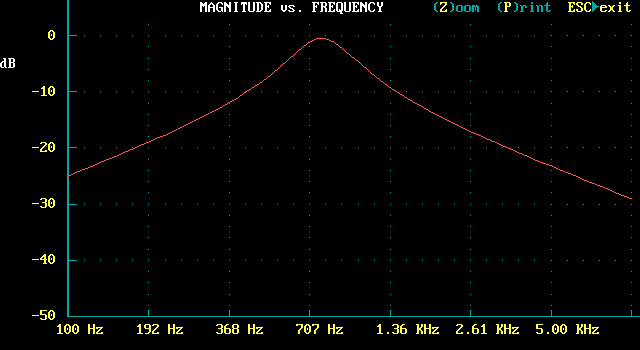
CW filter simulation
The properties of such a filter are largely influenced by different impedances. It is already clear from looking at the diagram that the potentiometer P1 reduces the Q of the circuit. Another non-negligible impedance is the impedance of the detector. I tried to simulate the behavior of the filter at different impedances and the results are different, but still good.