

The designer of this artificial load is Mak, SV1BSX. Several interesting constructions, but not only that, you can find on his website: https://www.QSL.net/sv1bsx. TNX Mak!
V článku sa dočítate
Reasons for high PSV umelej záťaže
Home made artificial load is usually made by connecting several carbon resistors in parallel to achieve a resistance of 50 ohm. Such a construction will serve well on KV, but not on VHF, or VHF (430-440 MHz), where a high PSV suddenly appears during measurement. Such an artificial load is then unusable for measurement purposes.
The reason for the high PSV is in the parasitic capacitance of the resistors. Figure 1 shows a carbon resistor. The two caps at the ends of the ceramic body act like two plates of a small capacitor. By connecting resistors in parallel, this capacity is "multiplied" by the number of resistors. Disaster!
Scheme of artificial load
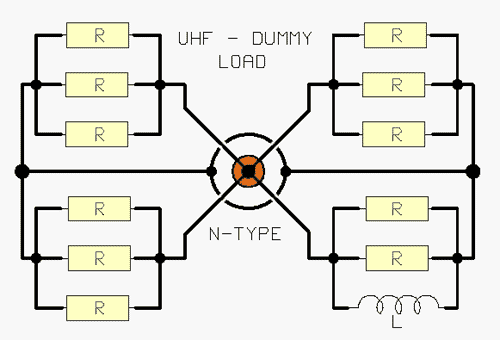
If we want to eliminate this unwanted capacity, it is possible and easy with a small inductance, with which we reduce the PSV to 1:1. Picture no. 2 shows a diagram of such an artificial load.
Practical connection of the artificial load
Resistors are 560 ohm/2W. I used eleven resistors connected in parallel to achieve a value of 50 (50.9) ohms. The total load is 11x2W = 22W, but in practice such a load can handle a power of 100W for a few seconds. This is sufficient for most measurements with commercial equipment whose output power is between 5 and 35 watts.
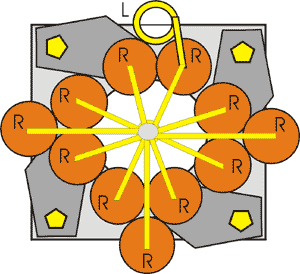
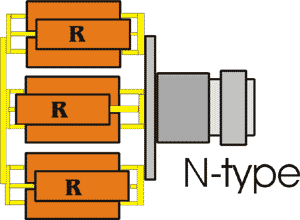
Picture No. 3 shows the practical design of the artificial load. A panel N-connector (female) is used as a connector. Inductance "L" consists of four turns of 0.8 mm wire with a diameter of 3 mm in a winding length of 15 mm. If the PSV is not optimal, the number of threads can be increased or decreased.
One last note - the artificial load created in this way is only suitable for VHF (for VHF it will again have a higher PSV, let's say 2:1).
Makis SV1BSX, https://www.qsl.net/sv1bsx