
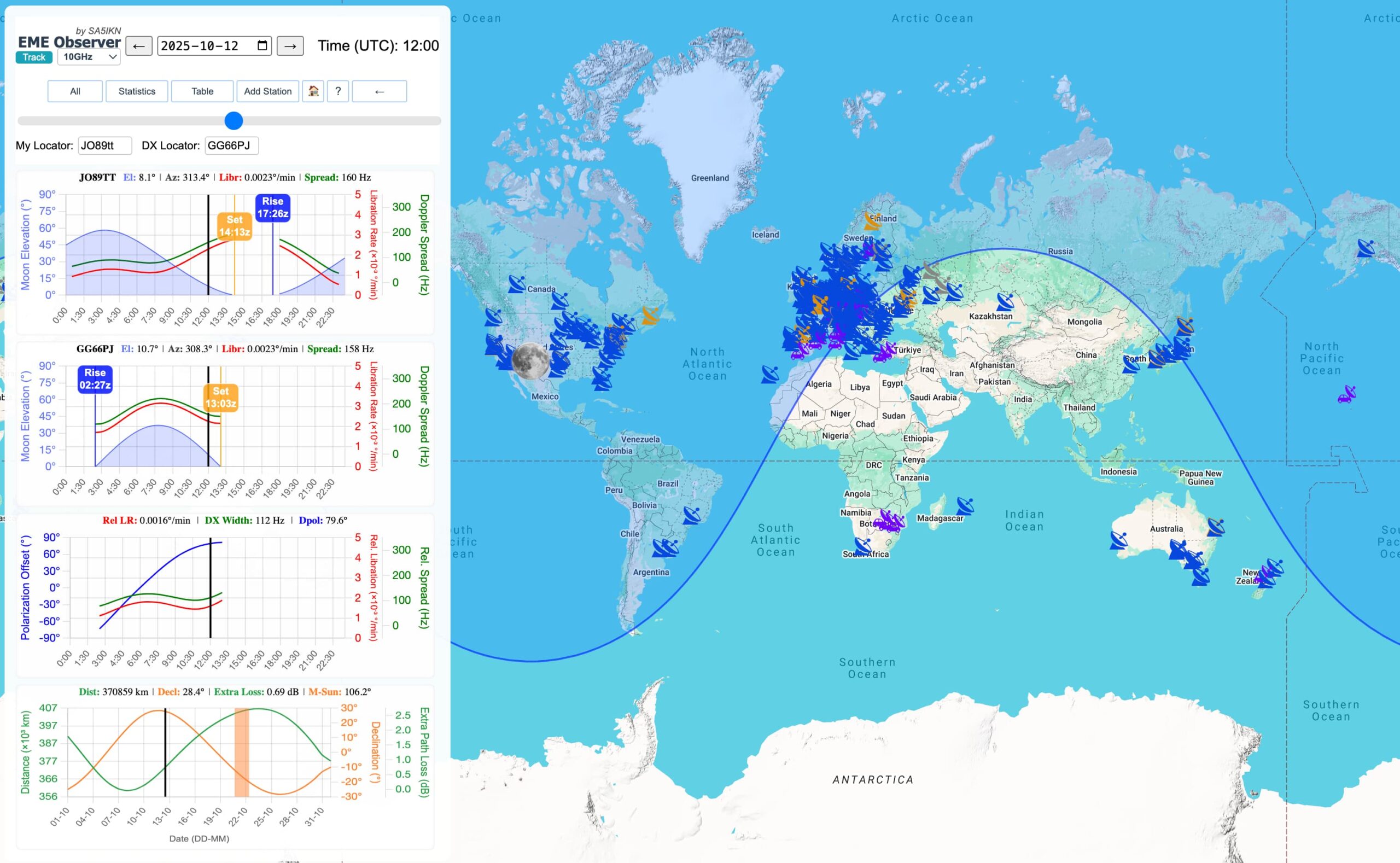
EME Observer is a modern web application designed for the planning and analysis of Earth-Moon-Earth (EME) links, focusing mainly on the 10 GHz band. It is not the first project of SA5IKN. Some time ago Max created other applications: Satelit LEO Observer , QO-100 Satellite Observer . Both are useful aids for VKV-ists working in these areas. Now Max SA5IKN comes with another tool: EME Observer .
At the core of the tool is an interactive map showing stations and a lunar "footprint" that allows you to visually locate common windows of lunar visibility between your station and a selected DX. The application provides detailed topocentric and geocentric monthly parameters (Moon distance, declination, libration, doppler spread), plus station profiles and clear antenna and performance statistics. EME Observer is not a link-budget calculator — its strength lies in the visualization and comparison of parameters that significantly help in sked planning.
The accuracy of the calculations is one of the key advantages of the tool. Astronomical calculations are performed using the "Astronomy Engine", based on VSOP87 and NOVAS C 3.1, while some calculations use the optimized Meeus method for speedup without losing the necessary accuracy. The author verified the results against the Skyfield library using the NASA DE421 ephemeris; the result is a positional accuracy better than 1 arc minute, which is sufficient for planning 10 GHz EME links. Calculations of Doppler spread and spatial polarization offset (Dpol) are based on published algorithms (including procedures incorporated in WSJT-X).
You will read in the article
EME Observer main modes
Praktické používanie: rozhranie ponúka tri hlavné režimy — Map View, Table View a Statistics View. Map View je štandardné zobrazenie: po zadaní svojho QTH lokátora (6-znakový Maidenhead) a lokátora DX stanice sa zobrazia separátne grafy pre „My Location“ a „DX Location“, ktoré ukazujú mesačné okno (výška, mesačný Azimut, libration, doppler spread) in 30-minute intervals. When both locators are entered, the Sked Chart is activated, showing relative libration (Rel LR), relative doppler spread (DX Width), and spatial polarization offset (Dpol) for a common window — parameters very useful in deciding whether a sked is worth planning. Map markers have different icons (active home stations, inactive, DXpeditions, Silent Key) and clicking on the marker will open the station profile with power data, antenna, QRZ link and the option to immediately send an email to the operator.

Planning options
Table View a Statistics View rozširujú možnosti plánovania. Table View ponúka kompletný, triediteľný a prehľadný zoznam 10 GHz EME staníc s full-text vyhľadávaním naprieč stĺpcami (callsign, lokátor, DXCC, antenna, performance, contact information). Statistics View generates dynamic graphs of station distribution by antenna size, power and DXCC coverage — useful for orienting where "open" entities are and what infrastructure the most active stations are using. This data is updated in real time when adding or editing records.
Important limitations and technical notes. The Doppler spread in the EME Observer is specifically calculated for the frequency 10.368 GHz (WSJT-X reference value); when used on other bands, the results should only be taken as indicative, because DX-Width and libration effects are frequency dependent. Spatial polarization offset (Dpol) may show sharp changes in some path geometries and sign for values near ±90°, which is consistent with WSJT-X and other EME planners — users should be careful at such points when setting polarization and interpreting fast transients.

How to support EME Observer?
Spolupráca komunity je vstavaná funkcia: databáza staníc je obohacovaná príspevkami užívateľov cez formulár; autor žiada pridávať len stanice, ktoré skutočne realizovali aspoň jedno 10 GHz EME QSO and have broadcasting capability. This keeps the database relevant and reduces the "noise" of non-operational records. The application is designed to be responsive — fully functional even on mobile devices, which mobile EME operators will appreciate when quickly planning skeds in the field.
How to integrate it into your EME routine? Use EME Observer to quickly identify overlapping monthly windows with potential partners, compare Rel LR, DX Width and Dpol before sending the sked, and then verify additional parameters (eg operating times, antenna focus, QTH shadowing) directly with the partner via QRZ or email. Since the tool does not say whether a QSO will "go", it is best combined with operator experience and real signal measurements under given conditions.
EME Observer is a practical and easy-to-use tool that combines precise astronomical calculations with community-shared station information. For anyone involved in 10 GHz EME — especially mobile and portable operations — it is an essential aid in fast and efficient sked planning.