
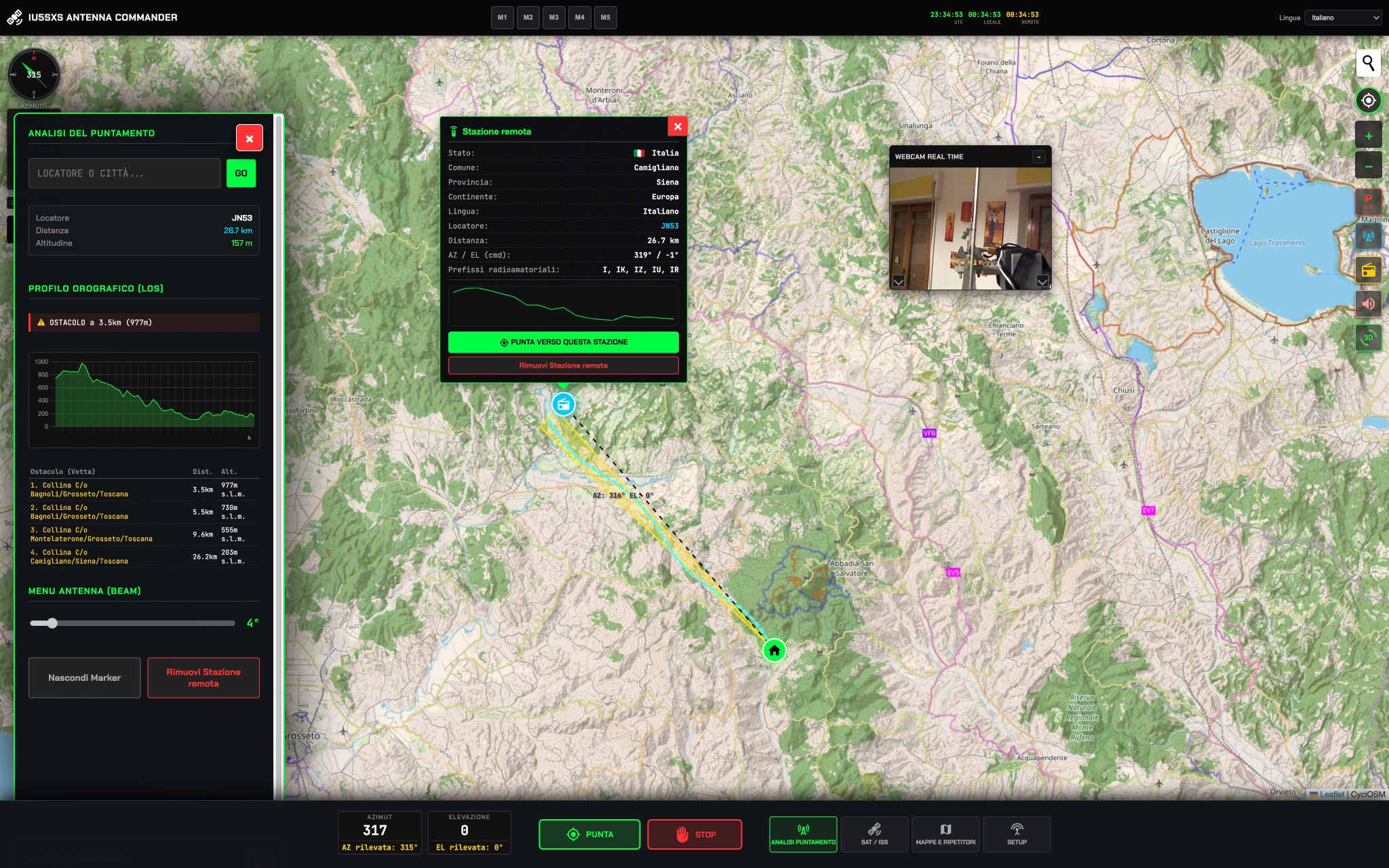
In the amateur radio world, there are several tools for controlling rotators, tracking satellites, or working with maps. However, these are usually separate applications that need to be connected via Hamlib, CAT rozhrania, doplnky alebo vlastné skripty. Projekt Antenna Commander od rádioamatéra Alfonso Fiorentino, IU5SXS, approaches this task differently: it tries to create a unified web-based working environment for the operator who wants to have antenna orientation, map data, satellite tracking and SDR monitoring under one roof.
Pre rádioamatéra, ktorý prevádzkuje smerové systémy – či už yagi, quad, log-periodické antény alebo satelitné AZ/EL zostavy – je to koncept, ktorý stojí za pozornosť.
In the article you will read
What is Antenna Commander and what is it for?
Antenna Commander is an open-source web platform designed primarily for Raspberry Pi and Debian-based systems. Its main idea is to provide a modern browser-based interface for controlling antenna systems without having to be tied to a specific desktop operating system. This means that the logic itself can run on the Raspberry Pi in hamshack, while the operator accesses it via a web browser from a laptop, tablet or other PC.
Unlike classic rotator utilities, it is not just about simple azimuth input. Antenna Commander strives to be a visual operations center where geography, RF operation and tracking are connected into a single workflow.
| Area | Function |
|---|---|
| Antenna control | AZ/EL routing via map interface |
| Map tools | Interactive maps, LOS analysis, terrain profile |
| Station databases | Repeater and target points with one-click pointing |
| Satellites | ISS and other orbital objects in real time |
| SDR | Optional OpenWebRX+ integration |
| TRX integration | Compatibility via Hamlib architecture |
What Antenna Commander really does in practice
Maps and station database as an operational tool
The most visible part of the system is the interactive map. It is not a decorative widget, but an active tool for the operator. After defining the QTH, the system initializes with your location and allows you to visually work with targets.

In practice, this means that instead of manually calculating the azimuth or switching between external map services, you can click on a point of interest and the system will prepare the antenna direction.
For a radio amateur, this has immediate significance when:
- DX work with directional systems where you need to quickly verify heading.
- EME experiments where pointing accuracy is essential.
- portable prevádzke, keď chcete rýchlo zistiť vhodný smer bez ďalších aplikácií.
- working with repeaters and regional RF points.
One of the practical features is database access to repeaters and stations from which pointing can be done directly. This is especially interesting for VHF/UHF operators who work with directional systems and do not want to manually enter each Azimuth.
LOS and terrain profile
A very interesting technical part is the line-of-sight and terrain profile analysis. For a radio amateur, it is much more than just pretty graphics.
Whether you are working on 70cm, 23cm or higher, the terrain profile between your QTH and the target is often the deciding factor in the success of the connection. Antenna Commander allows you to visually analyze the route and identify geographical obstacles.
Takýto prístup ocenia najmä operátori venujúci sa troposférickým experimentom, mikrovlnným spojeniam a contest prevádzke.
Satellite tracking: ISS is not the only target
Satellite operations are often handled by separate software, such as Gpredict, or proprietary packages. Antenna Commander integrates this functionality directly into the main interface.

The project supports tracking of amateur radio and meteorological satellites, including the ISS. This means that if you have an AZ/EL Rotator and a suitable antenna array (such as a cross-yagi or helix), the system can serve as a basic control center for satellite operations.
The advantage is a unified workflow:
| Step | Operator activity |
|---|---|
| 1 | Satellite selection |
| 2 | Orbit and current position tracking |
| 3 | Automatic or assisted antenna pointing |
| 4 | Optional SDR downlink monitoring |
For portable satellite operations, this can be a very elegant solution, as long as the user builds the system around a Raspberry Pi and a lightweight rotator.
Samozrejme, seriózni satelitní operátori budú riešiť aj Doppler korekcie TRX frekvencie, CAT synchronizáciu a presnosť tracking modelu. Antenna Commander nie je náhradou za komplexný satelitný mission-control stack, ale pre mnohé ham použitia je prakticky postačujúci.
Radio and SDR integration
OpenWebRX+ as a natural supplement
An interesting detail of the project is the integration of the SDR widget via OpenWebRX+. This means that if you have an SDR receiver in your shack, you can access its audio and spectrum directly in the same browser interface.
In practice, this is useful, for example, for:
- monitoring the beacon before attempting to connect,
- satellite downlink control,
- frequency occupancy verification,
- passively watching band activity.
Pre contest operátora alebo DX-era to nie je len komfortná funkcia. Je to spôsob, ako zlúčiť smerovanie antény a RF monitoring do jedného pracovného priestoru.
TRX and Hamlib ecosystem

The project is designed with an orientation towards amateur radio interoperability. The project's web presentation explicitly states the link to Hamlib and SDR workflow.
This is important because Hamlib is the de facto standard in the amateur radio world for communicating with TRX devices. If you are using an Icom, Yaesu, Kenwood or compatible SDR transceiver, this is the right direction for integration.
The exact scope of support for specific models needs to be verified according to the current state of the project, but the architecture is built in the right way.
Hardware requirements
Antenna Commander is not a cloud service. It runs locally, which is an advantage from the ham radio perspective – the system stays in your shack and is not dependent on an external backend.
| Component | Requirement |
|---|---|
| Computer | Raspberry Pi |
| OS | Debian stable |
| Runtime | Python 3.9+ |
| GPIOs | Rotator hardware control access |
| Network | LAN/Wi-Fi for web interface |
| Optional | OpenWebRX+, SDR receiver, camera |
It should be added that the Raspberry Pi Zero can handle basic hosting, but for more comfortable operation with multiple widgets, a more powerful model makes more sense.
Final evaluation
Antenna Commander is an interesting open-source project that doesn't play for fancy presentation, but solves a real amateur radio workflow. I see the biggest benefit in that it connects several activities that an operator normally solves separately: maps, pointing, satellite tracking and SDR monitoring.
This is probably not an essential tool for the typical HF operator with a single dipole. However, it is a very interesting concept for the VHF/UHF radio amateur, satellite operator, or technically oriented rotator experimenter.
Ak staviate moderný Raspberry Pi hamshack and you want a web-based control center for your antenna system, Antenna Commander definitely worth testing.