
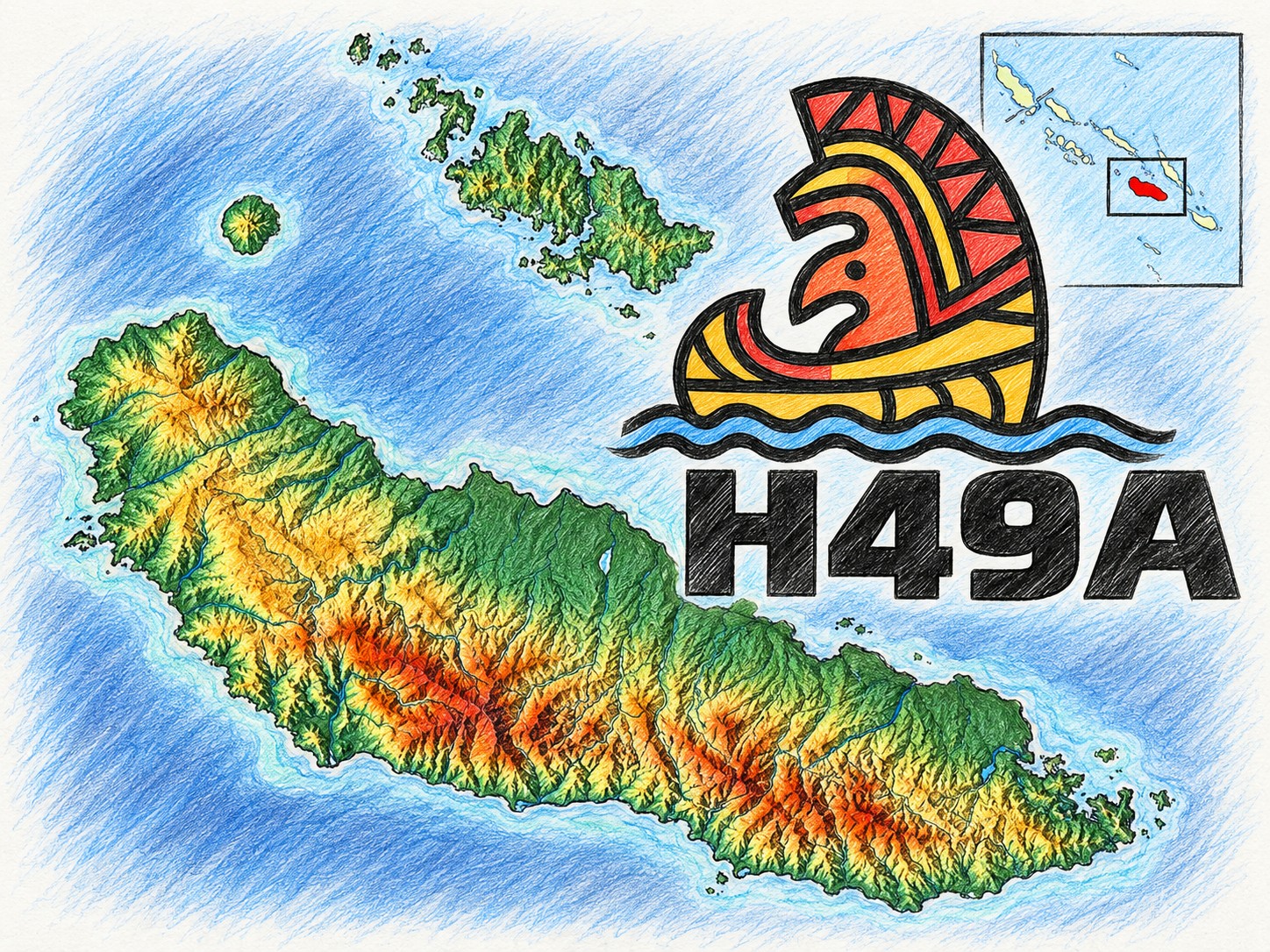
The Solomon Islands (H4) attract DX interest in fall 2026 from two sides simultaneously. While Bernhard, H44MS, pokračuje v dlhodobej solo prevádzke z ostrova Malaita, v dňoch 9.–21. októbra 2026 bude QRV aj ďalší tím – šestica chorvátskych a nemeckých operátorov pod značkou H49A. Ich QTH je Dolphin View Beach na severovýchodnom pobreží ostrova Guadalcanal (IOTA (OC-047), locator QI90VQ. The location was chosen deliberately: direct visibility towards North America, Europe, and Japan.
The Solomon Islands rank 79th globally and 62nd in the CW category on the Most Wanted list on Club Log. For European stations, the situation is even more interesting – 70th place and 48th in CW. These numbers suggest why every activation of H4 is welcomed.
In the article, you will read
Team H49A
Rolando, 9A3MR is a team leader and veteran of four DXpeditions (TO19A, 5W0LM, TX9A). He is in charge of the antennas and the budget. Mladen, 9A2NA is a versatile operator on SSB, FT8 and CW with three previous expeditions; his favorite band is 50 MHz. Fran, 9A3CJY is a 17-year-old rookie on his first DXpedition - the grandson of the team leader; the team is happy that the hobby is staying in the family. Kristijan, 9A4WY is a greyline and CW pile-up specialist, also a team technician responsible for field repairs. Livio, 9A7Y keeps his morals, cooks and stops by the radio without any problems when others need a break. Zrinko (Zik), DK8ZZ/YT3ZZ is co-leader, PR manager and QSL manager; he has expeditions A65DLH, XV2DLH, 8Q7LH and TX9A.
Technical and antenna equipment
The team operates with three stations. The transceivers are 3× ICOM IC-7300, and the amplification is provided by a setup of amplifiers from ACOM Bulgaria: 1× ACOM 1200S and 2× ACOM 500S. The choice of two smaller amplifiers instead of one large one is intentional – when operating from a generator, managing power consumption is simpler, and the lower overall power also reduces transport costs for luggage.
The antenna system consists of two multi-band VDA antennas (Vertical Dipole Array) covering the bands from 20 to 10 meters, tested in July 2026 on the Adriatic coast in Bilice, Croatia. The antenna setup will be installed directly on the coast – access to the sea over a 100-meter stretch near the bungalows is a key factor for the VDA, whose performance heavily depends on the quality of the grounding system near the water. The 4O3A Signature Team bandpass filters will limit mutual interference during simultaneous operation of three stations. Power is supplied by a diesel generator – grid power isnot reliable.
Bands, modes, and operational strategy H49A

The team plans to operate on all KV bands, including 160m and 60m, as well as 6m. Enabled modes are CW, SSB and FT8. Emphasis is on human modes - CW and SSB. Greyline operator Kristijan, 9A4WY proved himself during the previous TX9A expedition in the targeted search for optimal windows for Europe; the same approach is expected on the H49A. Propagation conditions from CQ Zone 28 (ITU Zone 51) to Europe are available on 20m through UTC morning hours; 15m and 17m offer opportunities during the morning; low bands require patience and precise timing around the greyline.
The log will be continuously available via the Club Log Live Stream - provided that the internet connection at the location allows it. This is a handy tool for operators who want to verify that their QSO has been logged before making the next call. The location of QTH by the sea on the northeastern shore of Guadalcanal is advantageous from an antenna point of view: VDA antennas near the coast achieve better signal reflection at low elevation angles, which is crucial for transoceanic routes to Europe (approx. 15,000 km through Asia) and North America.
Expedition highlights
The expedition also has a humanitarian aspect: part of the funds raised will go to the Sisters of Love mission in Buma (a Catholic mission on Guadalcanal). This aspect was also appreciated by the German radio club OV K07 DL0MZ from Mainz, which organized a collection to support the expedition – with DK8ZZ being one of their members.
Logistics are challenging: the team travels from Zagreb through Istanbul, Kuala Lumpur, and Brisbane to Honiara. All equipment – transceivers, amplifiers, antennas, cables, filters – is packed into six checked bags. Every extra kilogram is an additional cost. Therefore, choosing the ACOM 500S instead of one large amplifier makes sense not only electrically but also logistically.
Bernhard, H44MS, assisted the team with logistics directly in Honiara even before their arrival. It is an example of a community where operators active in the same QTH help each other – even when they operate under different callsigns.
The youngest member of the team, Frane, 9A3CJY, promised his colleagues a lecture on the Guadalcanal campaign of World War II during the expedition. Guadalcanal was the site of one of the bloodiest campaigns of the Pacific War in 1942–1943.
QSL H49A
The QSL manager is DK8ZZ (Zrinko Zibert), who has also performed this role in previous expeditions TX9A and others. The recommended method of confirmation is OQRS, for both direct and bureau requests. Direct QSL with immediate upload to LoTW costs 5 EUR. Bureau OQRS requests are free. All QSOs will be uploaded to LoTW 6 months after the end of the expedition. Direct cards can also be sent by mail to: Zrinko Zibert, Rothweg 1, D-55494 Erbach, Germany. QSL cards are printed by Tony LZ1JZ.
Current information, logs, and news can be found at solomon2026.com.