
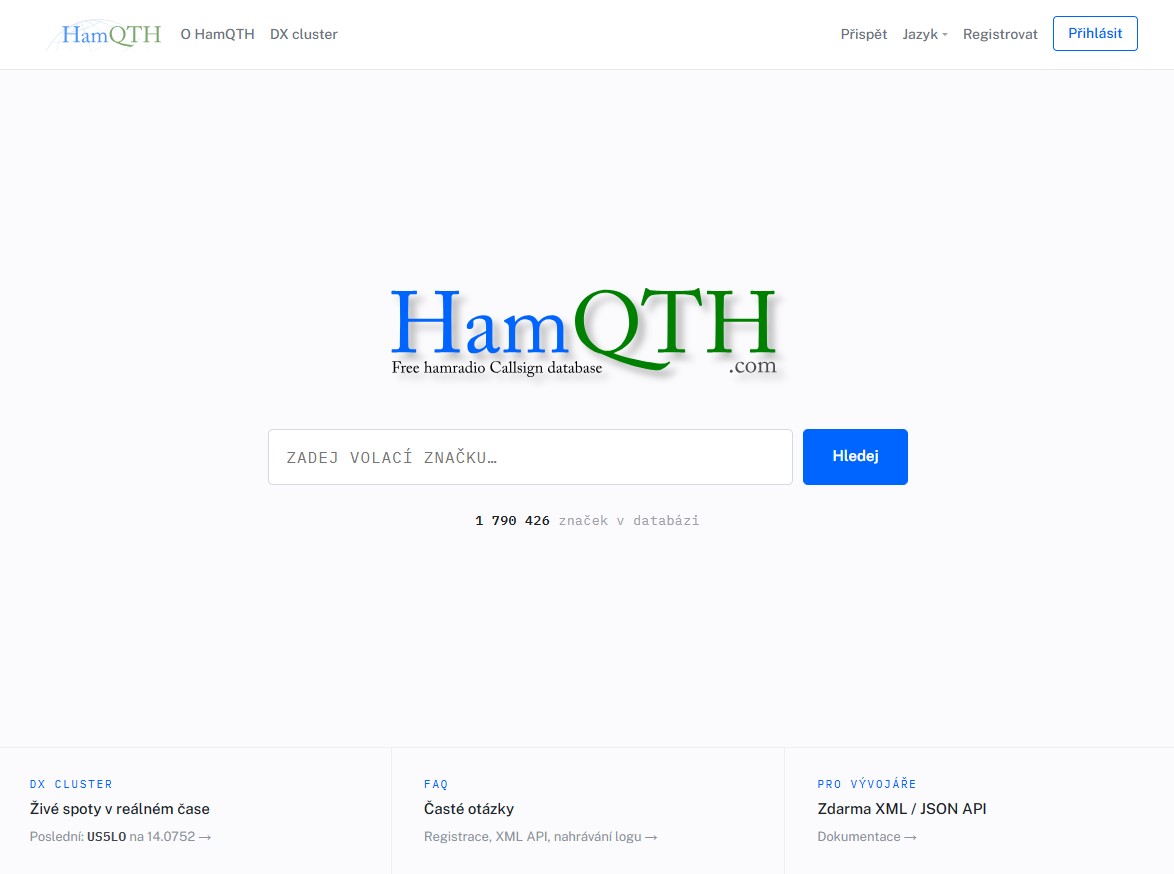
HamQTH.com je bezplatný rádioamatérsky callbook, operated by Petr Hložek, OK2CQR. It was established in June 2011 as an alternative to paid and ad-laden solutions – with a clear principle: addresses obtained for free from users are not sold further, the operator profile is not censored, and access via XML API remains open for logging programs. Over fifteen years, the callbook has built a foundation of hundreds of thousands of registered callsigns and is now used by dozens of popular logging applications across all major platforms.
In the article, you will read
What’s new in October 2026: completely rewritten website from scratch
On October 2, 2026, OK2CQR launched a completely rewritten version of the website. This is not a redesign – the site was written from scratch. The practical impact for the everyday user is immediately visible.
The first change you will notice is the responsive design in all 18 language versions. The website finally behaves optimally on a phone or tablet – important for quickly verifying a callsign during operation from the field or on portable activation.
All account settings are now centralized on one page, including the switch between callsigns you manage (for example, your own callsign and club station). The profile editor covers each section separately. Editing the profile header image now offers three options: ready layouts, a photo library, and a blank canvas for uploading your own image.
The most practical novelty for contesters and DX operators is nový DX klaster. Zobrazuje live DX spoty aj spoty z Reverse Beacon Network, filters are saved to the account (not just to cookies), and crucially – new countries, bands, and modes are color-highlighted directly from your uploaded log. This means the DX cluster at HamQTH works as a personalized band plan: at a glance, you know what's new for you and what you've already worked. There is also a new search feature in the spots archive and the ability to submit your own spots directly from the website.
In addition to the web interface, the DX cluster HamQTH is also available via Telnet at hamqth.com, port 7300 – a standard access point for logging programs that connect directly to the Cluster node. For stations that prefer a classic Telnet client or have it set up in N1MM+ or Logger32, this interface works unchanged even after the website update.
The log upload has undergone significant improvements. Compressed archives such as zip, 7z, rar, and gz are now accepted – so there's no need to unpack large ADIF files before submission. After each upload, a history of previous uploads will be displayed, including a backup that you can download. The program also alerts you to issues in the ADIF file and sends the results via email. The uploaded log is displayed directly on your profile, which is practical for POTA or SOTA activations, where other stations verify the log on the same day.
An interesting small feature is the option to contact a station or report incorrect data directly from the profile. Until now, you had to search for an email elsewhere; now it just takes one click. All these changes do not disrupt the existing XML API, and logging programs work exactly as before the update – compatibility has been maintained without exception, according to OK2CQR.
Previous updates: new server and Chinese
In January 2026, HamQTH was moved to a new server by CalmBit s.r.o. with significantly greater resources. In April 2026, a Chinese language version was added, thanks to Shandong, BI4IWL. HamQTH currently supports 18 languages.
FAQ: frequently asked questions

Why another callbook? OK2CQR openly states that it disagreed with the policy of a popular paid callbook. The goal of HamQTH is a free callbook that does not sell addresses obtained from the community and does not censor operator profiles.
You can help the project by registering and filling out your profile, sharing the link, or making a financial contribution via PayPal (petr@ok2cqr.com). If you have access to any freely available national callbook, OK2CQR is interested in importing it.
Do you want to remove your address? A registered user can delete everything except their name and QTH themselves. Complete deletion can be ensured by OK2CQR upon request at support@hamqth.com.
Translations into other languages? Language files are available at hamqth.com/translate. The Slovak translation is missing from the list – this is an opportunity for a volunteer from the community.
Privacy Policy. HamQTH has a publicly available Privacy page (hamqth.com/privacy) outlining what data is stored about you. In your profile settings, you can set each item to be visible to everyone, only to logged-in users, or only to you. This is practically important for operators who do not want their address or phone number to be publicly available.
Supported applications
HamQTH supports a wide range of logging programs and utilities via XML API. For Windows, these include: N1MM+ Logger, Logger32, DXKeeper (DX Lab Suite), LOG4OM, Fldigi, Swisslog, WinLog32 and others. On Linux, integration works with CQRLOG (also developed by OK2CQR), Fldigi and QtLog. On macOS and iOS, these are Aether, MacLoggerDX, RUMLog or HamLog. On Android, the HamQTH app by DG7EAZ covers it. Among network tools, HamQTH collaborates with KiwiSDR, PSK Reporter and AR-Cluster.
For most of these programs, it is enough to select HamQTH in the callbook settings, enter your username and password – and with each new QSO, the program automatically fills in the name, QTH, locator, and DXCC entity of the other station. The practical consequence: during fast contest operation, you do not waste time searching for information elsewhere. Since the XML API HamQTH is open and documented, integration is not complicated even for developers of their own logging software – documentation is available at hamqth.com/developers. The actual load volume of the API reaches millions of requests daily, which the newserver (moved in January 2026) handles with significant reserve compared to the original hosted solution.
Real-time upload of recent QSO activity
A lesser-known but practically useful feature of HamQTH is real-time QSO upload via API. Logging programs that support it can send each new QSO immediately after logging - without waiting for the end of contests or activations. Recent activity can then be seen on the profile: the latest connections from DX cluster spots and RBN. This is interesting, for example, during SOTA or POTA activations when you want to allow stations to quickly verify the log while still in the field. The feature is also available as an XML interface for developers, so you can integrate it into your owntool.
HamQTH is available at hamqth.com. Registration is free and requires nothing except a valid amateur radio license.