
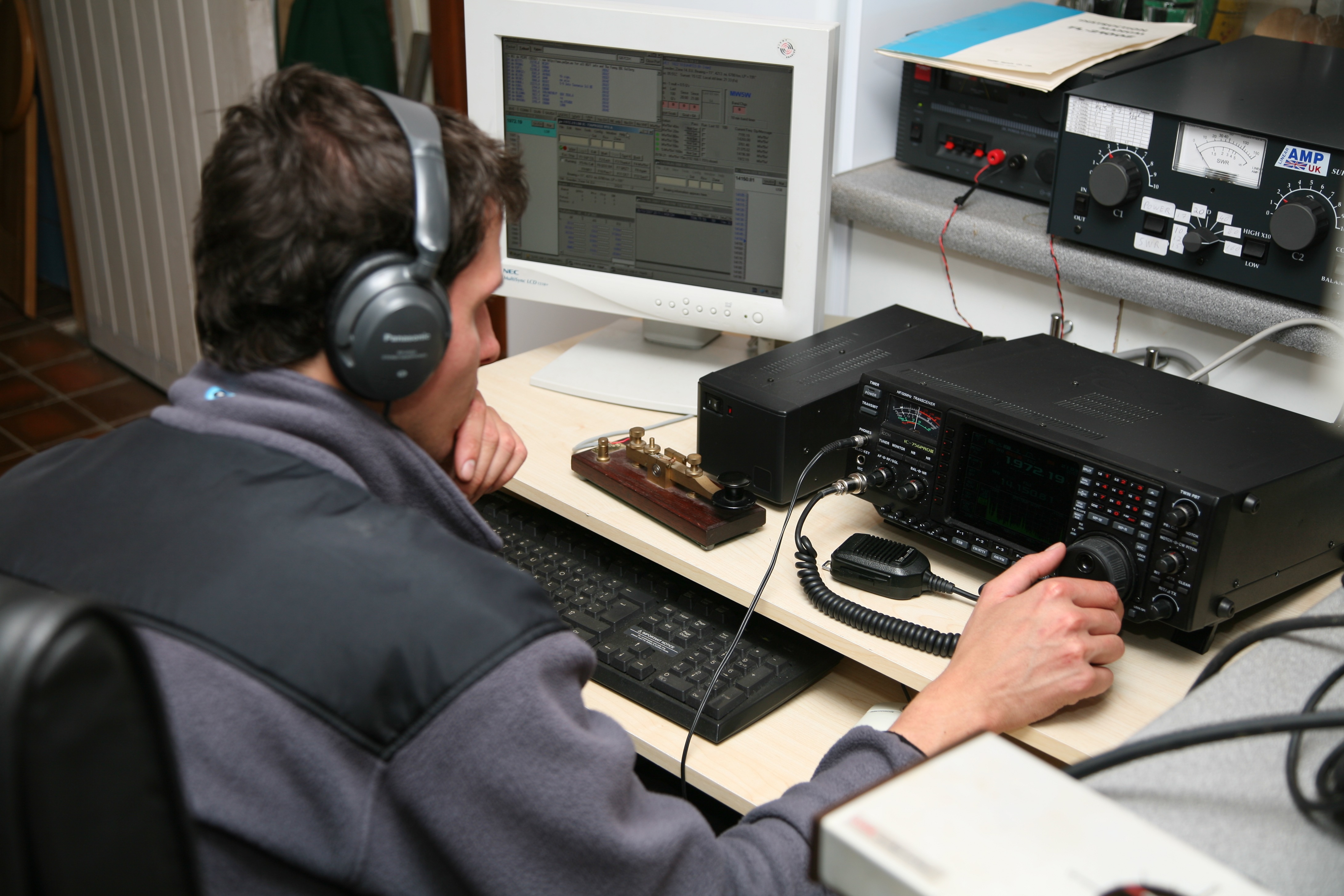
Small, light, simple, practical... This is how Alan, G4ERZ, envisioned his 160 m antenna. To what extent he succeeded, judge for yourself.
You will read in the article
Dimensions and shape of the antenna
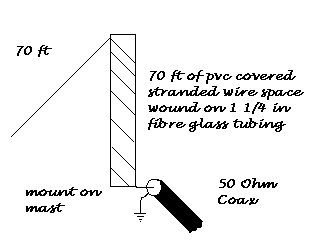
He divided the 42.6 m long insulated wire into two parts and simply wound the first 21.3 m on a pipe made of insulator. In his case it was fiberglass, but we can also try e.g. a new major pipe, or an installation pipe with the trade name Hostalen. The diameter and length depend on our conditions, but please keep in mind that the longer the pipe, i.e. the wire will be wound on a longer length, so our antenna will have more favorable radiation parameters. So we will not try to wind this half of the wire unnecessarily on a 50 cm peg, when we can safely anchor e.g. 5 m long. In both cases, this section of the antenna will have a very adverse effect on the radiation parameters, especially on the efficiency of the entire system, but in the case of a 5 m pipe, our antenna will be significantly more usable. I recommend keeping the gaps between the turns as wide as the diameter of the coiled wire.
The second part of the length of 42.6 m is then stretched diagonally from the roof towards the ground so that it ends approximately at a height of 3-4 m above the ground. It should fulfill the function of capacitive load and its position is not critical.
Power supply with 50 ohm coaxial cable
The system is powered by a 50 ohm coaxial cable in the foot of the vertically placed coiled part, where we must not forget a good counterweight. In this case, the more the merrier. The improvement of the ground system for such an antenna clearly leads to the improvement of the behavior of the entire system, which in this case has both vertical and horizontal polarization and must be tuned into resonance as a whole.
Bandwidth
According to Alan, the bandwidth is about 30 kHz from resonance for usable SWR. Alan experimented with both the antenna and the ground system and came to a generally known conclusion: the quality of the ground system directly depends on the resulting quality, or function of the entire antenna. He himself used two 42 m long raised, tuned radials. We do this simply by tuning two radials against each other into resonance at the desired frequency, as if it were a dipole lying low above the ground. Then we connect them and connect this point at the antenna power point to the cold end of the power cable.
Summary
Of course, this is a spare antenna and it won't be a miracle on the band, but if you only have a few meters of free space around you, this antenna will get you to 160 m. It's up to you how much you win with the ground system, which doesn't have to be very large. In an emergency, we can stick to the rule: "we'd rather bury 40 × 15 m long radials than 1 × 80 m long radial."
73, Petr OK1RP