
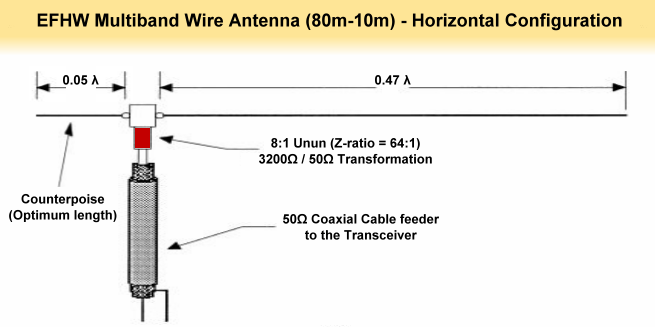
Anténa End Fed Half Wave (EFHW) je ľahká, nízkonákladová, viacpásmová a preto na prvý pohľad lákavo lukratívna. Aby som pomohol pochopiť silné a slabé stránky antény EFHW, pokúsim sa v tomto článku prezentovať konštrukčné atribúty, vlastnosti, správanie, účinnosť and the resulting performance that can be expected from the EFHW antenna. This could help many operators make informed decisions and also avoid the various pitfalls that many radio amateurs encounter with this type of antenna, only to later spend a lot of time and money trying to find solutions to various performance deficiencies.
Antenna EFHW

As a radiating and receiving element, the EFHW antenna is a decent multi-band antenna with good performance on all ham bands, provided it is properly powered. However, it has its peculiarities. The radiation pattern of this antenna on most bands produces multiple lobes. The orientation of these lobes varies with the frequency band of operation, resulting in directional inconsistencies between bands. In addition, this antenna creates several interlobe null points, which create multiple band-dependent shadow (deaf) areas in its coverage. Most EFHW antenna configurations resort to the use of broadband impedance transformers at the feed point to achieve acceptable SWR in all operating bands. This is usually a weak point.
Celkové usporiadanie impedančného prispôsobenia v tomto prípade nie je ani zďaleka tak dokonalé, čo vedie k značným reaktívnym prúdom v niektorých pásmach. Parasitic reactances near the feed point also vary from installation to installation. Therefore, there is no optimal simple solution. Each installation may require the antenna to be adapted to perform within acceptable standards... This condition is rarely met in a typical field placement of an EFHW antenna, resulting in a reduction in overall antenna system performance. Vyššie uvedené faktory často vedú k neprijateľne vysokému povrchovému VF prúdu (Common mode Current) on the coaxial cable transmission line, resulting in a relatively poor antenna system. The bottom line is that although the EFHW antenna has promising potential, most amateur radio installations that rely on the immediate use of a commercially procured EFHW antenna can suffer from many performance-related shortcomings. To make matters worse, many radio amateurs tend to believe that this antenna could be positioned in any way they feel like and still perform well… This is a misconception… Even if an acceptable SWR can be achieved on all bands, this does not necessarily mean that the antenna is performing well. Antenna radiation efficiency, lobe shapes, gain, etc. are all lost if the EFHW antenna wire is placed randomly and in random orientations.
Napríklad aj štandardná a úhľadná konfigurácia Inverted-V drôtovej antény EFHW je z hľadiska výkonu oveľa horšia ako pri bežnej horizontálnej konfigurácii, not to mention other random orientations that could often end up quite horribly. Read on to understand the EFHW antenna so you can learn how to optimize your EFHW antenna installation and avoid various performance pitfalls: https://vu2nsb.com/antenna/wire-antennas/Multiband-efhw-antenna/

You can read more about the EFHW antenna in the VU2NSB article
- For a good antenna system, it is essential to ensure that the transmission line is not part of the antenna radiation system in any way. It should be isolated from any possibility of playing a role in radiating the signal. Comparison of EFHW antenna and dipole
- SWR is good so I have a great antenna… Right? No!!! … The low SWR you get means next to nothing unless various other antenna attributes are set correctly. Otherwise, even a perfect 1:1 SWR might not be good enough. Also, a lot depends on what is causing the low SWR. Is it due to a good antenna feed point match, or is it due to a fit match with the ATU?
- Typical characteristics and performance of the EFHW antenna
- Effect on performance due to placement of the antenna in the environment
- The EFHW antenna is very practical and convenient for use in the field for temporary installations
- Optimal counterweight length and impedance transformátor Unun 8:1 (64:1 Z-pomer) sú najlepšie výsledky na dosiahnutie SWR pod 2:1 na všetkých pásmach
- Effect of EFHW Conductor Orientation on Performance Best results are achieved with classic placement in the shape of a horizontal wire. When used, the Inverted-V variant should never have an apex angle in the upper part of less than 90°-100°. Preferably, it should be kept around 120°-130. It is even more important that the end points of the inverted V are as high as possible, for the 80 m band at least 4 m above the ground.
In the original article, for a better understanding of the given topic, there are animated images, graphs and more detailed information. I wish you a pleasant and especially informative reading about this issue.
YOU 73! Villa, OM3CAQ
Wonderful article, thanks for it! Hopefully, it will help at least some die-hards to understand what the "balun" is for and that it is not about some sort of post-feeder symmetry, but about separating the power supply from the antenna. The power supply is supposed to supply (transmit energy) and the radiator is supposed to emit. If this is not the case, something is wrong. And there are many people who refuse to understand it. However, it all makes sense only when you study (not READ, but really STUDY) the original article by VU2NSB.
The laws of physics apply, you can't make a whip out of it, there is no such thing as a miracle antenna and, with some exceptions, wire antennas are bad. Except for exceptions! "Wired" is a substitute, it's better than nothing, let's not reject them - but expecting them to compete with antenna systems whose price is comparable to the price of a barrack is really waiting for Godot. And you can find all this in the subtext of the VU2NSB article, which is why I highly recommend it!
Praktická stavba doma vyrobenej antény EFHW (80-10 m). Stretching over the lake, measuring SWR, broadcasting:
https://www.youtube.com/watch?v=1IWhhns7w2k