
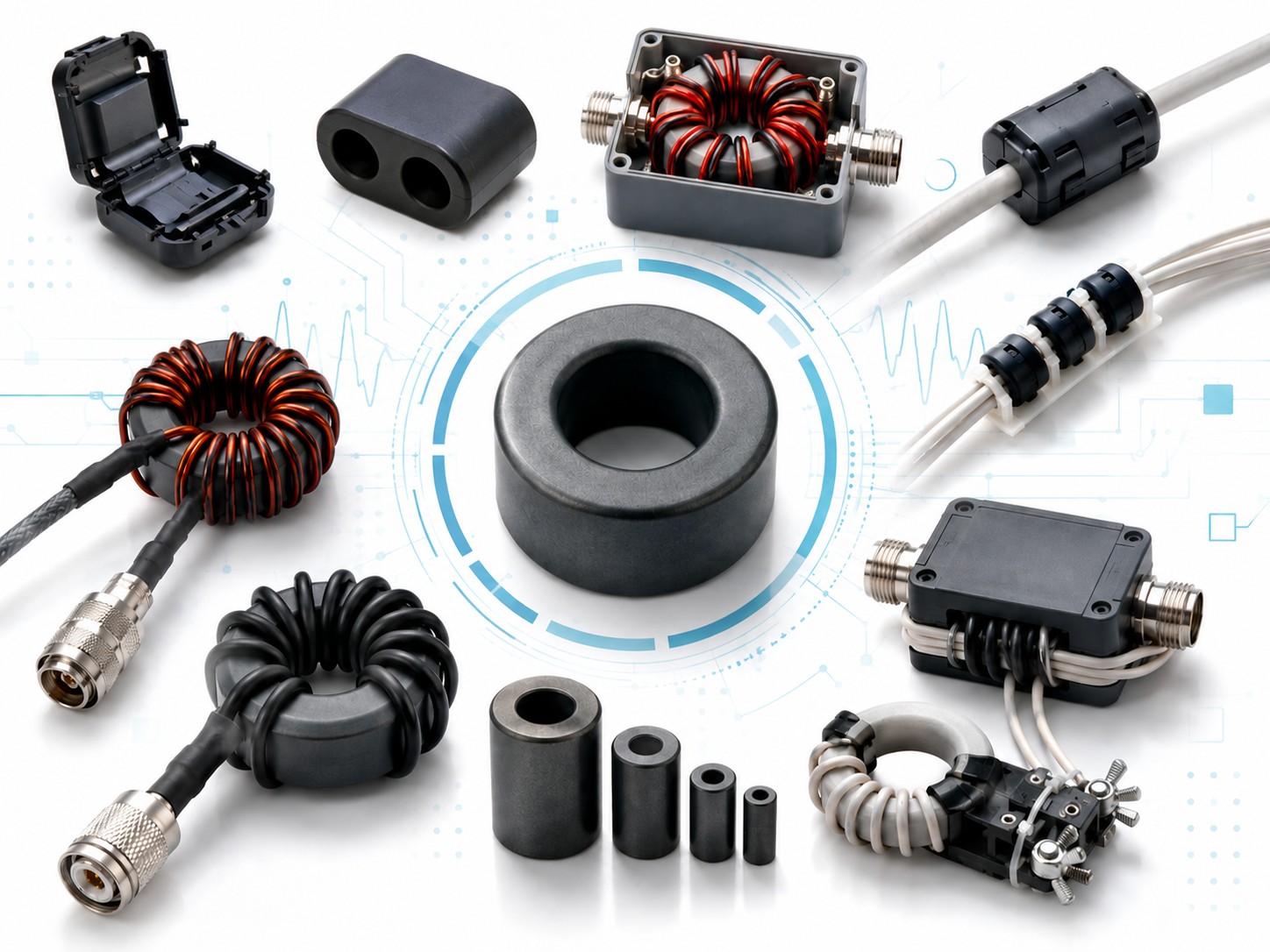
Každý rádioamatér, ktorý sa niekedy pustil do stavby balunu, anténneho choke, širokopásmového transformátora, LPF, BPF alebo VF zosilňovača, skôr či neskôr narazil na jednoduchú otázku, ktorá však nemá jednoduchú odpoveď: aký ferit použiť?
At first glance, this is a banal problem. toroid as toroid, binocular as binocular, snap-in ferrite as snap-in ferrite. However, the reality is diametrically different. Using the wrong material can lead to the balun not working at all, the choke will have a lousy common-mode impedance, the RF transformer will overheat, or during QRO operation the core will simply saturate.
There are many half-truths, simplified recommendations and “recipes” circulating in the amateur radio community that work in a particular situation, but fail when transferred to another band or another application. A typical example is the universal recommendation “put in an FT240-43 and it will work”. Sometimes it does. Sometimes it doesn’t at all.
Ak chceme navrhovať spoľahlivé baluny, Guanella transformers, choke for suppression of reverse currents, transformers for RX antennas or VHF interference suppression elements, we must understand the basic physics of the magnetic materials used.
In the article you will read
Two basic types of magnetic materials
In amateur radio practice, we encounter two main groups of cores:
- ferrite materials
- powdered iron materials
At first glance, they may look similar. Both groups are manufactured as toroids, cylindrical cores, binoculars, or snap-on ferrites. However, electrically, they are worlds apart.
Ferrite materials
Ferrites are ceramic magnetic materials based most often on combinations of iron, manganese, nickel and zinc oxides.
For a radio amateur, two main families are crucial:
- MnZn (manganese-zinc)
- NiZn (nickel-zinc)
MnZn materials have high permeability and perform very well at lower frequencies. Therefore, they are suitable for HF common-mode chokes, choke baluns and EMI suppression.
NiZn materials have lower permeability, but better properties in higher frequency bands, i.e. VHF/UHF.

Ferrite in choke applications does not function solely as an inductance. This is a fundamental misunderstanding. A well-designed common-mode choke should create a resistive common-mode impedance, i.e. convert the energy of the disturbing common-mode current into heat.
This is exactly why Jim Brown K9YC emphasizes that the Rs parameter is important for a choke, not just the total impedance Z.
Powdered iron
Powdered iron cores work on a different principle. They are made of iron powder bound by a dielectric binder.

Their main features:
- lower permeability
- higher Q
- lower losses
- better stability for resonant applications
This makes them an ideal material for:
- resonant coils
- LPF
- BPF
- antenna tuners
- matching circuits
- QRP filters
On the contrary, as common-mode chokes they are usually a bad choice. Typical ham radio mistake: T200-2 used as a choke balun. Electrically it "somehow works", but not in the way we expect from a quality current balun.

The most common amateur radio materials

Mix 31
Currently one of the most versatile materials for HF common-mode chokes.
Strengths:
- 1.8–30MHz
- excellent common-mode loss
- broadband
- vysoká rezistívna zložka impedancie
Typical use:
- 1:1 current balun
- choke at the power point
- EFHW choke
- choke pre jednopásmový dipól
- multi- or omni-band choke
- RFI suppression
K9YC recommendations very often point to this. The FT240-31 in a stack configuration is practically the standard for a QRO HF choke.

Mix 43
Historically very popular. Works well:
- higher HF
- some VHF applications
It performs less well on the lower HF bands compared to mix 31.
Many older designs use FT240-43 automatically, but modern measurements show that there are better choices for 80m and 160m.
Mix 61
NiZn material for higher frequencies. Application:
- VHF
- 6 m
- 2m
- UHF
- broadband transformers
Not ideal for HF chokes for the 160–40 m bands.
Mix 73
Excellent for lower frequencies and EMI suppression. Uses:
- Faculty of Medicine
- MF
- receiving systems
- noise suppression
Mix 75
Strong material for low bands, for example for transformers in RX antennas. It is not a universal HF choke material.
Mix 77
Extremely high permeability.
Good for low frequencies, less suitable than a universal HF choke.
Overview of the use of ferrite materials in amateur radio practice
| Material | Common mode Choke (1 pass) | Common Mode Choke (multiple turns) | Impedance transformer (UN-UN) | BAL-UN 1: 1 |
|---|---|---|---|---|
| #31 | 3.5 - 100 MHz | 1.5 – 50 MHz | — | 1.5 - 30 MHz |
| #43 | 25 - 600 MHz | 2 – 60 MHz | 2 – 50 MHz | 2 – 30 MHz |
| #52 | 150 – 1000 MHz | 4 – 150 MHz | 1 – 60 MHz | 1 – 60 MHz |
| #61 | 200 – 2000 MHz | 5 – 200 MHz | 15 – 200 MHz | 10 – 100 MHz |
| #77 | 200kHz - 10MHz | 100kHz - 10MHz | 0.5 – 8 MHz | 1 – 8 MHz |
Technical parameters of ferrite materials
Material #31
| Parameters | Symbol | Value | Unit |
|---|---|---|---|
| Initial permeability | µi | 1500 | — |
| Magnetic flux density at field strength | B/H | 3900 / 5 | Gauss / Oersted |
| Residual magnetic induction | Br | 3200 | Gauss |
| Coercive power | Hc | 0.28 | Oersted |
| Loss factor at a given frequency | Tan δ / µi | 20 @ 1MHz | 10⁻⁶ |
| Temperature coefficient of permeability (20–70 °C) | — | 1.6 | % / °C |
| Curie temperature | Tc | >130 | °C |
| Electrical resistance | ρ | 3000 | ohm·cm |
Material #43
| Parameters | Symbol | Value | Unit |
|---|---|---|---|
| Initial permeability | µi | 800 | — |
| Magnetic flux density at field strength | B/H | 2900 / 10 | Gauss / Oersted |
| Residual magnetic induction | Br | 1300 | Gauss |
| Coercive power | Hc | 0.45 | Oersted |
| Loss factor at a given frequency | Tan δ / µi | 250 @ 1MHz | 10⁻⁶ |
| Temperature coefficient of permeability (20–70 °C) | — | 1.25 | % / °C |
| Curie temperature | Tc | >130 | °C |
| Electrical resistance | ρ | 1 × 10⁵ | ohm·cm |
Material #52
| Parameters | Symbol | Value | Unit |
|---|---|---|---|
| Initial permeability | µi | 250 | — |
| Magnetic flux density at field strength | B/H | 4200 / 10 | Gauss / Oersted |
| Residual magnetic induction | Br | 3300 | Gauss |
| Coercive power | Hc | 0.6 | Oersted |
| Loss factor at a given frequency | Tan δ / µi | 45 @ 1MHz | 10⁻⁶ |
| Temperature coefficient of permeability (20–70 °C) | — | 0.75 | % / °C |
| Curie temperature | Tc | >250 | °C |
| Electrical resistance | ρ | 1 × 10⁹ | ohm·cm |
Material #61
| Parameters | Symbol | Value | Unit |
|---|---|---|---|
| Initial permeability | µi | 125 | — |
| Magnetic flux density at field strength | B/H | 1500 / 15 | Gauss / Oersted |
| Residual magnetic induction | Br | 1000 | Gauss |
| Coercive power | Hc | 1.1 | Oersted |
| Loss factor at a given frequency | Tan δ / µi | 30 @ 1MHz | 10⁻⁶ |
| Temperature coefficient of permeability (20–70 °C) | — | 0.1 | % / °C |
| Curie temperature | Tc | >300 | °C |
| Electrical resistance | ρ | 1 × 10⁸ | ohm·cm |
Material #77
| Parameters | Symbol | Value | Unit |
|---|---|---|---|
| Initial permeability | µi | 2000 | — |
| Magnetic flux density at field strength | B/H | 5100 / 5 | Gauss / Oersted |
| Residual magnetic induction | Br | 1800 | Gauss |
| Coercive power | Hc | 0.25 | Oersted |
| Loss factor at a given frequency | Tan δ / µi | 15 @ 100kHz | 10⁻⁶ |
| Temperature coefficient of permeability (20–70 °C) | — | 1.2 | % / °C |
| Curie temperature | Tc | >200 | °C |
| Electrical resistance | ρ | 100 | ohm·cm |
1:1 current balun – practical design
Modern amateur radio standard: ferrite common-mode choke
The principle is simple: the differential signal inside the coax passes normally, but the common-mode current on the sheath encounters high impedance.
Practical cores
| Core | Use | Note |
|---|---|---|
| FT240-31 | HF choke | excellent universal choice |
| 2× FT240-31 | QRO | lower heating |
| 3× FT240-31 | legal limit | robust solution |
| FT240-43 | higher HF | older standard |
Number of threads
It strongly depends on:
- mix
- core diameter
- bands
- used coax

Approximate:
- 8–12 turns for HF Multiband choke
- fewer turns for higher frequencies
- more turns for lower frequencies
Too many turns is a mistake. Why? The parasitic capacitance between the turns will shift the resonance and the choke will start to fail where you want to use it.
What coax?
Most common:
- RG316
- RG400
- RG142
PTFE coax is mechanically and thermally more suitable than cheap PVC coax. For QRO, a more robust cable is worth it.
Guanella baluns: when the goal is current control, not just impedance transformation
If there is a design principle that deserves respect in the amateur radio community, it is the Guanella transmission-line transformer. Many OMs use the designations 1:1 balun, 4:1 balun, or 9:1 unun without distinguishing whether it is a voltage or current architecture. This is a mistake, because the electrical behavior of the two solutions is fundamentally different.
The concept was proposed by Gustav Guanella in 1944, but was made famous in amateur radio practice by Jerry Sevick W2FMI. The Guanella balun is essentially a transmission-line transformer that uses the defined properties of a transmission line wound on a suitable ferrite core.
Unlike the Ruthroff voltage balun, the priority here is not to enforce the correct voltage ratio. The goal is to control current and common-mode behavior.
This is why Guanella architecture is used in high-quality:
- 1:1 current baluns,
- 4:1 baluns for symmetrical antennas,
- 9:1 in transformers,
- broadband RX transformers,
- prispôsobovacích členoch pre beverage a iné RX antény
1:1 Guanella current balun
The simplest version is a classic 1:1 current balun.
Typical implementation:
- coaxial cable wound on FT240-31,
- PTFE twinlead on FT240-43,
- stack of 2–3 toroids for QRO operation.
Typical thread counts:
| Band | Mix | Core | Number of threads |
|---|---|---|---|
| 160–40 m | 31 | FT240 | 10–12 |
| 80–20 m | 31 | FT240 | 8–10 |
| 20–10 m | 43 | FT240 | 6–8 |
These values are indicative. The final design always depends on the required inductor impedance, the wire used and the power.
K9YC recommends a choke impedance of the order of 1–5 kΩ for effective common-mode suppression, with a high resistive component Rs being more important than a purely reactive impedance.
4: 1 Guanella balun
A very popular design. It is essentially two 1:1 current transformers connected in a suitable configuration. Typical applications:
- OCF dipole,
- some Windom configurations,
- symmetrical higher impedance power supply.
Very important note: 4:1 balun is not a universal cure-all. The amateur radio legend of the type "put 4:1 on any wire" often produces more problems than benefits. If the load is not electrically suitable, the result is:
- core overheating,
- increased common-mode current,
- unpredictable PSV,
- radiation pattern distortion.
9:1 Guanella unun
Extrémne populárny medzi portable operátormi. Use:
- random wire,
- portable wire antennas,
- ONE HUNDRED,
- SWEAT,
- QRP expeditions.
However, technical discipline is needed here. 9:1 unun is not a miraculous broadband matching element for every wire. VK1OD shows very accurately that with inappropriate wire lengths extreme impedances arise and the transformer can operate far outside the safe area.
Typical cores:
- FT240-43
- 2× FT240-43
- FT140-43 for QRP
At higher power, the FT140 will get out of its comfort zone very quickly.

Snap-on ferrites: a useful tool, not a placebo or a miracle
Snap-on ferrites are among the most misunderstood amateur radio components.
Many OMs use them as a universal "RF repellent":
- to the USB cable,
- on CAT cable,
- for microphone cable,
- for power supply,
- on coax.
Sometimes rightly so. Sometimes completely unnecessarily so.
How they work
Snap-on ferrite increases the common-mode impedance of the conductor passing through it. It determines:
- material,
- core size,
- number of conductor passages,
- frequency.
One core on a USB cable can help. One core on an 80m coax as a main choke is often just psychological therapy.
Mixes for snap-on use
| Mix | Use |
|---|---|
| 31 | HF common-mode suppression |
| 43 | higher HF / universal EMI |
| 61 | VHF/UHF |

Number of cores
A key thing that many OMs ignore. One core is often not enough.
Practical solutions:
- 4–8 snap-on pieces for the power cable,
- multiple passes through a larger core,
- multi-core stack.
K9YC has long warned that weak ferrite solutions give a false sense of eliminating the problem.
VHF applications: where HF logic stops working
A big mistake in amateur radio practice: a successful HF choke recipe applied without change to VHF.
That's a recipe for disappointment. The reason is simple: parasitic capacitances, resonances, and material properties behave completely differently at higher frequencies.

Materials for VHF
Most common:
- mix 43
- mix 61
- ferrite beads
- NiZn materials
Mix 31, great on HF, is not automatically the right VHF choice.
2 m / 70 cm choke solutions
Typical implementations:
- coaxial tube choke,
- ferrite beads on coaxial cable.
For VHF, a Sleeve balun is often a more elegant solution than a large HF-style toroid.
Typical use:
- 2m yagi power point,
- 70cm vertikál,
- satellite antennas
GPSDO, LNB and transverters
In a modern shack with VHF/UHF/SHF technology, ferrites appear everywhere:
- GPSDO power supply,
- LNB bias line,
- I2C cabling,
- Arduino Nano control,
- supply to the rotator
Here, snap-on EMI suppression makes great practical sense.
Saturation: the silent killer of ferrite structures
Saturation occurs when a magnetic material reaches the limit of its magnetization.
Practical implications:
- a sharp decrease in efficiency,
- growth of losses,
- overheating,
- transformer instability.
In an extreme case:
- core rupture,
- insulation degradation,
- balun failure.
What causes saturation?
- too high power,
- inappropriate mix,
- asymmetric load,
- common-mode current,
- too small a core.
A current balun can overheat not because of differential power, but because of common-mode power.
That is a crucial detail.
Performance limits

The question "how many watts can it handle?" does not have a universal answer.
It depends on:
- cores,
- material,
- number of cores,
- frequencies,
- SWR,
- load cycle.
QRP
The world is very tolerant up to 10 W. FT82 or FT140 are usually usable.
100 W class
Normal Shack performance. Reasonable minimum:
- FT240 current balun,
- the right mix,
- good driver.
QRO
500W+
This is where the improvisation ends. Recommended:
- 2–3 stacked FT240,
- high-quality PTFE conductor,
- thermal reserve.
Legal limit
This requires a professional approach. A faulty balun at the legal limit is not an experiment. It's a smoke generator.
The most common design errors

Powdered iron as a current balun
Very common. LPF toroid ≠ common-mode material for the choke.
Too many threads
More is not automatically better. Parasitic capacitance kills broadband performance.
Core too small
QRP component used at 1 kW. Predictable result.
Wrong mix
43 instead of 31 on 160m. 61 instead of HF choke material.
Voltage balun where current balun is needed
Typical problem of a radiating power supply.
Single snap-on coax
That's usually not a serious choke.
Practical reference table
| Application | Material | Core | Note |
|---|---|---|---|
| HF 1:1 current balun | 31 | FT240 | universal choice |
| QRO HF choke | 31 | 2–3× FT240 | thermal reserve |
| 4: 1 Guanella | 31 / 43 | FT240 | by band |
| 9:1 unun | 43 | FT240 | not a universal solution |
| VHF choke | 61 | beads / tubes | better than HF recipes |
| LPF | Mix 2 / 6 | T68/T106/T200 | iron powder material |
| ATU | Mix 2 / 6 | T200 | high Q |
| RFI suppression | 31 | snap-on | more pieces |
Conclusion
Ferrite is not just a “black ring for a cable.” The right choice of material determines whether your design will function as a current balun, a broadband transformer, or just an expensive piece of overheating ceramic.
In amateur radio practice, there is no universal mix for everything.
And that's good news.
Because a properly designed ferrite element can significantly improve the antenna system, reduce RF in the Shack, and protect your TCVR from problems that otherwise appear as a mysterious fault in the antenna, SWR bridge, or power supply system.
Neškodilo by k tak skvělému článku přidat další zkušenosti.
Powdered iron jsou dva druhy. Jedno něco jako pro Pupinizaci telefonních drátů. nevhodné. RF železo dělá Micro Metals svojí technologií žíháním, údajně mikrofotografie vypadá jako slupky cibule. Nevím o nikom jiném, který be měl podobná kvalitní železová magnetika. Amidon jsou lichváři, LICHVA. Amidon překupují a nic nevyrábí. Epcos/TDK na ty můžete čekat 32 měsíců. Nestojí za moc, osobní zkušenost. Ferroxcube jde. Fair-Rite jde. Bourns něco OK. Obyčejně jako firma jsem kontaktoval přímo výrobce. Digikey prodává aušus. Nikdo to neměří, neví jak, a nemají lidi. Když objednají, jen čert Lucifer ví co skutečně přijde. Takže pokud něco chcete, musíte vzít vzorek, ten přeměřit a pak se rozhodnout. Měřím na kmitočtu použití a také na Q. Je to vždy překvapení.
Kde nakoupit? Osvědčily se mi staré amaterské kšefty celosvětově i přes web, které to prodávají roky a aušus by jim lidi poslali nazpátek. Nebo rovnou vztah firma – firma. Budoucnost patří lidem který umí něco udělat. Nakoupit něco na dálném východu a pak študovat proč to nechodí, to umí každý.