
Modern solid-state power amplifiers (PA) equipped with LDMOS transistors (for example, the popular ART1K6, ART2K0FEU or the classic BLF188XR series transistors) have revolutionized amateur radio hamshacks. They offer huge gain, excellent linearity, high efficiency and the ability to deliver full legal power from a compact device without the need for glow or complex tuning of anode circuits. However, this technological advancement is offset by one fundamental weakness - the extreme sensitivity of the transistor input structures to wake-up.
While classic tube amplifiers were able to convert a short-term excess of the excitation power into heat in the grid without permanent consequences, for the LDMOS structure, exceeding the maximum gate-to-source voltage Vgs) a matter of microseconds before an irreversible breakdown occurs. For every active radio amateur who has invested considerable funds and effort in building or purchasing a power stage, reliable input protection is an absolute priority.
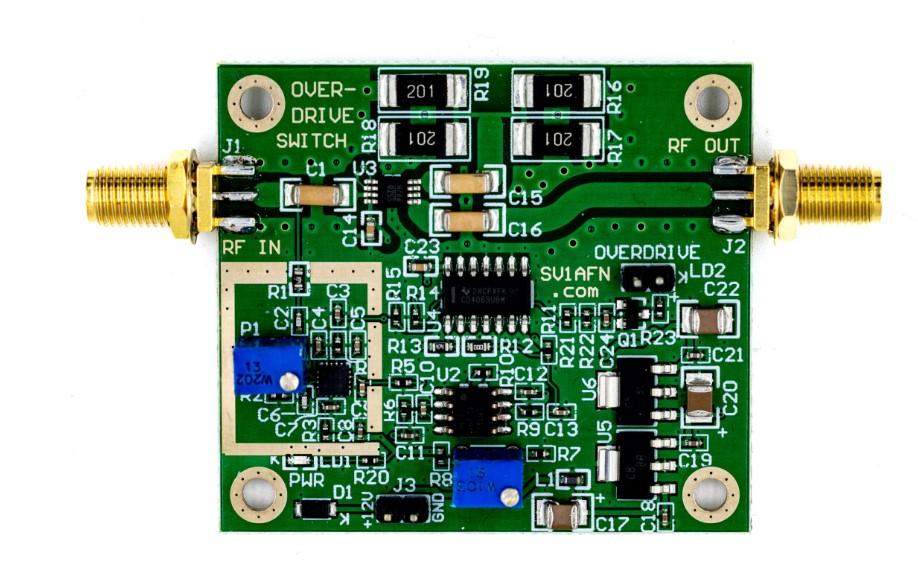
One of the technically cleanest solutions on the market is the module RF Amplifier's Input Power Over-Drive Switch from the famous Makis designer, SV1AFN. This article analyzes in detail why LDMOS transistors are destroyed, how this active protection works, and what its real technical parameters are.
In the article you will read
Reasons for using wake-up protection
The main reason for using active protection is the physical nature and design of LDMOS (Laterally Diffused Metal Oxide Semiconductor) transistors. Unlike bipolar transistors, LDMOS are controlled by a voltage across an extremely thin insulating oxide layer between the gate and emitter.
Amplifier destruction in amateur radio practice most often occurs in the following situations:
- A phenomenon called "Power overshoot" (ALC overshoot): Most modern transceivers (TRX) exhibit a short power overshoot when switching from receive to transmit mode (due to the delay of the ALC control loop). If you have the power set on the TRX to, for example, 10 W, in the first milliseconds a peak reaching a full 100 W can appear at the output connector. For an unprotected LDMOS input, this means instant death.
- Operator error: Inadvertent turning of the RF PWR knob on the transceiver, forgetting to set the high power setting after operating in portable style, or a software error in the amateur radio log that resets the TRX configuration to the default 100 W via the CAT interface.
- Coaxial relay failure or reflection from the antenna: High PSV at the PA output can cause changes in impedances and voltage ratios, which are transmitted back to the input through the internal capacitance of the transistor.
Bežné pasívne ochrany, ako sú útlmové články (atenuátory), problém neriešia komplexne. Ak vložíte permanentný 10 dB Atenuátor, znížite síce 100 W na 10W, ale zároveň permanentne strácate budiaci výkon pri normálnej prevádzke a znižujete celkovú flexibilitu reťazca. Aktívna ochrana od SV1AFN funguje inak – v lineárnom stave je transparentná a zasahuje až v momente reálneho nebezpečenstva.
The principle of operation of active protection SV1AFN
The module works as an ultra-fast RF switch that continuously monitors the signal level passing from the input (from the TRX) towards the output (to the PA). The entire protection process takes place in three key steps:
Signal detection
The heart of the module's measurement section is the Analog Devices ADL5513 wideband logarithmic amplifier/detector. This integrated circuit processes RF signals with a huge dynamic range and is characterized by an extreme response speed that is fully comparable to the fastest diode detectors, but with much higher temperature and frequency stability. The detector continuously converts the level of RF power passing through it to a DC voltage.
Evaluation and comparison
The output voltage from the ADL5513 detector is fed to a voltage comparator. The designer defines the threshold level at which the protection should intervene using a precision trimmer on the printed circuit board. If the excitation power is within the standard, the comparator holds the integrated RF switch in the basic position. The signal passes directly with minimal inserted attenuation.
Power redirection (Switching)
If the input power exceeds the set critical value, the comparator immediately (in the order of nanoseconds to microseconds) changes its state and activates the integrated high-isolation RF switch HMC784. This switch disconnects the output port going to the amplifier and instantly redirects the input signal to the internal dummy load.
The internal artificial load is constructed directly on the module PCB and consists of four non-inductive power resistors with a value of 200 Ω in a 3 W package. Their parallel arrangement creates a precise 50 Ω load capable of absorbing and dissipating excess energy (up to 12 W for a short time).
The amplifier is thus perfectly isolated. The protective state lasts exactly until the excitation level drops below the set safe limit. As soon as the operator reduces the power to the TRX (or the overshoot disappears), the module automatically restores the direct pass-through path.
In addition to the protection itself, the PCB also includes an output for an external LED (labeled LD2). This is used to output an optical wake-up (Overdrive) indication to the front panel of the power stage, which provides the operator with immediate visual feedback during QSOs or races.

Technical parameters
The device is designed as a broadband module implemented on a double-sided printed circuit board (FR4) with optimized microstrip lines. Thanks to this, it is usable from KV bands up to 1GHz.
| Parameters | Value / Range | Note |
|---|---|---|
| Frequency range | 1 MHz to > 1 GHz | Covers HF, 50 MHz, 70 MHz, 144 MHz, 432 MHz |
| Input/Output impedance | 50 Ω | Standard for amateur radio equipment |
| RF connector type | SMA (female) | Directly to PCB |
| RF control switch | HMC784 | Integrated circuit with high linearity |
| Detector | Analog Devices ADL5513 | Logarithmic detector |
| Input power detection range | -30 dBm to +40 dBm | Corresponds to 1 μW to 10 W |
| Maximum permissible continuous power consumption | 10W | Limited by artificial load dissipation |
| Internal artificial load | 12W (4 x 200Ω / 3W) | To safely absorb the awakening |
| Insertion Loss | approx. 0.15 dB at 30 MHz (< 1 dB at 1 GHz) | Negligible effect on wakefulness |
| Output port isolation when activated | 35 to 75 dB (KV and VHF) / approx. 20 dB (UHF) | Higher frequency = lower isolation, but still sufficient |
| Supply voltage | +12V DC | Single power supply for hamshack/PA |
| Current consumption | approx. 50 mA | Low internal auxiliary power requirements |
| Printed circuit board (PCB) dimensions | 47 × 53 mm | Easy integration into a PA box |
Thanks to its wide range of uses, this module in a hamshack can be used not only to protect the inputs of power amplifiers, but it will also do the same job when protecting sensitive inputs. SDR receivers, spectrum analyzers or preamplifiers (LNA) in front of a nearby strong RF field from the second antenna.
Availability and price
The component is delivered as a fully assembled, powered and tested printed circuit board module. This means minimal effort for the designer – just mechanically mount the module, connect the coaxial lines using SMA connectors and supply +12 V.
- Kde zakúpiť: The module is available directly in the official e-shop of the developer SV1AFN at:
https://sv1afn.com. - Current price: €79.00 (price valid when purchased directly from the manufacturer, excluding shipping).
- Product identification number (SKU): SV1A0315
Considering that the price of a new power LDMOS transistor today ranges from €150 to more than €400 depending on the type, investing in this active protection represents a fraction of the cost of a potential repair. Prevention in the form of a reliable RF switch is always cheaper than replacing a destroyed semiconductor after an unexpected power overshoot of your transceiver.
šikovné. Tento typický problém se špičkama byl v transceivrech Icom už v 90. letech and je vidět dodnes. Všude. Na spektru, šířka pásma vyskočí na mnoho kHz. Ruší to, pak se BW stáhne. Uspěšnost řešení si už napamatuji. Jestliže tolerujeme odflákutou práci, pak dostamene ke koupi už jen odfláknutou práci.
Je to ale složitější.
Představte si, že šetříte elektriku and přepínáte napájení. Rychle. Jako v Bluetooth nebo vašem mobilním telefonu. LNA. Při zapnutí vidíte podivné 9V špičky, schopné oddělat třeba modulátor.
Tento jev popisoval před hodně lety W1FB. Téměř každý (jsou vyjímky) operační zesilovač při zapnutí Vcc vytvoří nežádoucí špičky na výstupu. Invertující i neinvertující se ziskem. Pak se to usadí za mikrosekundy až milisekundy. Operák jako sledovač to většinou nedělá.
Situace je totožná při použití NPN pro mikrofon. Prd ho, 9V na výstupu and pak si to sedne. Jde to udělat spolehlivě, ale chce to náročný výdech. Nakonec si člověk řekne jak jsme zblbli PR, nesmyslnou oblbovací reklamou and cílenou degenerací, včetně kopírování. Ovšem že to jde, s PNP to jde líp. Ale jde o tu myšlenku.