
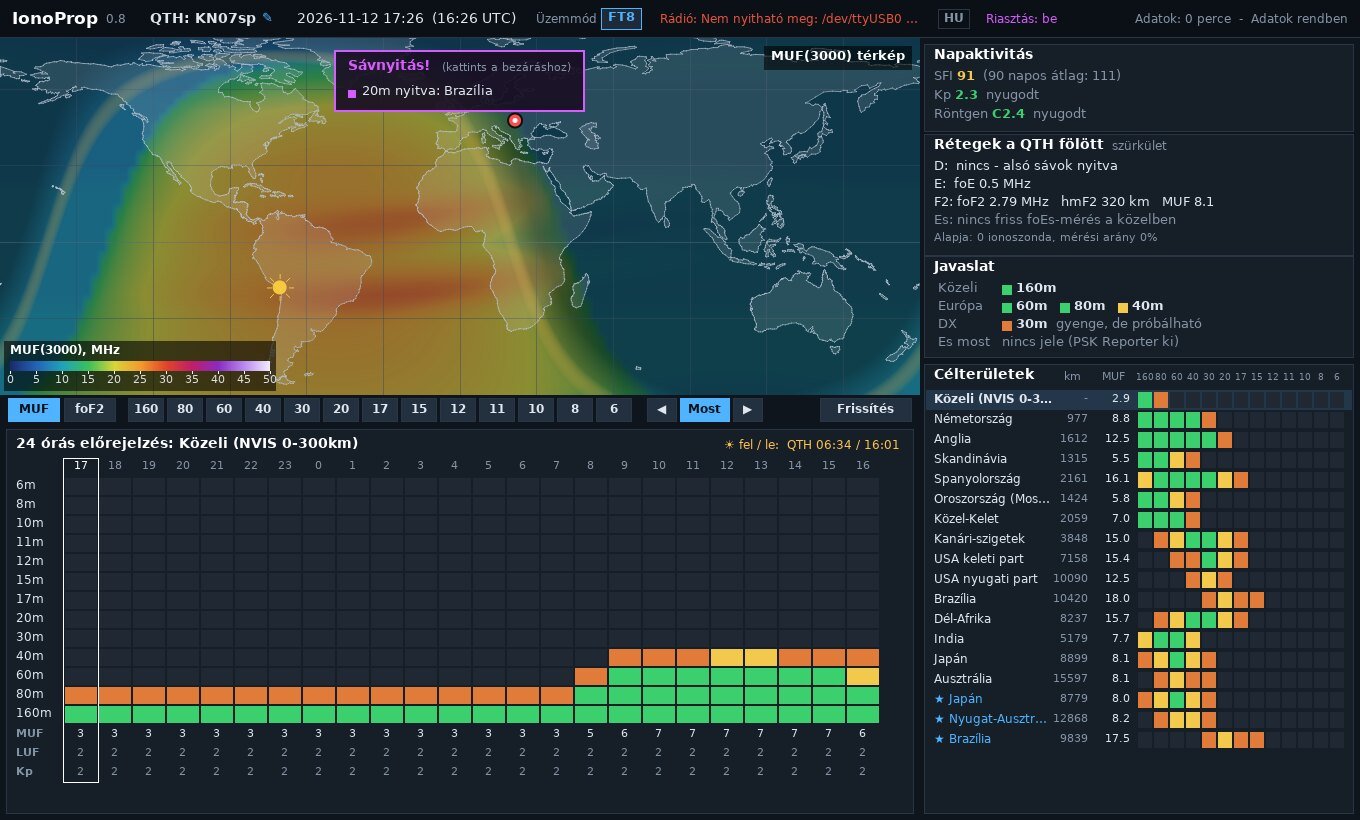
One page with the solar flux, the second with the MUF map, the third with PSK Reporter and still silent at 20 m. If that merry-go-round sounds familiar, check out the IonoProp. A small free program from Hungarian radio amateur HG0MV (QTH KN07sp) combines live ionospheric measurements, propagation forecasting and actual income reports into one window.
It is a native application in C11 language without ads, registration and heavy browser skin. This article is based on the project repository on GitHub (version 0.9.1), the project page and a review on the hamradio.my portal.
You will read in the article
Where does it get the data from?
IonoProp downloads GIRO network ionosonde measurements via the KC2G server: foF2 critical frequency, MUF(3000), hmF2 layer height and measurement reliability. From NOAA SWPC takes SFI solar flux, Kp index, X-ray flux from GOES satellites and three-day Kp forecast.
Ionosondes are updated every 15 minutes, NOAA data every 5 minutes and Kp forecast every hour. The files are stored in the local cache and while they are fresh, the program does not download them again. In case of failure, it will use the last good data.
It is pleasing how the author deals with privacy. Your locator remains on your computer or phone. With PSK Reporter enabled, the server only learns the four-character square from which you want spots, not your brand or exact locator.
How it calculates the spread
The basis is a simple model of the ionosphere according to the SFI and the position of the Sun, which the program corrects according to ionosonde measurements up to a distance of about 1500 km. It divides the route into jumps, for F2 a maximum of about 3500 km, and the model asks for the center of each jump. It also counts layer E during the day.
Attenuation in the D-layer calculates hop by hop according to the height of the Sun and the frequency, and the LUF is derived from it. An eruption above class M1 will silence the lower bands on the day side, and at Kp 4 and above, routes through the polar region will deteriorate. Bands are rated good, average, weak or closed.
13 bands from 160 m to 6 m are evaluated, including 11 m (27 MHz) and 8 m (40.68 MHz). It also depends on the type of operation: CW can tolerate about 8 dB and FT8 about 16 dB more attenuation than SSB, so the same route can still be open on FT8 when it is already closed on SSB.
For each of the 15 built-in target areas and up to 10 custom targets (locator, tag or prefix) you get a 24-hour hourly forecast with MUF, LUF and Kp forecast. He also knows the gray zone and the long way.
Spread prediction controlled by real spots
The most interesting part is the comparison with reality. IonoProp logs into PSK Reporter via MQTT for locator squares around your QTH, by default within 300 km, and collects spots where one party is near you. On the band map, it will show with white dots where the signals from your area actually went in the last 30 minutes, and in the target table it will distinguish strong signals from weak ones at the FT8 level.
Spots from short routes high above the MUF of layer F2 are evaluated by the program as sporadic layer E and shown on the map as a purple cloud. It also adds foEs measurements from ionosondes up to 1200 km. It checks every minute to see if anything has opened and will alert you when Es at 10, 8 or 6m, F2 at 8 and 6m, or when the 20-10m band opens towards your targets.
Linux, Raspberry Pi, Windows and Android

The program runs on Linux, on Raspberry Pi 3, 4 and 5, on 64-bit Windows 10 and 11 and on Android 7 and later. For Windows, just extract the zip and run IonoProp.exe without installation. On a Raspberry Pi, the make autostart command will make it start full screen after login, alternating between MUF, foF2, 40, 20, 15 and 10m maps every 30 seconds. The F11 key turns it into a chess display even on a computer.
The Android app has a desktop widget and band unlock notifications. It's currently in closed testing on Google Play, so you can install the APK from GitHub.
If you have a Yaesu with CAT, for example FT-891, right-click on the band to tune the radio to the usual frequency of the selected type of operation. The program only sends the frequency and type of operation and never turns on the transmission. Radios other than Yaesu are not supported yet.
What not to expect from him
The author says it openly: this is an estimate, not a guarantee. It is most accurate in Europe, where many ionosondes measure. Where there is none nearby, the program only calculates from the model and marks it in the table. He cannot predict the sporadic layer E, he will show it only when it occurs. Antenna gain, power and local noise are not included in the calculation.
If you're looking for a classic long-term prediction, it still has a place VOACAP. IonoProp is more of a tool for asking "what is happening right now and what will happen tonight". The program is licensed under GPL-3.0, the interface is in Hungarian and English. Downloads can be found at project page, instructions for translation and editions in repositories on GitHub.
Frequently asked questions
Is IonoProp free?
Yes, no ads and no registration. The repository is licensed under GPL-3.0.
Does the program send my tag or locator somewhere?
Nope. The locator stays on your device and PSK Reporter only learns the four-character square you want spots for.
How accurate is the forecast?
It's an estimate. It is most accurate in Europe, where there is a dense network of ionosondes, and the sporadic E layer is only captured by the program when it occurs.
Can it be used as a permanent display in the shack?
Yes. On a Raspberry Pi, the make autostart command will launch it after logging in to full screen with map rotation, on a computer you switch to full screen with the F11 key.
Which radios can he control?
Only Yaesu radios via CAT, tested is FT-891. The program only changes the frequency and type of operation and never transmits.