
In this article, you will learn
Why a new digital mode?
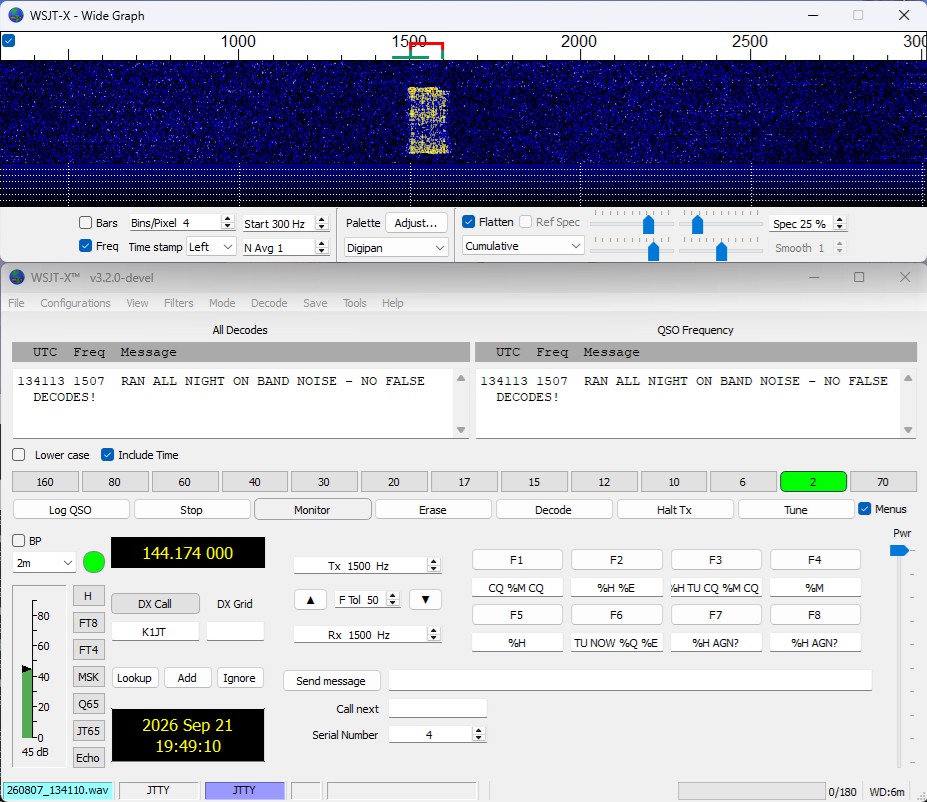
The JTTY digital mode, introduced by the WSJT team in the upcoming WSJT-X 3.2 generation, was developed to combine two features that have been difficult to integrate in amateur radio digimodes: natural keyboard-to-keyboard operation known from RTTY and significantly better resilience to weak signals and errors. JTTY is mainly intended for quick contest exchanges and keyboard-to-keyboard communication.
Unlike FT8 and FT4, JTTY does not use fixed time slots tied to UTC. Transmission can start at virtually any time and typically lasts a few seconds. It thus retains a key feature of RTTY - the operator can respond immediately and control communication similarly to classic keyboard modes.
Traditional amateur radio RTTY is primarily based on the 5-bit ITA2 (Baudot) code and FSK. The Baudot code itself does not provide forward error correction. Under poor propagation conditions, QSB, QRN, QRM, or multipath propagation, the receiver may display incorrect characters. At the same time, it is impossible to establish a single universal S/N threshold below which RTTY becomes unusable - the result depends on the speed used, filters, receiver, signal quality, and conditions on the band.
JTTY addresses this problem with digital coding. The transmitted data is protected by a convolutional code and CRC checksum, allowing the receiver to reject erroneous or insufficiently certain decodings and to utilize redundancy to recover the original data in signals of acceptable quality.
How JTTY works
JTTY uses 4-GFSK with four tones. The keying rate is 31.25 baud and the occupied bandwidth is approximately 125 to 127 Hz. A single frame lasts 1.888 seconds. However, unlike FT8 or FT4, these frames are not locked into fixed UTC intervals - transmission can start at any moment.
FEC in JTTY is not based on LDPC, as is the case with some other WSJT modes. A convolutional code with K = 10 and a rate of 1/2 is used, supplemented by CRC-12. Each frame thus contains the redundancy needed for more reliable receiver decision-making. The CRC primarily serves to verify the correctness of decoding and to suppress false results.
The advantage of this solution is the ability to operate even in conditions where classic RTTY would already provide very error-prone text. The official WSJT-X user manual, for example, includes a test recording with a weak JTTY signal and states that under the same conditions, classic 45.45-baud RTTY would be at the edge of decodability and would show errors. However, the developers have not yet published a universal S/N threshold for JTTY, so it is not appropriate to state fixed numbers like -15 or -18 dB as guaranteed mode sensitivity.
Speed and Response
JTTY is also interesting in that despite its lower keying speed compared to classic RTTY, it can achieve around 60 WPM with short, optimized contest messages. With any free text, the speed is approximately 30 WPM. This means that in typical contest messages, JTTY's practical speed approaches that of classic RTTY, while it is slower with longer free text.
However, some latency remains. JTTY operates with frames lasting 1.888 seconds, and the transmitted text is therefore processed gradually frame by frame, not literally character by character as with RTTY. In a live connection, the text appears continuously on the screen, so it is not the classic model of 'transmitting the entire message - then decoding'. Nevertheless, the response is somewhat different from the immediate display of each individual character in RTTY.
Advantages of JTTY
The biggest technical advantage of JTTY over classic RTTY is the combination of narrow bandwidth, coding, and robust decoding. Developers report significantly better performance in weak signals and much lower error rates than with standard RTTY. In cases of interference, fading, or overlapping signals, a well-designed receiver can utilize the redundancy in the code to recover data. However, this does not mean that FEC can automatically recover any length of signal completely obscured by strong QRM - JTTY also has its limits dictated by the signal-to-noise ratio and the nature of the interference.
Another benefit is the bandwidth of approximately 127 Hz, which is less than that of typical amateur radio RTTY with a 170 Hz shift. It is important to distinguish between the shift data in RTTY and the overall occupied bandwidth of the signal. JTTY is therefore interesting even in crowded segments of the band.
A major advantage is also the method of control. JTTY does not require synchronization of computer clocks with the precision needed for FT8 or FT4. Transmission can start as soon as the frequency is clear. This is very suitable for quick contest exchanges, pile-ups, and regular communication between operators.
Transceiver setup
JTTY is designed to operate through a standard SSB transceiver and a computer audio interface. From the perspective of the radio station, a configuration similar to other sound digital modes is used, typically USB or USB-DATA. It is not a classic hardware FSK keying of the carrier, as we know from RTTY.
Therefore, the purity of the audio signal is important during transmission. ALC should not significantly interfere with the modulation signal, and care should be taken to avoid waking the audio interface. Just like with FT8, FT4, and other AFSK digimodes, excessive audio signal levels can lead to non-linearity, intermodulation, and spectrum spreading.
On the receiving side, it is advisable to set a sufficiently wide IF filter so that the software can see the entire usable audio range. For a typical SSB transceiver, a practical starting point is a filter of approximately 2.5 to 3 kHz. The specific AGC setting depends on the receiver; it is essential that strong signals in the vicinity do not cause significant 'pumping' of gain or overload the receiving path.
When transmitting longer JTTY messages, one should account for a relatively high duty cycle. If the operator transmits continuously for a longer time, the final stage may be stressed similarly to other continuously transmitting digital modes. Therefore, it is correct to adhere to the thermal and power limits of the specific transceiver and reduce power as needed during long transmissions. There is no universal rule that every 100 W transceiver must be set to, for example, 30–50 W when using JTTY.
JTTY frequencies
Frequencies for JTTY should currently be understood as preliminary recommended dial frequencies, not as new officially allocated segments. The WSJT-X development team originally recommended the frequency 14.090 MHz as the main spot on 20 m and also published a preliminary list for other bands. Values may change with increased activity and operational experience.
| Band | Recommended dial frequency | Note |
|---|---|---|
| 160 m | 1.838 MHz | Preliminary frequency |
| 80 m | 3.575 MHz | Preliminary frequency in the narrowband digimodes segment |
| 40 m | 7.090 MHz | Preliminary frequency; respect the local bandplan and current activity |
| 30 m | 10.140 MHz | Preliminary frequency in the narrowband digimodes band |
| 20 m | 14.090 MHz | Initial main meeting place for JTTY |
| 17 m | 18.100 MHz | Preliminary frequency |
| 15 m | 21.090 MHz | Preliminary frequency |
| 12 m | 24.920 MHz | Preliminary frequency |
| 10 m | 28.090 MHz | Preliminary frequency |
| 6 m | 50.160 MHz | Preliminary frequency; check the regional VHF bandplan |
| 2 m | 144.160 MHz | Preliminary frequency; check the regional VHF bandplan |
In the current IARU Region 1 band plan, for example, on the 80 m band, segments for narrowband digimodes are reserved from approximately 3.570 MHz, and on the 20 m band, narrowband digimodes can be found up to 14.099 MHz. Recommended JTTY frequencies generally fit into these areas, but the developers' recommendations do not replace national or regional band plans.
Therefore, it is not appropriate to use the rule that upon hearing FT8, one should automatically move 2 kHz. With JTTY, it is better to watch the waterfall, find a free spot, and respect the actual activity in the given segment. It should also be noted that the recommended JTTY frequencies are currently experimental and may change.
Will JTTY replace RTTY?
From a technical perspective, JTTY has a very interesting position. It combines a style of operation similar to RTTY with modern encoding and significantly better resilience to weak signals. However, the technical quality of the mode does not necessarily mean that RTTY will immediately disappear.
RTTY has a huge advantage in the form of decades of user base, contest rules, logging software, and established operating procedures. Additionally, RTTY is directly supported by hardware FSK in many transceivers, which some operators prefer.
On the other hand, JTTY is already entering the contest ecosystem. N1MM Logger+ version 1.0.11449 and newer include an interface designed to work with JTTY in WSJT-X, and the WSJT-X user manual describes its configuration similarly to other digital modes.
However, real experiences from larger contests will be crucial. Just because JTTY technically supports fast exchanges does not mean it is automatically allowed in a specific contest. That is determined by the rules of the particular contest and its categories.
Therefore, it is more accurate today to refer to JTTY as a potential successor or alternative to RTTY, not as its immediate replacement. The success of the new mode will only be shown through long-term operation, expansion among amateur radio operators, support in logging programs, and especially results from real pile-ups and contests.
What can determine the success of JTTY?
The most interesting thing about JTTY is that it is not just another mode based on fixed UTC cycles. It retains the spontaneity of RTTY but adds more modern digital processing and error correction. This is a combination that neither FT8 nor FT4 offers in the same way.
That is why JTTY may be interesting for contest operators, DX stations, QRP operations, and anyone who wants to use a keyboard digital mode even with weaker signals. However, it should be noted that as of fall 2026, the mode is still very young, and its parameters, recommended frequencies, and user interface may continue to evolve.
JTTY thus represents an interesting experiment: an attempt to transfer the comfort and dynamics of RTTY into the era of modern weak-signal digital techniques. Whether it will become a new standard or remain a specialized mode for certain types of operations will only be revealed by its further development and the number of operators who adopt it in their daily practice.