
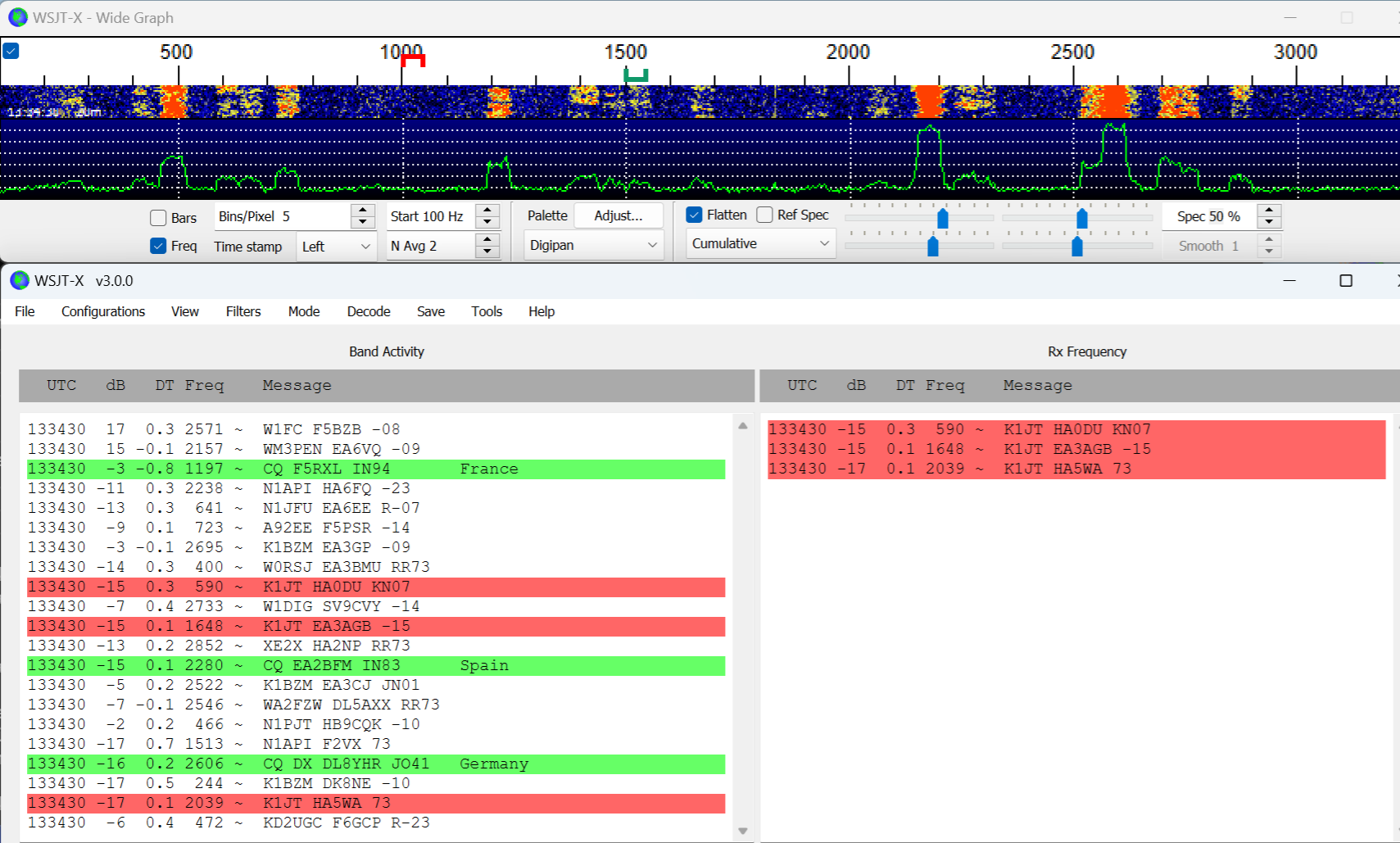
Projekt WSJT-X Improved, developed and maintained by Uwe Risse, DG2YCB, released a new major version, 3.1.0, on February 26, 2026. This is the most significant development step since the release of branch 3.0.0 in December 2025. Version 3.1.0 brings several major improvements that will be appreciated especially by active operators in digital modes - from everyday FT8 QSO cez meteor scatter s MSK144 až po EME prevádzku s programom MAP65.
For those who are not yet familiar with the project: WSJT-X Improved is an enhanced edition of the original WSJT-X software by Joe Taylor K1JT, Steve Franke K9AN and Bill Someville G4WJS (SK). It maintains full compatibility with standard WSJT-X, but adds a number of features not included in the official branch. The program is released under the GNU GPL v3 license.
In the article you will read
What's new in version 3.1.0
New FT2 experimental mode
The most notable innovation is the introduction of the open digital FT2 mode. This is a 77-bit mode with a T/R period of 3.75 seconds – exactly half that of FT4. The result is even faster QSOs than FT4, but at the cost of less immunity to interference.
Historically, FT2 has its roots in experiments by Joe Taylor, Steve Franke, and Bill Someville, which later evolved into FT4. Recently, operator IU8LMC has also introduced his own implementation of FT2. The version integrated into WSJT-X Improved 3.1.0 is parametrically compatible with his solution, but is completely open-source and does not contain any code from IU8LMC.
The author DG2YCB himself warns that FT2 is still experimental and its future depends on whether it finds a permanent place alongside FT4 or remains a short-term affair. In any case, the ability to try out the new mode directly from the shack without having to install third-party software will be attractive to many experimenters.
QSO between stations with non-standard call signs
This improvement will probably be the most appreciated new feature of version 3.1.0 in practice. Until now, making a QSO between two stations with non-standard or composite callsigns in 77-bit modes (FT8, FT4, FT2, MSK144, Q65, FST4) was a technical obstacle. Version 3.1.0 changes this and allows the following combinations:
- Two non-standard call signs (for example, DG123YCB with W250USA)
- Two composite call signs (for example DG2YCB/QRP with W1XYZ/YOTA, or HB9/DG2YCB with KP5/W1XY)
- Combined non-standard and composite call sign (for example, DG123YCB with W1XYZ/QRP)
- Non-standard callsign and variant /P (for example DG123YCB with W1XYZ/P)
- Two standard call signs with suffixes /P, /M, /R and similar (for example DG2YCB/MM with W1XYZ/P)
Je potrebné zdôrazniť, že pre využitie týchto nových typov správ musia obe stanice používať WSJT-X Improved v3.1 alebo kompatibilný softvér. Niektoré beta verzie JTDX a MSHV sa javia ako kompatibilné, avšak štandardné WSJT-X sa pri prijatí takýchto správ zasekne v nekonečnej AutoSeq slučke. Zároveň platí, že nové typy QSO nie sú dostupné pri špeciálnych aktivitách (SOTA, POTA, IOTA a podobne), pretože 77 bitov na zakódovanie všetkých informácií jednoducho nestačí. Spätná kompatibilita s existujúcimi typmi správ je zachovaná.
For portable operators working with the /P suffix, for participants in WWFF and SOTA activations, as well as for QRP stations that add /QRP, this improvement is extremely practical.
New technology for MAP65 and FORTRAN code
The executable file map65.exe has been rewritten using new compiler technology. As a result, its size has been reduced to less than a quarter of its original size. In addition to the reduced disk space requirements, stability improvements are also expected, which will be especially welcome by EME operators using long reception sessions. In parallel, the FORTRAN source code has been modernized.
Note: Builds marked as OFC (Official Code) use verified code from version 3.0.0, and therefore still contain the older version of MAP65.
QMAP v0.7 (v3.1.0 260522) now also supports 128, 192 and 256 kHz bandwidths:
- With 256 kHz spectrum we can cover almost the entire subband for EME operation!
- However, QMAP v0.7 is fully backward compatible. It still works very well with 96 kHz streams.
- QMAP v0.7 works seamlessly with N6NU SDR Bridges, providing a modern solution for connecting various SDR receivers to WSJT-X and QMAP without the need for Linrad or SDR-Console. For those who don't know yet: N6NU Bridges generate both a narrowband audio stream for connection to WSJT-X (via the virtual audio cable VAC), and a wideband I/Q network stream for QMAP or MAP65. In addition, they obtain the frequency set in WSJT-X via UDP, so that both SDR and QMAP remain synchronized.
Other improvements and bug fixes
Version 3.1.0 also brings several smaller but practically valuable adjustments:
- New option to skip a8 decoding for the multithreaded FT8 decoder (MTD), allowing better performance tuning on older systems.
- The band hopping interval is now switchable between 1 and 2 minutes directly via a new checkbox in the Settings | General tab.
- Option to log dial frequency instead of actual Tx frequency – useful in some split operation configurations.
- Fixed a bug where FT4 decodes were not displayed when running the program with CQonly enabled.
- Fixed random display of country names in FST4W mode.
- Fixed an inconsistency in prefix highlighting.
- Stations from the UK are once again allowed to transmit above 5362 kHz on the 60m band. Only the range 5358–5362 kHz remains blocked.
- Improved readability of the Settings | Tx Macros tab when dark theme is enabled.
- Support for the new Hamlib 5 series.
A quick look at version 3.0.0 as a baseline
For complete context: branch 3.0.0, released in December 2025, brought a major innovation in the form of a multi-threaded FT8 decoder (MTD). This can be intelligently combined with the existing single-threaded decoder (STD) in 2-stage and 3-stage configurations, achieving the best FT8 decoding performance to date. Other benefits included: Echo mode for EME experimentation (sending a call sign to the Moon and capturing the reflection), support for the Quick Filter function for highlighting stations by territorial affiliation, the ability to upload to eQSL.cc a podpora multilinguálnych zvukových upozornení cez voliteľný language pack.
Available versions and downloads
All files for version 3.1.0 are available on SourceForge at:
https://sourceforge.net/projects/wsjt-x-improved/files/WSJT-X_v3.1.0/
The following variants are available:
- Windows 64-bit (standard) –
wsjtx-3.1.0-win64_improved_PLUS_260226.exe(40.0MB) - Windows 64-bit (widescreen) –
wsjtx-3.1.0-win64_improved_widescreen_PLUS_260226.exe(40.0MB) - Windows 64-bit (AL version) –
wsjtx-3.1.0-win64_improved_AL_PLUS_260226.exe(40.0MB) - OFC varianty – the same three versions with the extension
-OFC, using verified code from branch 3.0.0 for MAP65 (40.2 MB) - Windows 32-bit, Linux, macOS and Raspberry Pi – available in the respective subfolders
- Language pack –
Language_pack.7z(27.1 MB) for multilingual voice notifications - Source code – source code for compilation under both Qt5 and Qt6
The files are released with the date February 26, 2026. Before installation, the author DG2YCB recommends backing up the files WSJT-X .ini and wsjtx_log.adi and install the program in a new folder (for example C:\WSJT\wsjtx-310). Obidva súbory sa nachádzajú v log priečinku aktuálnej inštalácie.
Practical notes before installation
Verzia 3.1.0 je stále označená ako vývojová v tom zmysle, že niektoré funkcie – konkrétne mód FT2 – sú experimentálne a ich finálna podoba nie je garantovaná. Napriek tomu je kód funkčne stabilný a spätne kompatibilný. prevádzka s existujúcimi log súbormi vo formáte ADIF je bezproblémová.
Pre stanice, ktoré aktívne pracujú v conteste alebo sledujú DX cluster a chcú korektne logovať QSO s portátnymi stanicami s príponou /P, prípadne aktivátormi SOTA a WWFF, predstavuje podpora zložených volacích znakov v 77-bitových módoch konkrétne praktické zlepšenie – nie len kosmetickú zmenu.
Current builds are the only version for which it makes sense to report any bugs. The author explicitly requests: Always use the latest builds available before reporting any bugs.
Further information, discussion, and an archive of previous versions are available on the project website and on the community mailing list on SourceForge. QRZ stránka autora: DG2YCB.
73 days of editorial staff