
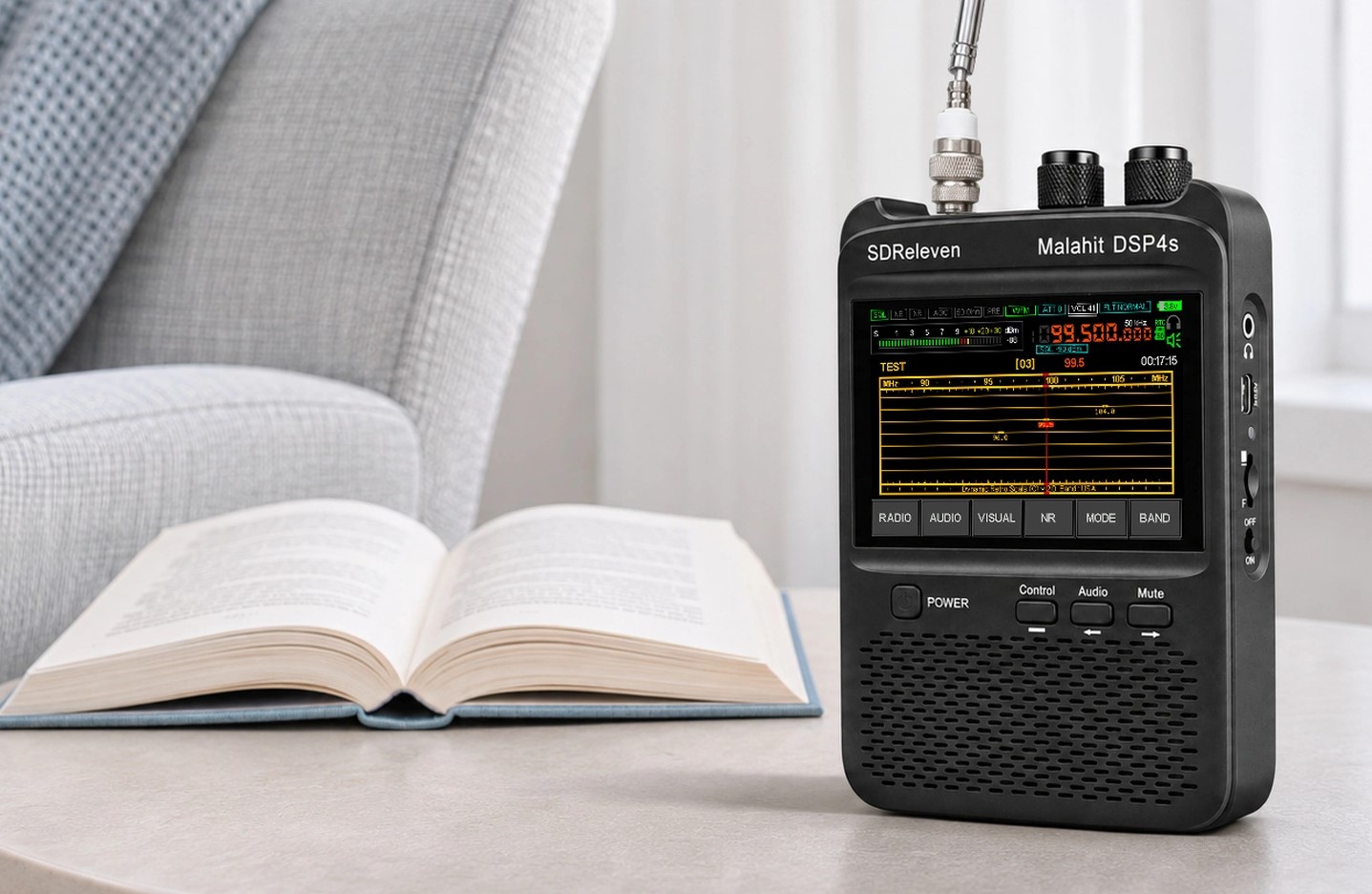
Rodina prijímačov Malahit má v komunite rádioamatérov a SWL listeners fixed place. The idea is always the same: broadband SDR in the palm of your hand, with a display and without the need to turn on the computer. The Malahit DSP4s model takes it a step further and is worth a closer look.
The DSP4s is a portable high-performance SDR receiver with frequency range od 100 kHz do 1620 MHz. Pokrýva teda dlhé, stredné aj krátke vlny, VHF also UHF up to 1.6 GHz.
The operator is based on a 3.5-inch touch screen with spectrum and waterfall. You enter the frequency directly by tapping on the display. You tune and adjust with two rotary encoders with a button: one is used for tuning, the other for volume or the currently selected parameter.
Add to that a built-in speaker and a 3.5mm headphone output. You can direct the sound to the speaker, to the headphones, or to both at the same time. You can receive, tune and adjust directly on the radio, without a computer.
If you do connect it via USB, you get CAT control, sound to the computer, IQ data with a width of 162 kHz and access to files on the card in separate storage mode.
You will read in the article
From AM to TETRA: modes and decoders
Among the classic types of operation, you can find AM (with MAG detection and synchronous SAM, SAMU and SAML), SSB, DSB, CW, narrowband and radio FM. However, the main change compared to the older model is in the decoders built directly into the receiver.

For text and video they are CW, RTTY, FT8, FT4 and SSTV. The FT8 operates in 15 second cycles and displays callers, locators and SNR messages on the display, the FT4 has 7.5 second cycles. With SSTV, the image is composed line by line, and the manufacturer shows an example in the Martin M2 mode. For digital modes, USB mode and correct cycle timing must be taken into account.
Digital voice is covered by DMR, D-Star, APCO/P25, TETRA (in DMO mode) and NXDN. The receiver displays identifiers, color code, timeslot or the route through the Converter, but these are only unencrypted signals. The manufacturer himself points out that a correct indication of synchronization does not yet mean an intelligible sound, and that the support of modes may change over time.
Antenna, attenuator and filters

The antenna input is SMA and supports 50 Ω impedance. A high impedance Hi-Z input is also available for a short whip or piece of wire, but this is only available up to 50 MHz.
For weak signals, you can turn on the Preamp, for strong ones, add ATT attenuation in the range of 0 to 30 dB. The manufacturer advises to compare the preamplifier on and off under the same conditions, not only according to the S-meter, but also according to intelligibility. The PWR ANT function is something else: it powers the active antenna and remains off with normal passive antennas.
NR, NB, AGC, ANF (only in USB and LSB) and squelch are used to suppress interference. There is also an adjustable filter and a five-band equalizer with eight presets and three user memories.
Memory, scanner and microSD recording
The receiver has 50 memory locations divided into five pages of ten stations. It remembers both frequency and mode and enables sequential monitoring of four groups. The scanner can handle up to 10 configurations and each has its own list of results with a capacity of up to 50 items.
With the FM radio you will find a retro scale, two user lists of stations and an RDS display (PS, PTY and PI). The European 87.5 to 108 MHz band, the Japanese 76 to 95 MHz band and the US setting are supported.
The microSD card slot is used for recording sound in WAV format (48 kHz), taking screenshots in BMP format and backing up lists and settings to text files. The image is suitable, for example, for SSTV images or FT8 news. The card must be formatted to exFAT and is not included in the package. Backups are not a complete system image and audio recording is separate from USB IQ output.
DSP4s versus DSP2
The seller compares the new model with the DSP2. The main differences are in this table.
| Parameter | DSP2 | DSP4s |
|---|---|---|
| Spectrum width | 192 / 96 / 48 kHz | 650 / 325 / 160 / 80 / 40 kHz |
| Dynamic blocking range | 82 dB | ≥100 dB |
| Built-in decoding | CW | CW, FT8, RTTY, SSTV, DMR, D-STAR, P25, TETRA, NXDN |
| Range of income | 10 kHz–380 MHz, 404 MHz–2 GHz | 100 kHz–1620 MHz |
| USB IQ | 192 kHz | 162 kHz |
| microSD | WAV sound | WAV, BMP, settings files |
Attention to one detail. The DSP4s is not "wider" in terms of frequency range, the DSP2 actually has a larger one. The displayed spectrum is wider (up to 650 kHz) and the blocking dynamic range is higher, which is reflected in strong signals in the vicinity.
Video
The following video shows what the operator looks like in practice.
Price and availability
Elecevolve's dealer site lists the receiver for 0. Postage to Slovakia is .78, including duty and taxes, and estimated delivery time is 8 to 10 days. However, as of November 16, 2026, the item was marked as sold out (Sold Out, 0 items in stock), so you should check the current status before planning a purchase.
Conclusion
Malahit DSP4s is interesting mainly because of what happens without a computer: spectrum, waterfall, digital mode decoders, recording on microSD and convenient control by touch and encoders. On paper, it looks like a smart companion for traveling, to the cottage and to the workshop.
Only independent tests and user experience will show whether the declared parameters are so good in practice. Only those will show how the receiver behaves with strong signals, and the quality of digital voice decoding will depend on the specific propagation conditions and the antenna used.
Frequently asked questions
What frequency range does the Malahit DSP4s have?
The receiver covers the range from 100 kHz to 1620 MHz. The manufacturer also supports Hi-Z input, but it is only available up to 50 MHz.
Does DSP4s need a computer?
No, the receiver is separate and controlled by a touch screen and two encoders. Via USB, it can be connected to CAT control, audio transmission and IQ data with a width of 162 kHz.
Which microSD card should I use?
The card must be formatted to exFAT and is not included in the package. It is used for WAV recordings (48 kHz), BMP screenshots and settings backups.
Which digital voice modes does the DSP4s decode?
These are DMR, D-STAR, APCO/P25, TETRA (DMO) and NXDN, and only for unencrypted signals. The manufacturer warns that mod support may change over time.
How is the DSP4s different from the DSP2 model?
The DSP4s offers a wider displayed spectrum (up to 650 kHz), dynamic blocking range of ≥100 dB versus 82 dB, and more built-in decoders. However, the reception frequency range is narrower than DSP2.