
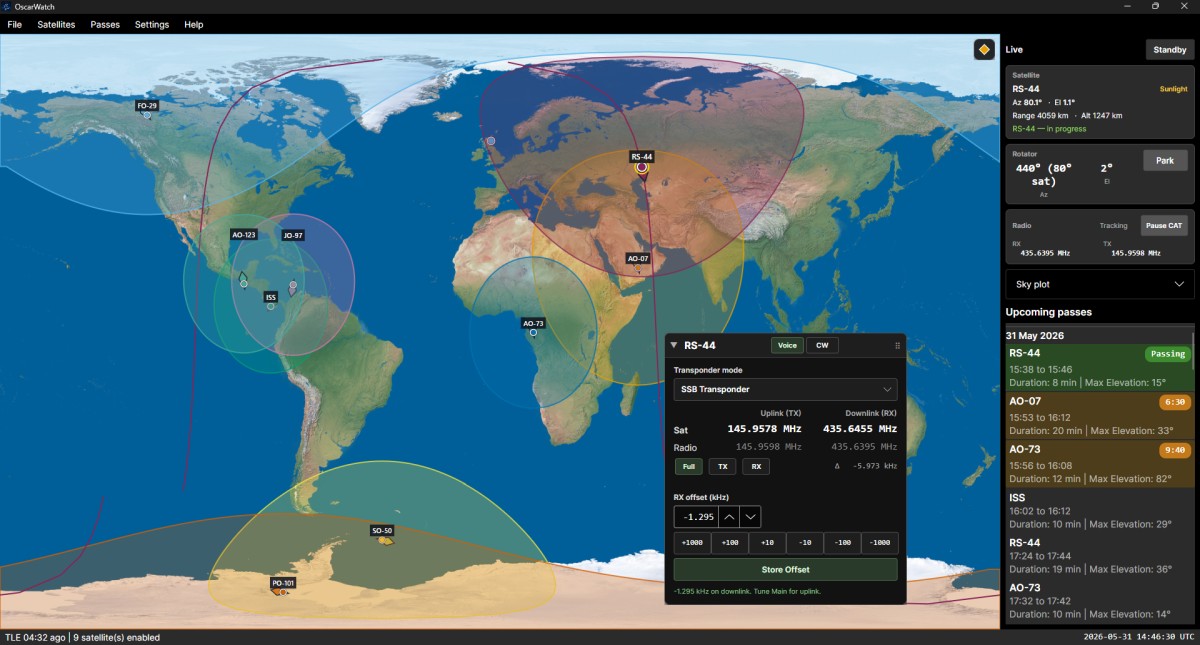
OscarWatch is an open-source desktop application for tracking amateur radio satellites. It is being developed by Peter Goodhall, MM9SQL, a radio amateur and developer also known as the author of the Cloudlog logging system. The project is hosted on GitHub (github.com/magicbug/ OscarWatch -Tracker) under the AGPL-3.0 license. The current version at the time of writing is v0.7.2 (released June 1, 2026). The application is still under development, but fully functional for everyday satellite operation.
In the article you will read
Who is OscarWatch for?
The target group is licensed radio amateurs working on VHF/UHF satellites: FM cubesats (SO-50, ISS, etc.), satellites with linear transponders (RS-44, FO-29, etc.) and similar systems. The author assumes that the operator is familiar with the basic concepts – time of flight, Azimuth, Elevation, Doppler shift – and OscarWatch takes over the calculations and optional hardware control so that the operator can concentrate on the QSO itself.
No programming knowledge is required to install pre-packaged packages.
What OscarWatch does

Aplikácia pracuje ako jedno okno sústredené okolo mapy sveta. Z neho sa ovládajú všetky hlavné funkcie: sledovanie satelitu, plánovanie prechodov, Dopplerom korigované frekvencie a voliteľné automatizované riadenie rotátora a transceivera.
Map and sky plot
The main screen displays an equirectangular map of the Earth with satellite position (subpoint), ground track, footprint and optional direction arrows. Next to the map is a polar sky plot – a view of the satellite’s azimuth and elevation from the station’s position. Both views are synchronized when a satellite is selected (focused). Optionally, the map can also display a marker for a distant DX station according to the Maidenhead grid locator with live azimuth and elevation for the satellite being tracked from its position – useful for mutual planning of connections.
Flight planning
The list of upcoming passes shows the AOS (Acquisition of Signal), TCA (Time of Closest Approach / maximum elevation) and the length of the pass. Filters for minimum elevation and minimum pass length allow you to display only usable windows. The pass planner supports multiple station profiles (home / portable), and passes can be exported to .ics format for calendaring - handy when planning AMSAT activities during contests or Field Day.
The Mutual pass finder function finds crossings visible from two stations simultaneously - a help when coordinating schedules.
Frequency panel and Doppler
The transponder viewer draws from a database hosted at tle.oscarwatch.org and displays live Uplink and Downlink with Doppler shift updated every second. For linear SSB transponders, separate RX offsets are stored for Voice and CW. If the satellite is FM, the panel also displays CTCSS tones (access and arm). Keyboard shortcuts allow for quick RX offset correction (numpad + / −), Voice/CW switching (Ctrl+W), or switching to solo map view (S).
Voice alerts and flight recording
Optional voice announcements inform the operator of a rising satellite (e.g., "Alpha Oscar Zero Seven is rising") when the set elevation is exceeded. Automatic recording of transitions to WAV files works via PortAudio from any audio input while the satellite is above the set elevation. Files are named according to the scheme {sat-name}-{yy}-{MM}-{dd}-{HH}-{mm}.wav in UTC.
Integration with Cloudlog
If satellite tracking is active, OscarWatch can synchronize live uplink and downlink frequencies directly to the Cloudlog logging system via the Cloudlog Radio API v2.
Supported transceivers and rotators
Transceivers (CAT via serial port)

| Transceiver | Protocol | Note |
|---|---|---|
| ICOM IC-910 | CI-V | Cross-band, satellite mode, Main/Sub VFO, Sub uplink CTCSS |
| ICOM IC-9100 | CI-V | Same functionality as IC-9700; default CI-V address 7C |
| ICOM IC-9700 | CI-V | Same layout as IC-910 |
| Yaesu FT-847 | Yaesu CAT | Satellite mode, SAT RX/TX VFO, Doppler, uplink CTCSS |
| Kenwood TS-2000 | Kenwood ASCII CAT | Beta – SATL via CAT, automatic FA/FB band swap, CW uplink in SATL |
| Dummy rig | – | No serial communication; for testing UI and Doppler without radio |
All transceivers supported: linear NOR/REV Doppler, interactive Main VFO tuning on USB/LSB/CW, TX/RX offset, configurable CAT thresholds and pause. CAT thresholds default to 350 Hz for FM and 50 Hz for SSB/CW.
Rotators
| Controller | Protocol | Note |
|---|---|---|
| Yaesu GS-232 | GS-232 | Yaesu rotators and most GS-232 clones |
| EasyComm | EasyComm II | SPID, M2 and other EasyComm-compatible controllers |
OscarWatch supports both 360° and 450° azimuth ranges (e.g. Yaesu G-5500). For 450° rotators, an optional smart azimuth is available, which selects 361–450° commands for the shortest path through north. Calibration offsets correct for tracking transitions and manual movements. Standby mode parks the Rotator and suspends CAT; manual rotator control remains available via the Rotator menu without the need to resume tracking.
The transceiver and rotator must be connected to different serial ports.
Platforms and downloads
OscarWatch is available for Windows x64, macOS (Apple Silicon and Intel) and Linux (x64 and ARM64 including Raspberry Pi 64-bit OS). Pre-built packages are available on the Releases page of the GitHub repository: github.com/magicbug/ OscarWatch -Tracker/releasesJust unpack the archive for the given OS and run OscarWatch On macOS, note that release builds are not code-signed - you need to approve the application on first launch via System Settings → Privacy & Security.
TLE elements and the transponder database are published at tle.oscarwatch.org and are automatically downloaded by OscarWatch. TLEs can be refreshed manually, at startup (if out of date) or automatically every 6 hours during runtime. The transponder database includes an editor that allows adding satellites, importing/exporting JSON, and merging with server updates with the option to preserve local edits in case of conflicts.
For those interested in development, the application is written in C# (.NET 10) with Avalonia UI. Orbit promotion uses the OrbitTools library. Documentation for creating your own radio drivers (IRigDriver) and rotator drivers (IRotatorDriver) is in the directory documents/The project is free and you can donate to support development via GitHub Sponsors or PayPal.
Videos
There are no YouTube videos available for the OscarWatch project from the author or third parties at the time of publication of this article. Follow the GitHub repository at github.com/magicbug/OscarWatch-Tracker and the project's GitHub Discussions, where the author regularly posts news and screenshots from the development.