
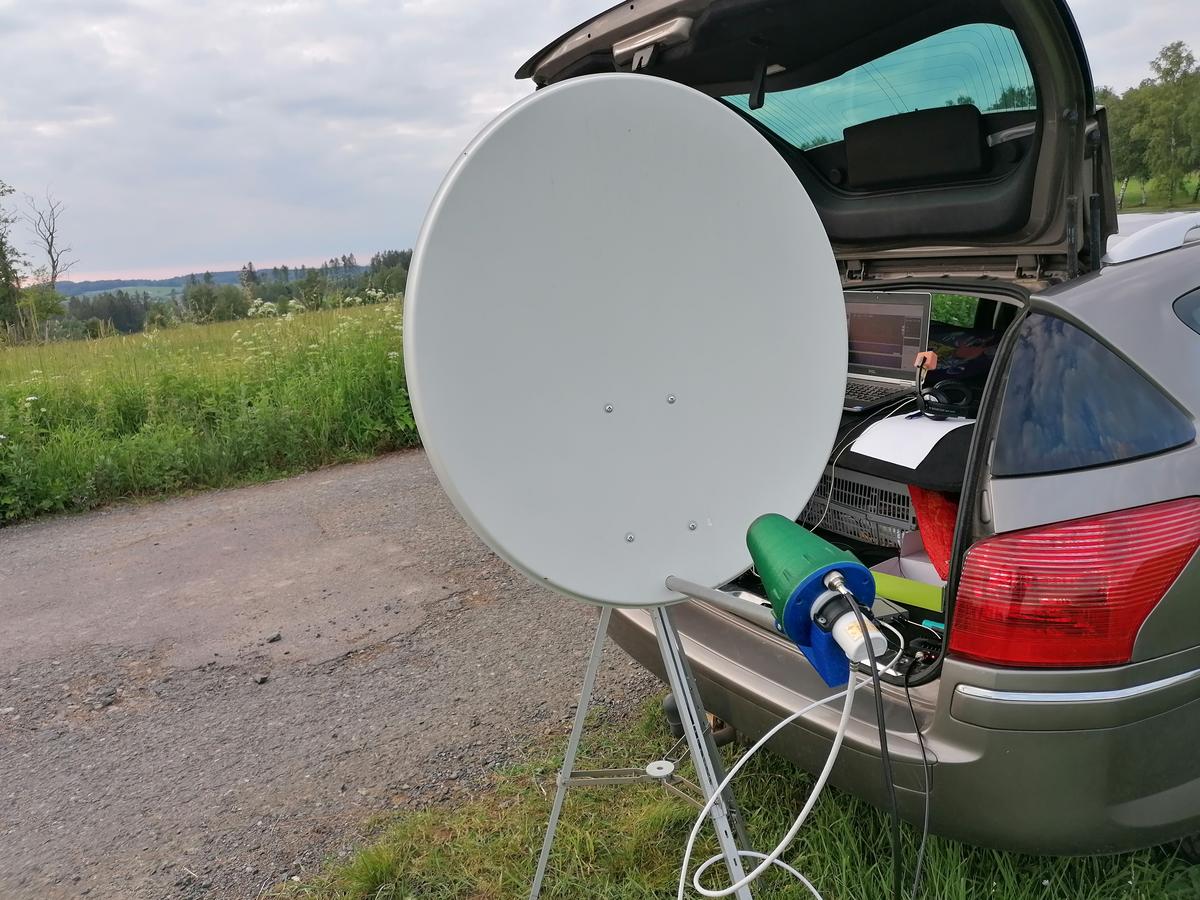
Satelitná komunikácia pre rádioamatérov prešla v posledných rokoch revolúciou. Zatiaľ čo v minulosti sme boli odkázaní na krátke prelety družíc na nízkych obežných dráhach (LEO), príchod QO-100 (Es’hail-2) at the position 25.5° east changed the rules of the game. Pavel Husák (OK1PHU) in his five-part series offers invaluable practical advice on how to build a functional device, avoiding unnecessary theorizing and getting straight to the core technical challenges.
In the article you will read
1. Antennas and feed systems: Gateway to space
Prvý diel seriálu sa venuje tomu najviditeľnejšiemu – anténam. Keďže QO-100 je geostacionárny satelit, najlogickejšou voľbou je offsetová parabola used for satellite TV reception. However, the challenge is that we have to handle two different frequencies: Uplink na 2,4 GHz (pásmo 13 cm) a Downlink na 10,5 GHz (pásmo 3 cm).
Battle of concepts: Patch vs. Helix
Pavel presents two basic types of dual feeds that allow the use of one parabola for both directions:
-
Patch Feed: It is a construction with an active element and a reflector for 2.4 GHz, through which a copper tube (waveguide) with a diameter of 22 mm passes. This tube leads the 10 GHz signal directly to the LNB. It is a mechanically compact solution that Pavel prefers for its precision.
-
Helix Feed (podľa DC8PAT): Here, a helix is used for uplink. It is easier to manufacture, but Pavel points out an important detail: the helix may shade reception (downlink) a bit more.
Critical factor: Polarization
In circular polarization, which QO-100 requires, an important phenomenon occurs. The uplink to the satellite requires right-handed circular polarization (RHCP). Since the signal reflects off the surface of the dish, its polarization rotates. Samotný ožarovač v ohnisku preto musí byť ľavotočivý (LHCP), aby výsledný vyžiarený signál bol pravotočivý. Na tento detail pri stavbe šroubovice alebo patchu nesmiete zabudnúť.
Tip od OK1PHU: To prevent rain from getting into the feed, Pavel uses a plastic flower pot. However, not every plastic is microwave transparent. A microwave test (to see if the dry pot heats up) is a simple and reliable way to avoid unnecessary signal attenuation.
2. LNB converters: The heart of reception
The second part dives into the inner workings of LNB (Low Noise Block) converters. For amateur purposes, inexpensive models like Zircon L101 ECO alebo Amico L208.
Why modify LNB?
Štandardné LNB používajú Kryštál 25 MHz, čo konvertuje signál z 10,5 GHz na mezifrekvenciu okolo 739 MHz. Pavel však vysvetľuje pokročilú modifikáciu: výmenu kryštálu za an external reference of 24 MHz.
-
This shifts the intermediate frequency to 1129 MHz.
-
Many LNBs have better gain in this range because they are originally designed for a wider TV band, and at 739 MHz, the signal may be attenuated by internal filters.
In the Amico L208 model (dual-output), Pavel uses one connector for the signal output and another for the external reference supply, which simplifies the cabling.
3. Stability and drift: The fight for every Hertz
V treťom diele Pavel otvára tému, ktorá trápi každého začiatočníka – frekvenčnú stabilitu. Ordinary LNBs are designed for broadband television, where a shift of a few tens of kHz does not matter. However, in narrowband operation (SSB, CW or FT8) je však takýto drift neprijateľný.
Temperature dependence
It is enough for the sun to shine on the LNB or for a cold wind to blow, and the frequency will start to 'drift'. Pavel shows that the drift can be in the order of tens of kHz, which will cause you to stop hearing the target station or your signal will become unreadable.
Solution options:
-
Softvérová kompenzácia: Program SDR Console has a unique feature. It can 'hang' on the central beacon of the satellite and recalibrate and correct the entire received spectrum in real-time according to its movement.
-
Hardvérová stabilizácia: Najlepším riešením je použitie GPSDO (GPS disciplined oscillator). An external reference ensures that the frequency does not move even by a hertz, which is essential especially for digital modes like FT8.
4. How to receive on your own (RX): Practical procedure
The fourth part is a 'cookbook' for assembling the receiving chain. If you do not want to immediately invest in expensive hardware, Pavel recommends starting with WebSDR (IS0GRB or BATC), where you can listen to the operation online.
Hardware setup
For your own reception you will need:
-
Parabolu s LNB (set to vertical polarization for the narrowband segment).
-
Napájaciu výhybku (Bias-T): LNB needs power for its operation (usually 12 V to 14 V).
-
SDR prijímač: RTL-SDR dongle, HackRF or ideally Adalm Pluto.
Golden rule: 30 dB attenuation
This is one of the most important pieces of advice in the entire series. The signal from the LNB is too strong for most SDR receivers and contains a lot of noise. Pavel recommends inserting an attenuator of about 30 dB between the splitter and SDR útlmový článok cca 30 dB. Výsledkom bude čistejší vodopád, lepší odstup signálu od šumu a ochrana vstupov vášho SDR pred zahltením.
Satellite searching
The QO-100 satellite is located at 25.5°E. If you do not have a professional measuring device, use an application on your mobile phone (e.g., through a camera with augmented reality). Look for the satellite under the name Badr alebo Es’hail-2. Akonáhle uvidíte na vodopáde typické čiary majákov, ste doma.
5. Finished devices and final thoughts
The last part of the series summarizes options for those who do not want to build everything 'on the knee'. Pavel mentions two main players in the market:
-
SP3OSJ (Poľsko): Produces compact modules that are mounted directly into the focus of the parabola. They contain an uplink exciter and a stabilized LNB.
-
DX Patrol: Offers comprehensive 'Ground Stations' that are very popular for their simplicity and integrated GPS stabilization.
The advantage of full duplex
Pavel zdôrazňuje, že najväčším komfortom pri prevádzke cez QO-100 je full-duplexná prevádzka. Thanks to it, you hear your own signal in real time as it returns from the satellite. This allows you not only immediate quality control of your own modulation but also precise 'sitting' on the frequency of the counterpart in the pile-up. Devices such as Adalm Pluto sú pre tento účel vďaka dvom nezávislým kanálom (RX a TX) priam stvorené.
Conclusion and evaluation
Pavel Husák's (OK1PHU) series is an excellent springboard for every radio amateur. It shows that entering the world of satellite communication does not have to cost thousands of euros. With a little patience, using an older parabola and modern SDR technologies, you will open a world where there is no interference from the city and where propagation conditions are stable 24 hours a day.
Whether you decide to make the patch antenna yourself according to the first part, or you opt for a ready-made solution from DX Patrol, the tips from this series will save you many hours of dead ends. QO-100 is a fascinating project that combines classic radio amateurism with the latest technologies – and thanks to Pavel, we have a map of how not to get lost in it.
Resources (links to videos):