
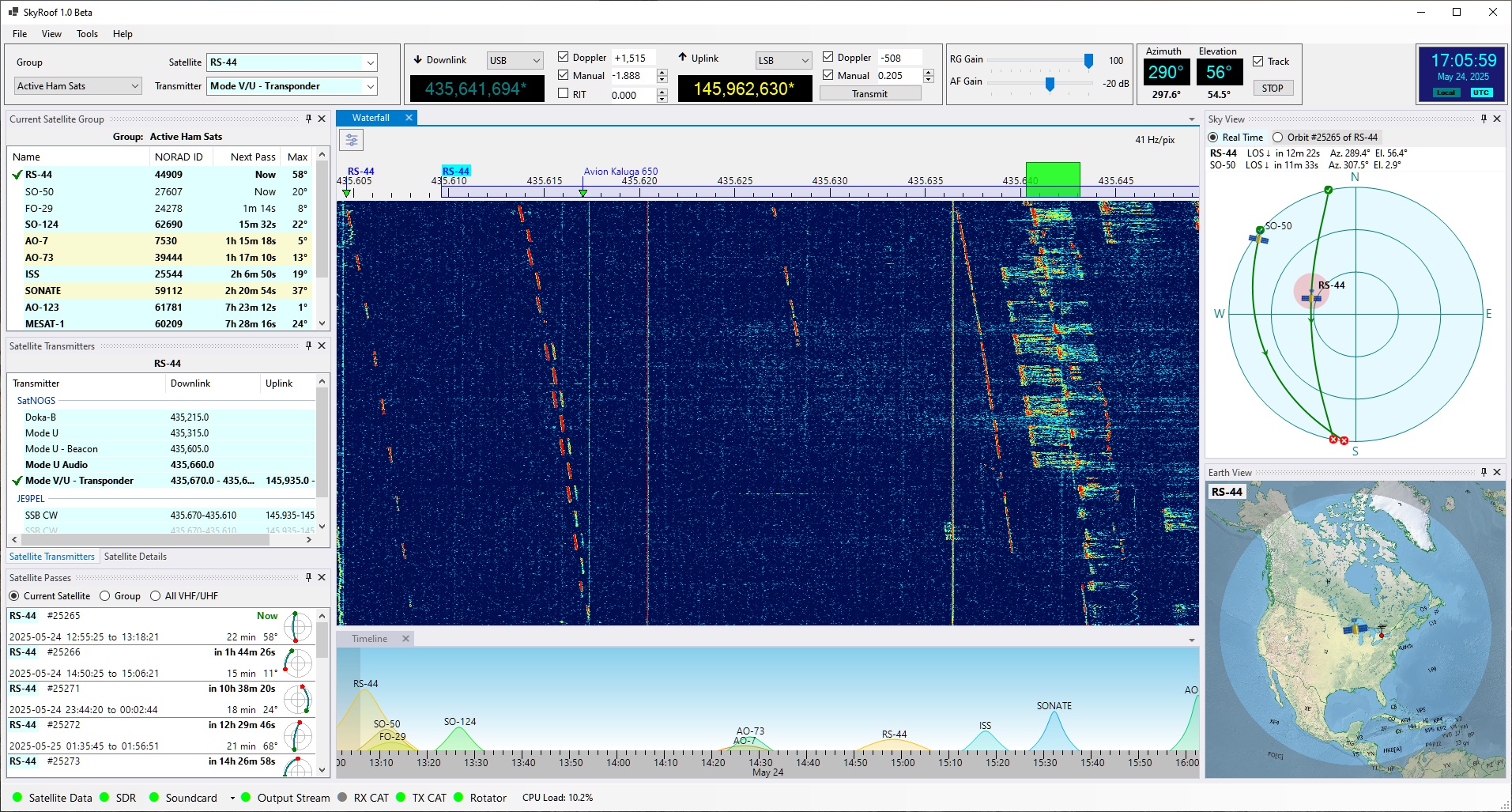
Working with amateur satellites traditionally means combining several programs. One ensures the calculation of the satellite position and flight prediction, the other controls SDR, iný rieši Dopplerov posun a pri príjme telemetrie, SSTV or digital data, more tools are being added. SkyRoof approaches this problem differently. It is an open-source 64-bit application for Windows that combines satellite tracking and SDR functions into one working environment.
You will read in the article
What is SkyRoof and to whom it can be useful
SkyRoof is intended for radio amateurs and users who are dedicated to receiving and operating via satellites. The program can also work without SDR or even without a connected radio, in which case the tracking and information functions remain available. However, when SDR is connected, the main options of the program are opened - waterfall, receiver, Doppler tracking, telemetry decoding and other functions related to the reception of satellite signals.
Upon first launch, SkyRoof requires a minimum six-character locator. Optionally, you can enter the radio amateur mark and the altitude. The program then downloads the satellite data and prepares the FFT configuration. Satellite data will be automatically updated later; the satellite list is downloaded every seven days and the TLE data every 24 hours.
Tracking and prediction of flights

The tracking part provides the current position of the selected satellite and a prediction of its future flybys. An important part is the satellite database, which can be searched by name, call sign or NORAD ID. Entries can be filtered by band, radio system type and service. For amateur radio operation, it is practical to create your own groups of satellites, for example by band or method of operation.
SkyRoof works with four ways of visualizing position and flyovers. Sky View shows the sky from the point of view of the ground station, Earth View the view of the Earth from the side of the satellite. Time Line places flyovers on a timeline and Pass List provides data on predicted flyovers. Individual panels can be docked, moved, grouped into cards or left floating as needed.
SDR waterfall for satellite bands
One of the most interesting features of SkyRoof is the direct connection of the tracking part with the SDR waterfall. The program uses the SoapySDR interface and has drivers for Airspy, AirspyHF+, SDRplay, RTL-SDR and HackRF in the installation. Other SDR devices are also supported if a compatible 64-bit SoapySDR module exists for them. The program also allows remote SDR access via SoapyRemote.

Waterfall is linked to a satellite database. The frequency scale can display satellite names and individual transponder segments, with their position adjusting to the Doppler shift. the operator does not only work with anonymous spectrum. In the image of the waterfall, it receives context - it knows which signal belongs to a specific satellite and where its Downlink or part of the transponder is located.
Doppler shift and automatic frequency tracking
In satellite operation, the Doppler shift is essential, especially for LEO satellites. SkyRoof calculates the Doppler correction using the SGP4 algorithm. The documentation states that, with accurate input data, the calculation accuracy typically reaches tens of hertz for LEO satellites. The correct station locator, exact system time, PPM SDR correction, current TLE and correction of the actual frequency of the satellite transmitter have a direct impact on the result.

PPM correction is therefore not just a calibration detail. The SDR frequency error is reflected in the tuning when working with satellites and can worsen the Doppler tracking result. SkyRoof allows the PPM value to be entered directly into the SDR configuration. In addition, TLE data is automatically updated every 24 hours, and can also be loaded manually from a file if necessary.
SSB, CW and FM receiver

SkyRoof includes an SDR receiver for SSB, CW and FM with RIT and Doppler tracking. Tuning is oriented visually - the frequency can be changed directly in the waterfall image using the mouse. Such a way of working is practical with a fast-moving satellite signal, because the operator can see both the immediate position of the signal and its movement over time.
Audio can be routed to a selected audio device. SkyRoof also supports the output of raw I/Q data or demodulated audio via Virtual Audio Cable or UDP. Streamed data is transmitted as 32-bit floating-point values at a sampling frequency of 48 kHz. This makes it possible to link SkyRoof with external applications where the built-in function of the program is not enough.
Telemetry directly from the SDR
For supported satellites, a separate program may not be required to decode the telemetry. The built-in Telemetry panel can process supported modulation and framing formats directly from the SDR. The documentation mentions, for example, FSK, GFSK, MSK, GMSK, AFSK, BPSK and DBPSK. The modulation, baud rate and framing parameters are obtained from the transmitter data in the database.
The advantage is that the decoder uses the same Doppler-corrected band as the receiver. Thus, the operator does not have to create a separate audio path between the receiver and the decoder. In case of incomplete or incorrect parameters, the parameters of the transmitter can be adjusted manually, and newer versions of SkyRoof also include the function of automatically searching for suitable parameters from the received signal itself.
SSTV, SSDV and Codec2
SkyRoof differentiates between analog SSTV and image data transmitted in the telemetry stream. SSTV has a built-in decoder designed for satellite Robot and PD modes. The mode is detected automatically from the VIS header and synchronization structure. The received image is gradually composed during the flight and automatically saved as a PNG when finished.

SSDV works differently. The image is divided into data fragments that are transmitted in a telemetry stream. SkyRoof can assemble these fragments and, if the SSDV format is supported, it can combine received parts from several flights. This is practical in case of incomplete reception, when part of the data is missing during one flight.
Another function is the decoding of short voice messages in the Codec2 format. These may be transmitted as part of telemetry frames. SkyRoof reconstructs them and enables playback directly in the Telemetry panel; received messages are saved as WAV.
FT4, logging and flight recording
SkyRoof contains its own FT4 Console designed for FT4 connections via satellites with a linear transponder. The FT4 reception can be used directly by an SDR or a sound card connected to the transceiver. When broadcasting, it is possible to set the output level, XIT and time watchdog. The program can also send UDP packets compatible with the WSJT-X format.
QSOs can be recorded directly in the program and exported in ADIF format. With the selected satellite transmitter, the band, mode and satellite are pre-filled according to the current selection. The program also includes a QSO Scheduler and the ability to record audio flyovers. This creates a usable path from reception itself through decoding to archiving the result.
CAT, rotator and transverter

SkyRoof can control an external transceiver via CAT. For this purpose, it uses skycatd.exe from SkyCAT or rigctld.exe from Hamlib. CAT communication takes place via TCP, so the controlled radio can also be on another computer in the network. The configuration allows for separate RX and TX CAT connections so that the SDR can serve as a receiver and the transceiver as a transmitter.
For the antenna system, rotator control can be used via rotctld.exe from HamLib. Azimuth and elevation ranges, corrections, rotation step and parking position can be set. SkyRoof can thus supplement tracking with automatic antenna direction according to the calculated position of the satellite.
The support for transverters is also interesting. If the SDR or transceiver operates on an IF frequency, SkyRoof can internally convert the RF frequency of the satellite to the appropriate IF. The actual RF frequency remains displayed on the screen. The function is usable, for example, with an SDR operating at 28–30 MHz and a transverter for 2 m or 70 cm.
One workplace instead of a chain of separate programs
The biggest interest SkyRoof therefore, it is not one particular function, but the way in which the individual parts are connected. Tracking determines satellite position and time of flight, TLE provides orbital data, SDR provides spectrum and I/Q data, Doppler tracking adjusts frequency, and built-in decoders can proceed directly from the received signal to telemetry, image or voice message. CAT control, rotator and transverter can be connected at the same time.
For a radio amateur who wants to not only monitor but also technically analyze satellite traffic, this way of working is interesting precisely because the individual functions are not isolated. SkyRoof creates a common environment for tracking, SDR reception, Doppler correction, digital decoding, FT4 and station management. In the case of a satellite station, it can thus represent an interesting alternative to the combination of several separate applications.