
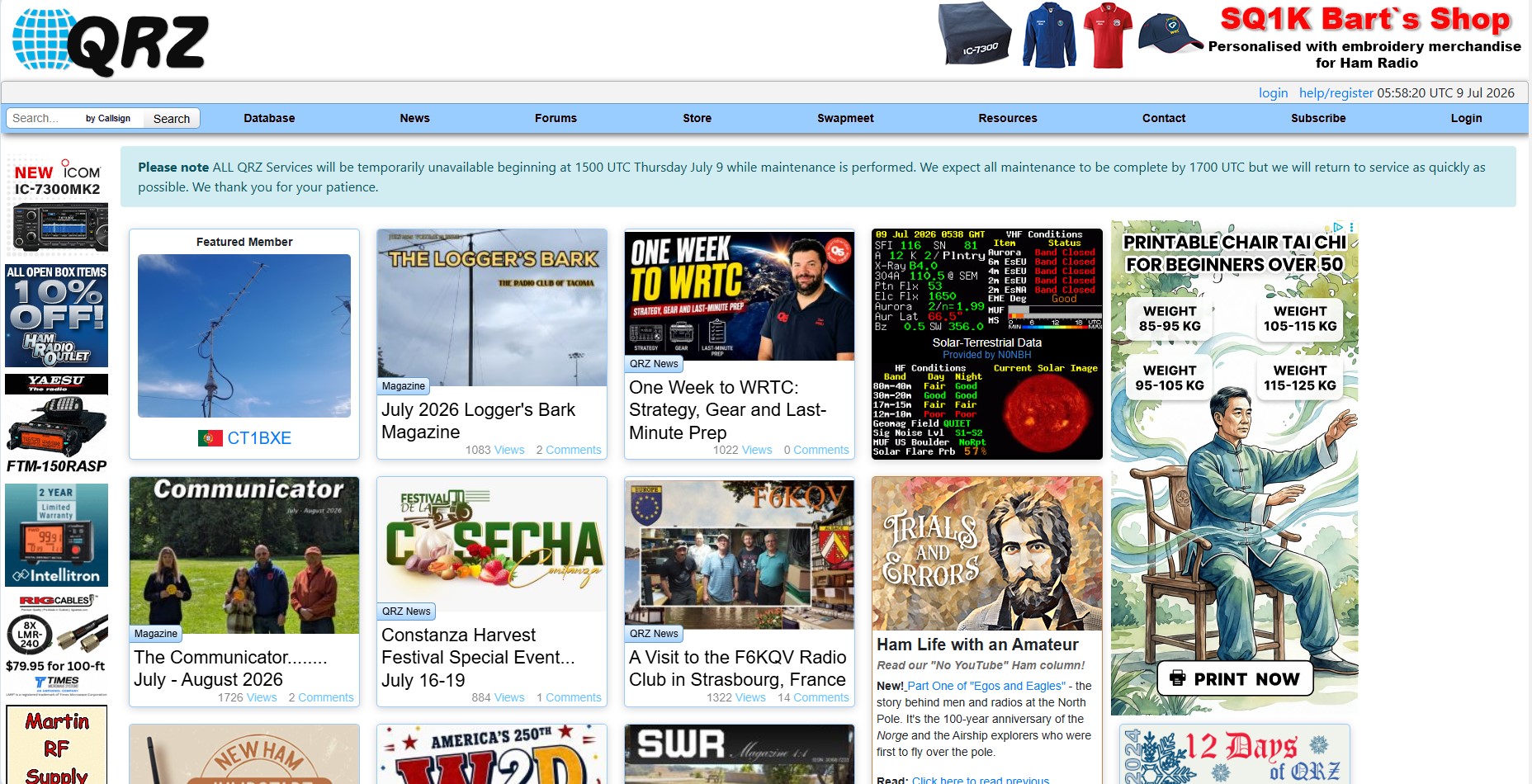
Medzi internetovými službami, ktoré sa stali prirodzenou súčasťou každodenného života rádioamatérov, patrí QRZ.com is one of the most well-known. Most operators today use it to verify call signs, obtain data about the opposing station, or keep an electronic log of calls. However, few people realize that the history of this service dates back to before the World Wide Web and that it was not originally a website at all.
QRZ.com was created as a practical solution for distributing a database of American amateur radio licenses. Gradually, the simple project became one of the oldest still functioning websites dedicated to amateur radio. Its development also well illustrates the transformation of the amateur radio community from the era of paper callbooks through optical media to today's online databases with instant updates.
In the article you will read
How was QRZ.com created?
Zakladateľom projektu je americký rádioamatér a softvérový inžinier Fred Lloyd, AA7BQ. História sa začína v roku 1992, keď sa zapojil do projektu nazvaného callsign Project. Its goal was to make the FCC's license database available to other radio amateurs. At the time, there was no publicly available online call sign search engine, and obtaining the database was technically and financially challenging.
The data was distributed on large nine-track magnetic tapes used in mainframe computers. The FCC tapes themselves cost more than 0, so the costs were split among those interested. Anyone who wanted to obtain the database sent a blank tape, a return envelope, and a contribution to cover the costs. Fred Lloyd then made individual copies by hand. This method of distribution was still manageable for a few dozen interested parties, but further development required a different solution.

It was around this time that the first CD-ROM drives were starting to appear. Although it was very expensive to produce a custom-pressed disc, Fred Lloyd came up with a simple idea – to find an existing label that had enough free space on the CD he was preparing. He approached Walnut Creek CD-ROM, which suggested creating a separate drive instead of renting a few dozen megabytes. rádioamatérske CD.
During the preparation of the new product, the name QRZ was also created. Lloyd was looking for a short designation that would be immediately recognizable to radio amateurs. The choice fell on the Q-code QRZ?, meaning in telegraph traffic the question "Who is calling me?". The name accurately described the purpose of the prepared call sign database and has been retained to this day.
The database itself only took up about 50 MB in compressed form. Most of the 650 MB capacity of the CD remained unused. Therefore, dozens of then-shareware programs for radio amateurs, archives of discussion groups from internetu a ďalšie pomocné nástroje. Súčasťou projektu sa stal aj vyhľadávací program pre operačný systém DOS, ktorý umožňoval rýchle vyhľadávanie podľa volacej značky.
The CD-ROM era – the digital callbook of its time
The first edition of the QRZ CD-ROM went on sale for .95. Fred Lloyd initially assumed that it would be a niche product aimed at a few dozen Internet users. However, the actual interest greatly exceeded expectations.
The first run of a thousand copies sold out quickly, and further reprints followed. More than five thousand discs were sold within the first few months, with orders coming in from all over the world. QRZ became one of the first commercially successful software products designed exclusively for radio amateurs.
In the following years, new editions of the database followed. Along with updated data, new search programs were added, and after the advent of Windows, a native 32-bit version of the application was created for Windows 95. From the perspective of today's user, this may be a common functionality, but in the early nineties, instant search for a call sign without browsing through paper callbooks significantly simplified the operator's work.
By the fall of 2009, a total of 33 CD-ROM releases had been released, and the total number of discs sold had exceeded a quarter of a million. The QRZ CD-ROM was used on all seven continents, including Antarctica. Interestingly, it was also used on board the Space Shuttle, the Mir orbital station, and later the International Space Station.
YouTube video – interview with the founder of QRZ
To mark the anniversary of the project, an extensive interview with Fred Lloyd AA7BQ was produced, describing the creation of the database, the transition from CD-ROM to the Internet, and the further development of the service. This is one of the most valuable historical materials available directly from the QRZ environment.
The evolution of QRZ.com in the internet age
While CD-ROM sales continued, the Internet was undergoing an extremely dynamic development. On October 28, 1993, it was launched QRZ.com website, which allowed online search of call signs directly through a web browser. At that time, search engines in their current form, social networks, and most of the well-known Internet services did not yet exist. QRZ was among the very first thousands of websites in the world and was created before Google or Amazon.

The biggest advantage of the online solution was the immediate updating of data. While the CD-ROM user had to wait for the release of a new version of the database, the web server could work with continuously updated information. This was extremely important, especially after the liberalization of call sign allocation in the USA and the rapidly increasing number of new licenses.
Počas druhej polovice deväťdesiatych rokov začal význam optických médií postupne klesať. Internetové As connectivity expanded to a larger number of users, and an online database became a more natural solution, QRZ gradually moved its main services to the web. The CD-ROM remained an ancillary product for several years, but its importance steadily declined until it was finally discontinued. At the same time, new services began to appear, financed by advertising and later by subscriptions for advanced features.
An important feature of QRZ was that it did not remain just a simple electronic callbook. The database gradually expanded to include personal pages of radio amateurs, photographs of workplaces, information about QSL managers and other data that helped in establishing contacts and in verifying the identities of opposing stations. It was this gradual transformation from a database to a community platform that paved the way for the services that radio amateurs take for granted today.
Who is behind QRZ.com?

The creation and further development of the portal was led by Fred Lloyd, AA7BQ, who remains one of the most important figures in the project. As a software developer and active radio amateur, he was able to combine the practical needs of the community with modern information technologies. It was his decision to make the call sign database available to the general public that laid the foundation for the service, which is now used by hundreds of thousands of radio amateurs.
As the scope of services has grown, the original personal project has become a professionally operated portal. Development is provided by a team of programmers, administrators and database managers who take care of the continuous operation of servers, database updates and the development of new features. QRZ also operates its own discussion forum, user support system and documentation for developers who integrate their applications with the QRZ database via an XML interface.
Unlike many commercial Internet services, QRZ is closely connected to the amateur radio community. Most of the new features are created in response to the needs of operators in daily operation, contesting, DX operation or electronic confirmation of contacts.
What does QRZ.com include?
Although QRZ.com is best known as a call sign database, its capabilities are now much broader. The basis remains an international call sign search engine, which collects data from national databases, public registers and information added by users themselves. For each station, it is possible to view basic identification data, location, Maidenhead locator, photos of the workplace, antenna systems, QSL information or a brief personal presentation of the operator.
Práve možnosť vytvoriť vlastnú stránku patrí medzi charakteristické vlastnosti QRZ. Mnohí rádioamatéri Here they publish photos of antennas, descriptions of the equipment used, information about QSL managers, diploma programs, and current activities. For DX expeditions or special call signs, the QRZ page is often the main source of operational information.
Veľký význam má integrovaný elektronický denník spojení QRZ logbook. Umožňuje import a export záznamov vo formáte ADIF, automatické párovanie spojení medzi oboma účastníkmi QSO and subsequent electronic confirmation of the connection. Confirmation occurs only if both stations independently record the same connection data. The system compares in particular the call signs, date and čas v UTC, pásmo a prevádzkový mód.
The advantage of the cloud solution is the continuous evaluation of new records. If the other station records its QSO after several days or weeks, the system automatically performs a new comparison and creates a confirmation without further user intervention. This principle is similar to other electronic contact confirmation systems, with QRZ using its own record verification mechanism.
The electronic logbook is followed by the QRZ Awards diploma system. It automatically evaluates the fulfillment of individual conditions from confirmed connections and the user can directly request the issuance of the relevant diploma via the portal. The advantage is that there is no need to manually create a list of confirmed connections or perform their additional verification within the QRZ system.
An important part of the portal is also the XML interface. This is a programming interface that allows logging programs to communicate directly with QRZ servers. After successful user authentication, the application can automatically search for data about counterparties, record connections in an online log, or synchronize data without operator intervention. The XML interface supports a number of well-known logging programs and is also publicly documented for in-house software development.
For contest operators and fans of digital modes, automatic synchronization represents a significant time saver. Modern logging programs can immediately send the record to the QRZ Logbook after the QSO, while at the same time they can provide synchronization with other services according to the user's settings. This way of working minimizes manual intervention and reduces the risk of errors when importing logs later.
QRZ is not just a database and a logbook. The portal also includes an extensive discussion forum with technical topics, a section for amateur radio news, equipment advertising, an events calendar, a diploma database, knowledge tests for future radio amateurs in the United States, and a number of auxiliary tools for everyday operation. The forum has long been one of the largest discussion platforms dedicated to amateur radio.
The Importance of QRZ.com for Today's Radio Amateurs
In its more than thirty years of existence, QRZ.com has become one of the pillars of the amateur radio Internet infrastructure. Many logging programs use its database as a primary source of data on opposing stations, and many operators consider the QRZ site their electronic calling card.
Z technického hľadiska je zaujímavé sledovať, ako sa pôvodný projekt založený na distribúcii databázy na CD-ROM dokázal prispôsobiť nástupu internetu, cloud services and logging automation. He retained his original idea – to answer the question hidden in the famous Q-code as simply as possible. QRZ?, teda „Kto ma volá?“.
Although other databases, electronic logs and contact confirmation systems exist today, QRZ.com remains one of the most frequently visited portals in the amateur radio community. Thanks to the combination of a callsign database, operator personal pages, electronic logbook, XML interface and community services, it represents a universal tool that finds application in regular contacts, DX operations, contesting and construction practice.
Conclusion
The story of QRZ.com is also the story of the development of information technology in amateur radio. From magnetic tape and CD-ROM media to the first websites to today's cloud databases and automatic log synchronization, it shows how the technical community can adapt to new possibilities without losing its original philosophy. For most radio amateurs today, QRZ is the first place they look after making a new connection, and after more than three decades of operation, it is one of the most significant Internet projects in the history of amateur radio.