
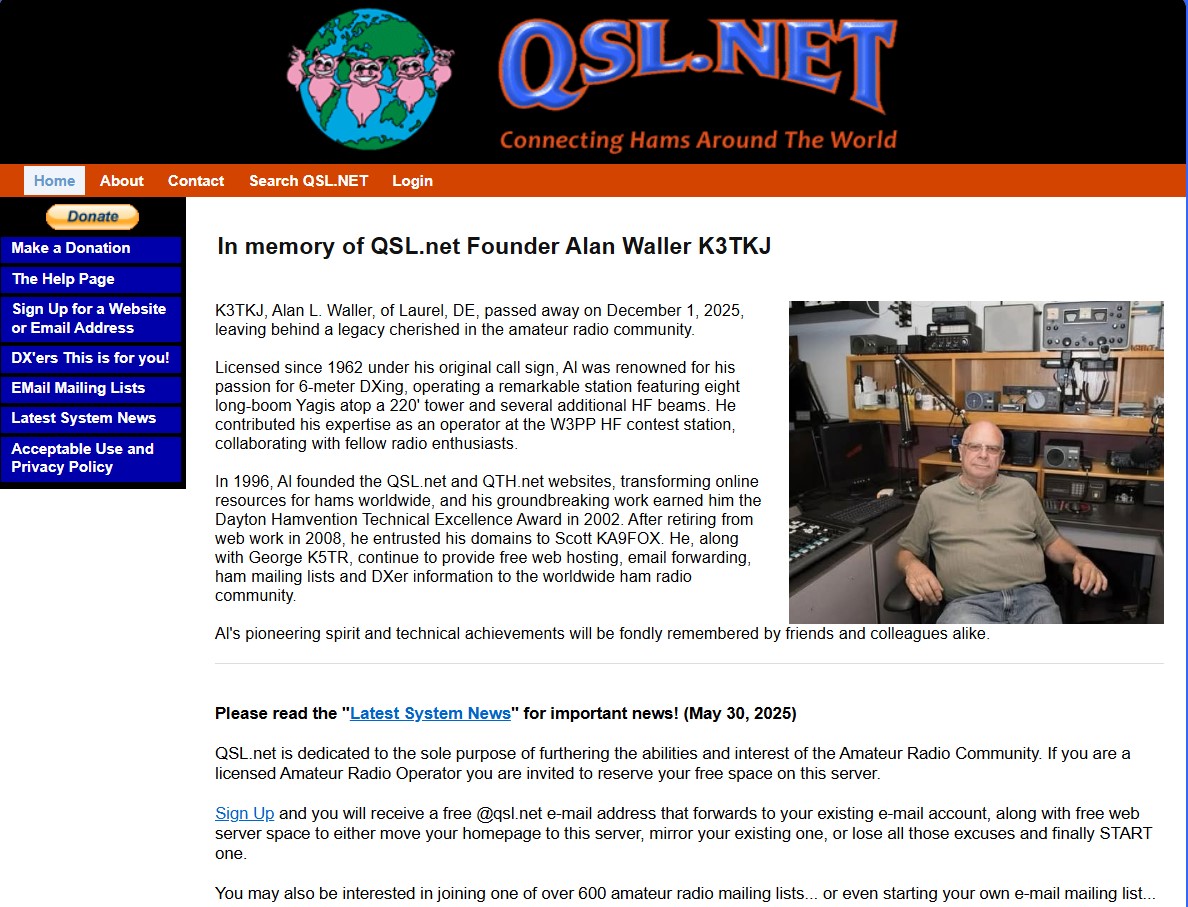
Anyone who has ever looked at the profile of an opposition station or searched for information about a DX expedition has almost certainly come across an address in the form of www.QSL.net/značka. For many a radio amateur, it was the first own website. It is still an easy way for clubs and expeditions to have a permanent address on the Internet without paying for hosting. However, few people think about who is behind this service and how it is possible that it has been operating without fees for three decades.
QSL.net is not a commercial provider or project of a large organization. It is a community service that has been carried on the shoulders of volunteers from the beginning and that is financed by radio amateurs themselves. At the same time, her story well illustrates how the amateur radio community has gradually moved to the Internet since the mid-nineties.
You will read in the article
How did QSL.net come about?

The founder of the portal is American radio amateur Al Waller, K3TKJ. He founded QSL.net in 1996, at a time when owning a website was more of a technical curiosity than a matter of course for the average person. The idea was simple: to provide radio amateurs and their organizations with free space and Internet services to share their stations, projects, constructions and information with others.
Al Waller ran the service continuously for twelve years. He retired from the web in 2008 and entrusted his domains to Scott Neader, KA9FOX. Thus, free web hosting, e-mail forwarding, e-mail conferences and information services for DXers continued without interruption.
K3TKJ – radio amateur even outside the web

Al Waller wasn't just a server administrator. It was licensed in 1962 and broadcast under its original call sign. He was known among radio amateurs as an active DX-er on the 6 m band. His station had eight long-boom yagi antennas on a 220-foot (about 67 m) tower. He also applied his experience as an operator at the KV contest station W3PP.
He received the Dayton Hamvention Technical Excellence Award in 2002 for his pioneering work. Al Waller of Laurel, Delaware passed away on December 1, 2025. Today, he has a memorial section on QSL.net commemorating his contributions to the ham radio internet.
New management and transfer to the data center
After the departure of the founder, it was necessary to find new administrators. In early January 2009, two American radio amateurs took over the operation: Scott Neader, KA9FOX, and George Fremin, K5TR. They decided to keep the service in its original spirit, i.e. free for radio amateurs and their organizations.
Part of the change was the modernization of the infrastructure. All QSL.net services have moved to new hardware located in a large data center in the US. For a service that today hosts tens of thousands of sites and processes mail for even more addresses, it was a necessary step.
Another noticeable change was the switch to an encrypted connection. As of September 10, 2018, websites on QSL.net use the HTTPS protocol, and original HTTP addresses are automatically redirected. At the time, operators warned that older sites with insecure content may report "mixed content" errors in the browser. They recommended whynopadlock.com as a solution.
What does QSL.net provide?
According to the data of the operators, today QSL.net provides:
- more than 39,000 websites,
- more than 58,000 email redirects,
- more than 600 e-mail conferences,
- computing power and hardware for DX Services from N6RT, including log searches of over 20 million QSOs.
When registering, a new user chooses from three types of services. The first is the email forwarding itself. An address on the qsl.net domain will be created, which automatically forwards mail to your existing mailbox. However, mail from QSL.net cannot be downloaded via POP3, the service only forwards it.
The second option is a website along with email forwarding. The page will receive an address in the form of www.qsl.net/brand, the club abbreviation is used for clubs. The user receives a name and password for uploading HTML files. E-mail forwarding is automatically turned on for the web account and can be turned off.
The third service is the Mailman e-mail conference, that is, a discussion group with its own name. When setting it up, you have to count on an administrator who takes care of the day-to-day operation and support of the members.
Static website via FTP

Web hosting at QSL.net is deliberately simple. Pages are uploaded exclusively via FTP and hosted by ftp.qsl.net. Scripting languages such as PHP and databases are not available and access to CGI is no longer provided due to high server load. For those who need a dynamic website, the operators recommend paid hosting at QTH.com.
From the FAQ, some practical advice is worth paying attention to, which will save a lot of searching:
- the main page must be named index.html,
- the server runs on Unix, which is case-sensitive, so it's a good idea to use only lowercase letters in file names and links,
- the login name and password must also be entered in the correct form, name in lowercase letters,
- the remote directory is left empty in the FTP client,
- there are no quotas for websites as long as the page contains meaningful radio amateur content.
There is also an older detailed tutorial on uploading via FTP on the QSL.net site. It walks you through installing WS_FTP for Windows, creating a session profile, and uploading a page step by step. For other operating systems, it refers to alternative FTP clients.
Self-Help system
The user manages the regular account management by himself through the Self-Help system, to which he logs in with his FTP data. In it, he can change the password, request its recovery, change the forwarding destination address, disable email forwarding or delete the website. If something cannot be resolved this way, the contact form will serve to open a support request.
An interesting detail is the change in the call sign. There is no standard procedure for renaming an account. Whoever receives a new brand registers new services and cancels the old ones.
Who can use the service?
QSL.net is intended exclusively for radio amateurs. The service can be requested by the holder of a valid radio amateur license, for himself or for the club, if he is authorized to act on his behalf. The registration form requires a name, club callsign or abbreviation, QTH and email. An address on the qsl.net domain must not be entered in the e-mail field. The verification question, as usual, refers to the number with which radio amateurs greet each other.
The terms are clear and reasonable. The site must serve radio amateur activities and must not be used, for example, to back up personal files. After the account is assigned, the user has sixty days to create a radio amateur site or request an extension. Abandoned sites and FTP accounts can be removed. Each user is responsible for regularly backing up their site.
QSL.net is not universal free hosting. It's a space for amateur radio content and that's why it can work without fees.
Background for DXers: dx.qsl.net
In addition to individual websites, QSL.net also provides the infrastructure for the DX services it manages N6RT. Portál dx.qsl.net offers a search engine that searches many DX logos. According to the operators of QSL.net, it is a logo search with more than 20 million connections.
The portal also features an extensive collection of dynamic propagation information, including an overview of tropospheric ducting reports. Included is the #CQDX chat, which shows real-time spots from the DX Summit. For the DXer who wants to verify that he is in the expedition log or monitor band conditions, this is a useful addition to the regular tools.
E-mail conferences at mailman.qth.net
In addition to web forums and social networks, e-mail conferences still have their place in the radio amateur world. The discussion takes place in them directly via e-mail, and the Mailman software takes care of managing members. QSL.net runs more than 600 such conferences and their management is provided by the mailman.qth.net server.
Each conference has its own administrator. Therefore, if you are not the owner of the conference and need to unsubscribe or resolve a delivery problem, the operators expressly recommend that you contact the administrator of the conference in question, not the QSL.net team. A contribution of per year per group is recommended when setting up a new conference.
How is QSL.net funded?
All services are free for radio amateurs and their organizations. Users do not pay any mandatory fees. operation is fully dependent on voluntary contributions from users and supporters.
The costs are not negligible. In the call dated May 30, 2025, the operators explain that approximately two years have passed since the last request for support. Meanwhile, the consumption of transmission bandwidth, computing power and disk space is growing. Major expenses include:
- operation in the data center,
- hardware,
- a subscription to a professional spam filter that redirect users receive for free,
- hours of work on support and maintenance of Self-Help and Ticket systems.
Contributions can be sent via PayPal, credit card, check or money order. The call was signed by Scott, KA9FOX, and George, K5TR, who still run the service today.
Why donate?
If you have a QSL.net page, an email address, or are a member of one of the conferences, you are using an infrastructure that someone pays for and maintains. Even a small contribution helps keep the service free for other radio amateurs, including beginners just building their first site.
Conclusion
QSL.net is a silent pillar of the radio amateur Internet. It was created in 1996 on the initiative of one radio amateur, and after the departure of the founder, it was taken over by two other enthusiasts. Thirty years after its founding, it hosts tens of thousands of sites, forwards mail for even more addresses, and provides the background for hundreds of e-mail conferences and searches in DX logos.
It's not state-of-the-art hosting, and it doesn't even try to be. Its strength lies in its simplicity, long tradition and the fact that it is intended exclusively for radio amateurs. If you are looking for a permanent address for a page about your station, antennas or club, registration on QSL.net is still one of the easiest options. You can find more about the history and operation of the service on the website About QSL.net.