
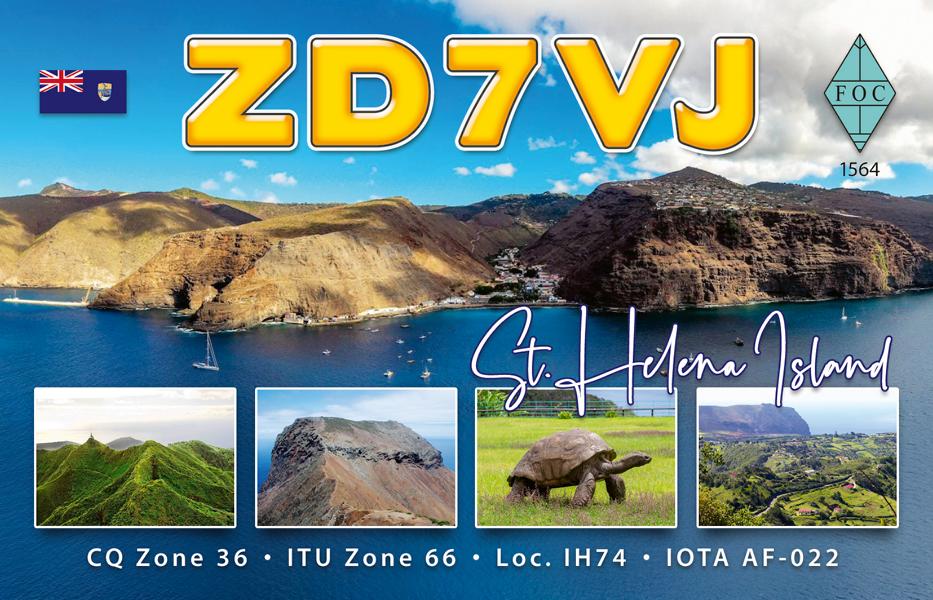
Some amateur radio connections are interesting because of the distance reached, others because of the propagation conditions, and still others because of the location of the opposite station. ZD7VJ belongs to the last group. The call sign indicates amateur radio activity from the island of St. Helena, which lies far from the main continental routes in the South Atlantic. It represents a valuable destination for DX stations and an interesting opportunity for listeners to pick up a signal from one of the world's most isolated inhabited islands.
ZD7VJ používa Andy Chadwick, známy aj pod značkami 5Z4VJ, G3AB a ex-G4ZVJ. Podľa údajov na QRZ sa jeho aktivita sústreďuje predovšetkým na telegrafnú prevádzku CW. Stanica je vedená v lokátore IH74, v IOTA skupine AF-022, CQ zóne 36 a ITU zóne 66. QSL manažment zabezpečuje M0URX, k dispozícii je OQRS a denníky sa nahrávajú do LoTW a Club Log.
You will read in the article
Saint Helena - an island in the middle of the ocean
Saint Helena is a volcanic island in the South Atlantic with an area of approximately 121 km². The nearest land is about 1,950 kilometers away. The capital is Jamestown, the largest settlement is Half Tree Hollow, and the official language is English. The island uses its own currency - the Saint Helena pound (SHP).
Its location explains why St. Helena appears so often in amateur DX logs. It's not a place one happens to go on a short trip. For many years the island was dependent on sea transport and the arrival of a mail ship was an important event. RMS St Helena provided connections with the world as a rule once every three weeks, mainly from Cape Town. The voyage lasted about five days, and the ship often continued to Ascension Island.
A fundamental change occurred in 2017, when the airport opened. Regular air connections are provided by Airlink with Embraer E190 aircraft. The route runs from Johannesburg, usually with a stopover in Walvis Bay, Namibia. Even air transport does not mean that the island is easily accessible in all circumstances.
An airport that also checks experienced pilots
St. Helena Airport is one of the most interesting technical buildings on the island. The runway is approximately 1,950 meters long and is located on an elevated platform approximately 300 meters above sea level. The surroundings are made up of steep cliffs and complicated terrain, which creates challenging conditions when approaching.
The biggest problem is the strong side wind and its sudden changes, known as wind shear. It was these conditions that complicated the test operation of the airport and led to a change in the originally planned type of aircraft. In addition, there are no aviation fuel tanks on the island. The aircraft must therefore have sufficient reserve for the return flight and the pilot can decide to return to South Africa if the weather worsens.
Specially trained pilots are designated for these flights, who undergo special training and repeated checks. If the conditions do not suit them, they simply do not make the landing. Passengers can thus stay on the island for another week, or even longer. For a radio amateur planning a DX activation, this is not an insignificant detail - the return date may not always be completely under control.
Napoleon, postage stamps and island history
Saint Helena is also known for its history. The most prominent figure associated with the island is Napoleon Bonaparte. After the defeat and deportation, he spent the last years of his life here. His name still attracts visitors and the island has become an important place of historical memory.
Collectors are also interested in Saint Helena postage stamps, which have a special status among philatelists. The island has preserved its own currency and many historical peculiarities. This is also why Saint Helena is interesting not only from the point of view of radio amateurs, but also travelers and collectors.
Radio amateur activity of ZD7VJ and competition achievements
In June 2024, Andy spent about a week on the island and made about 4,000 CW connections. A significant event was November 2024, when he participated in the CQ WW CW Contest in the SOSB 10 m category. According to the information from his QRZ profile, he managed to achieve a new world record in the 10 m range in this category.
Another activity followed in November 2025, including participation in the CQ WW CW contest in the SOSB 15 m HP category. During this stay, other operators also broadcast from the island: Marty N6VI as ZD7VI and Fred G4BWP as ZD7WP. During the November activity in 2024, Oliver W6NV, using the ZD7W tag and competing in the SOSB 20m category, also appeared on CQ WW CW.
QRZ also recalls earlier voyages on the ship RMS St Helena. In January 1990 there was a two-day visit with approximately 1,200 CW connections and in March-April 1996 a two-week DX expedition with over 12,000 connections. These older activities are listed in the profile as ZD8, not ZD7VJ, but document the longer amateur radio history associated with the island and ship.
QRP connection on 10 meters during CQ WW CW 2024
The first video captures the interesting connection of station ZD7VJ with operator BA6QH (Ruan) on 23 November 2024. It is a telegraphic QRP connection on the 10m band during CQ WW CW. Even with limited power, a connection to such a remote location can be achieved when suitable propagation conditions and good operator work meet.
ZD7VJ on 15 meters with Kenwood TS-870
The second video documents the reception of station ZD7VJ in the 15 m band. The recording is from November 30, 2025 at 20:20 UTC and a Kenwood TS-870 is used as the receiving transceiver. For the listener, it is a practical demonstration of how the signal from the island of St. Helena appears in the short wave band and what the telegraph operation of the station sounds like in real conditions.
Attempt to connect on 20 meters and greyline
The third video goes back to June 2024 and the 20m band, or about 14 MHz. Captures an attempt to call station ZD7VJ in CW mode.
The recording also shows the practical side of amateur radio operation. Not every call has to end in a successful QSO. Even testing the connection, monitoring the conditions and working with the antenna system belong to DX operation.
A DXCC destination with its own story
ZD7VJ is a fine example of how the amateur DX connection is not just a log entry. Behind the call sign is a specific location, its history, difficult accessibility and conditions that also affect the amateur radio activity itself. Saint Helena is a remote, traffic-complicated and interesting location from the point of view of distribution.
For DXCC hunters, ZD7VJ is a valuable target, for telegraphers an opportunity for an interesting QSO, and for other radio amateurs a reminder that even a signal from a small station in the middle of the Atlantic can travel thousands of miles. And that is the magic of short waves.
Frequently asked questions
Where is station ZD7VJ located?
ZD7VJ broadcasts from the island of Saint Helena in the South Atlantic. The station belongs to IOTA AF-022 and uses the locator IH74.
Who is the operator of ZD7VJ?
The operator is Andy Chadwick, also known as 5Z4VJ, G3AB and ex-G4ZVJ. His activity is primarily focused on CW telegraphy.
How can a QSL be obtained for a call to ZD7VJ?
QSL management is provided by M0URX. OQRS is available and logs are uploaded to LoTW and Club Log.
What was the significance of CQ WW CW Contest 2024 for ZD7VJ?
The station participated in the SOSB 10 m category. According to the profile on QRZ, she achieved a new world record in the 10 m range.
Why is transport to Saint Helena so complicated?
The airport has a runway approximately 1,950 meters long on an elevated platform surrounded by cliffs. Strong crosswinds and wind shear may result in the flight being delayed or the aircraft returning to South Africa.