
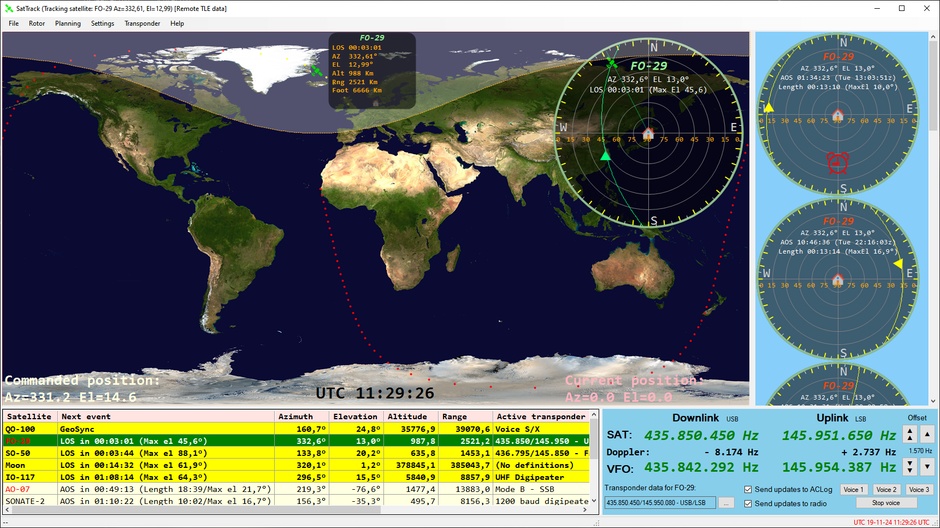
Working with amateur radio satellites requires precise tracking of their position, calculation of azimuth and elevation, and for transponders, ongoing monitoring of operating frequencies. SatTrack is a program by Danish amateur radio operator Carsten Groen, OZ9AAR, which was originally created as his own tool for satellite operation. The author states that after returning to amateur radio in 2022, he tried several existing applications, but none exactly met his requirements. Therefore, he created his own tracker.
In the article, you will read
SatTrack by OZ9AAR
SatTrack was gradually expanded during further development with features that the author needed for practical work through satellites. Later, it was also used by other amateur radio operators, and in 2024 the first version of the program was released. The author openly warns that SatTrack was not created as a universal tracker for any combination of radio station and rotor. Support for specific hardware is intentionally limited.
The program runs on Windows and does not require a traditional installation. It consists of a single executable file that can be placed in its own directory. Settings are saved in a configuration file in the same directory. The current version listed on the author's page is 1.0.1.17 from August 8, 2026.
What SatTrack can do
The core of the program is real-time tracking of satellites and displaying calculated data. SatTrack can also track the Moon and the Sun, display the satellite's footprint on the map, and organize a list of selected satellites by their next ascent. For position calculation, it uses TLE/OMM data, which can be updated from the internet at set intervals or loaded from a local file.
The program also includes voice alerts for upcoming passes and notifications when the satellite rises. For the selected satellite, it can retrieve the current status from AMSAT and display it in a readable form. Data about the current satellite, such as name and frequency, can be sent to the logging program ACLog.
An interesting feature is the ability to change the tracking time. The user can set a specific date and time, speed up or pause the progress. It is not just about displaying the current position, but also a tool suitable for preparing and testing satellite operations.
Control of IC-9700 and rotor
One of the practical features of SatTrack is the connection of tracking with the radio station and antenna rotor. The program is primarily designed to control the Icom IC-9700 according to the defined transponder of the tracked satellite. The author also mentions support for some other Icom radios, such as the IC-910, IC-821H, and IC-706, recommending that compatibility be verified in practice.
On the rotor side, SatTrack supports Yaesu GS-232B, PstRotator and its own URC - Ultimate Rotor Controller. The antenna can be automatically rotated to follow the satellite based on the calculated position. A 180° elevation flip is also supported for rotors with a mechanical stop to the north. Newer versions also include a simulation mode, so the movement of the antenna can be tested before actual operation without physically rotating it.
Transponders and working with satellites - example RS-44
For satellite operation, a database of transponders is important. In SatTrack, it is possible to define one or more transponders for a specific satellite. These definitions can be exported and imported; the program can also read an SQF file from SatPC32.
When working with a satellite such as RS-44, the user works with the definition of its transponder, and SatTrack controls the frequency of the radio station accordingly. An advantage is also the ability to make a small manual correction of the uplink frequency if it is necessary to get one's own signal exactly to the desired place in the transponder. The transponder definition window is, according to the author, one of the parts of the program that requires a bit of experimentation.
Future Pass Planner and flight simulation

Future Pass Planner is used for planning future passes and alarms. This allows the user to prepare specific satellites and their passes before actual operation. This also relates to the program's simulation mode. It is possible to set the date and time, speed up the simulation process, or pause it.
In newer versions, a separate rotor simulation has also been added. This is particularly practical during system configuration, as it allows observing the behavior of tracking and planning antenna movement without the actual rotor moving. Version 1.0.1.17 additionally added the ability to zoom and move the main window using the mouse and adjust the size of some of its parts.
SatTrack Video
The program author also prepared a short video in German, in which SatTrack is presented. The video is a suitable supplement to the written description, as the operation of the main window and individual functions of the tracker is often more understandable directly from the program's screen.
What SatTrack cannot do and who it is suitable for
SatTrack is not a universal satellite control system. It is not open source and the author does not plan to add support for arbitrary radios or antenna controllers. Radio support is mainly focused on the IC-9700 and several other Icoms. For rotators, the Yaesu GS-232B, PstRotator, and URC are listed. The program also does not handle tones for FM družice; tie sa nastavujú priamo na IC-9700, prípadne na podporovanom Icome.
SatTrack therefore makes the most sense for the amateur radio operator whose hardware matches the supported interfaces and who wants to combine satellite tracking with automatic control of the radio station and rotor. Its philosophy is simple: if the supported devices meet the specific station, the program can serve as a compact working environment for satellite operations. If not, the author himself recommends using another application.
This open definition of options is important for SatTrack. It is not an effort to cover all possible configurations of an amateur satellite station, but rather a tracker created from the practical needs of a specific amateur radio operator and subsequently expanded with features that have proven themselves in real operation.