
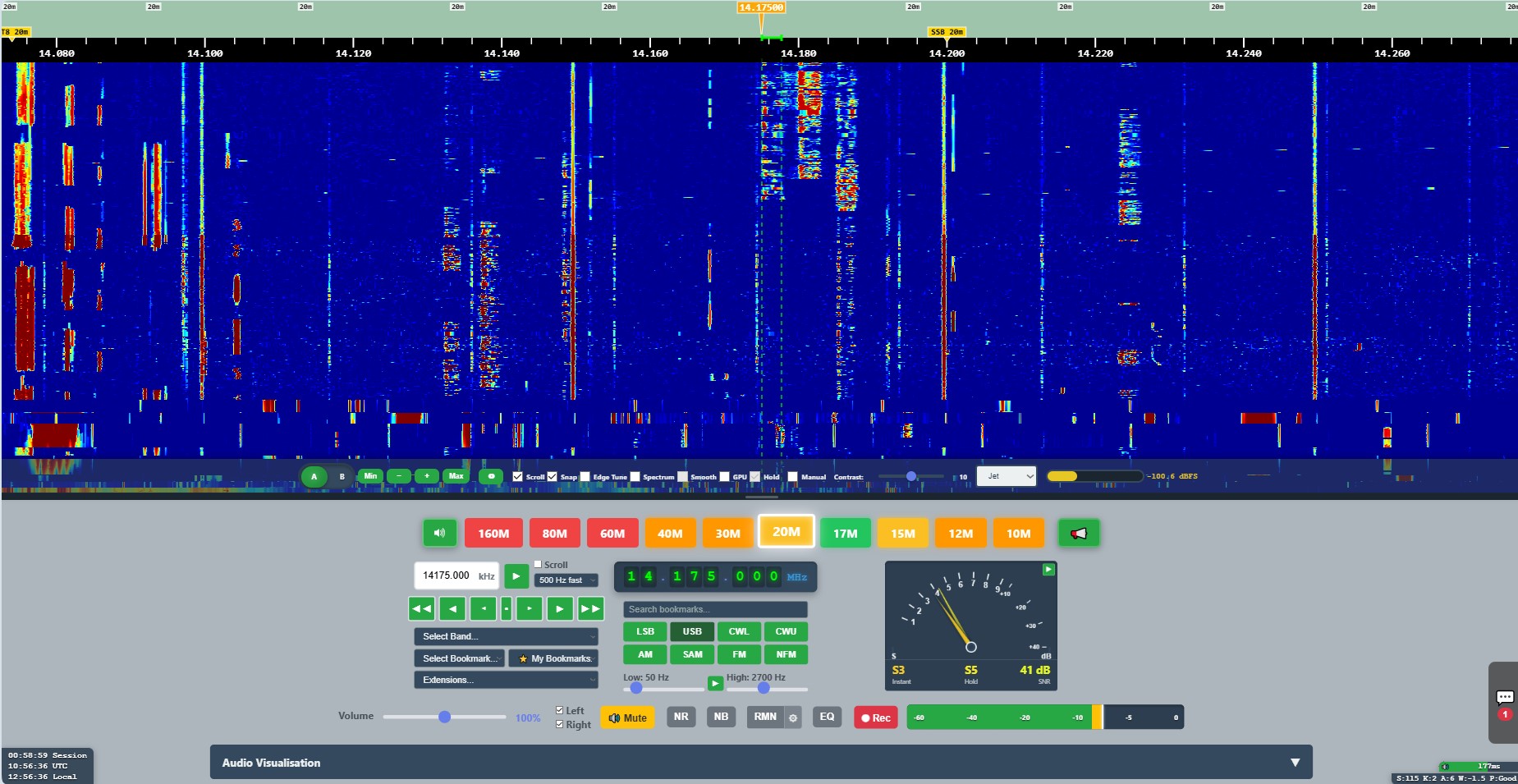
Software-defined radios have become an integral part of amateur radio operations in recent years. From simple RTL-SDR receivers to professional wideband SDR systems have expanded the possibilities of monitoring bands, digital modes, DX operations and technical experiments. In 2025, the UberSDR project, which follows the architecture, began to gain more traction among radio amateurs. KA9Q Radio and brings a new perspective on remote SDR reception.
UberSDR is not just another web SDR receiverIt is a distributed platform combining a broadband SDR server, advanced digital decoders, a centralized receiver directory, a map interface, and native clients for Windows, Linux, and macOS operating systems.
In the article you will read
What is UberSDR?
UberSDR is an open SDR platform based on KA9Q Radio technology. Its goal is to enable simultaneous access by a large number of users to broadband SDR receivers distributed around the world. Unlike classic WebSDR or KiwiSDR systems are designed for modern multi-core processors and high-speed internet connections.
Základnou myšlienkou je sprístupniť celé krátkovlnné spektrum prostredníctvom jedného servera, pričom každý používateľ môže nezávisle prijímať vlastný signál, dekódovať digitálne módy alebo využívať špecializované doplnky.
At the time of writing, the UberSDR public directory contained 42 public receivers spread across Europe, North America, and South America.
Main features and benefits of UberSDR
The most significant feature of the system is its ability to handle a large number of simultaneous listeners without significant performance degradation. Multiple public instances allow for 20 to 200 concurrent users.

The platform supports multiple bandwidths including 48 kHz, 96 kHz, and on some servers, 192 kHz. This allows for convenient monitoring of entire amateur radio bands and simultaneous decoding of multiple signals.
A significant advantage is the integration of advanced tools. Many receivers provide CW skimmer, HFDL decoder, NAVTEX, SSTV, WEFAX, Doppler, GPSDO reference, TDOA or DSP functions.
For DX operators, it is interesting to be able to instantly compare reception from different geographical areas. An operator can watch the same signal simultaneously from, for example, Austria, Scotland, the Canary Islands and the USA.
UberSDR interactive map

One of the most practical features of the project is the global interactive receiver mapThe user can filter receivers by country, distance, available bandwidth, supported add-ons, reception quality or current band status.
The map shows the geographical distribution of receivers and allows for an instant audio preview without the need to connect to a specific server. Filtering by day or night operation and by reception quality of individual HF bands is also available.
A great advantage is the display of current propagation conditions, SNR of individual receivers and information about solar activity. This allows the operator to quickly select the most suitable receiver for a specific band.
Add-ons and extensions
The UberSDR architecture allows for the integration of several specialized add-ons. The most commonly used ones include CW Skimmer, HFDL monitor, NAVTEX decoder, SSTV receiver, WEFAX decoder, and Doppler tools.
Some receivers also provide GPSDO synchronization, TDOA signal source localization, or reference frequency sources for precision measurements. For example, the M9PSY and M9PSY-1 receivers in Scotland provide GPSDO, Doppler, NAVTEX, SSTV, and WEFAX functions.
For digital operators, the connection with WSJT-X, Fldigi and other applications via virtual audio devices is interesting.
Desktop Client
UberSDR Desktop Client is a full-featured alternative to the web interface. It provides a spectrum analyzer, waterfall, multiple receiver management, and integration with external amateur radio applications.

CAT, TCI, OmniRig and virtual audio devices are supported. This allows you to use WSJT-X, JTDX, Fldigi, JS8Call or other programs exactly as you would with a local SDR receiver.
The desktop client is intended primarily for active DX operators and competitors who need long-term band monitoring or simultaneous work with multiple receivers.
Minimal Audio Client

is a lightweight application designed for users who do not need a graphical spectrum or waterfall. It only transmits audio data and basic control information.
The advantage is minimal processor load, low data consumption, and the ability to operate on less powerful computers or remote systems.
This is a very practical solution when monitoring digital modes or listening to DX traffic for long periods of time.
Windows clients, drivers and browser interface
A native client is available for Windows users using virtual audio cables and standard CAT interfaces. Integration with WSJT-X or Fldigi does not require special hardware.
The web interface works in modern browsers without the need for additional plugins. Most features are available directly through the HTML5 interface.
When using RX-888 MkII receivers, standard SDR drivers available for both Linux and Windows are used.
Why build your own UberSDR server?
The custom UberSDR server allows you to share the receiver with the community, create a remote monitoring workstation, or ensure reception from an electromagnetically clean environment.
For contest stations, it presents an interesting possibility for remote monitoring of the propagation. QRP operators can verify the quality of their signals from multiple locations and experimenters gain access to advanced decoders.
Many public institutions use RX-888 or RX-888 MkII receivers supplemented with active loop antennas, beverage antény, EFHW or vertical systems.
What is needed to build your own UberSDR
The basis is an SDR receiver supported by the KA9Q Radio architecture. The most commonly used is the RX-888 MkII, which provides sufficient bandwidth and dynamic range.
You also need a computer with a multi-core processor, a Linux operating system, a stable internet connection, and a suitable HF antenna.
According to data from public sources, Intel Core i5, i7, Xeon, AMD Ryzen, and the energy-efficient Intel N100 processors are used.
Selection of public UberSDR receivers
| # | Marking | Location | Country | Antenna / Note | Bandwidth | Current listeners | Main accessories | Status |
| 1 | WESSEX | SW England | UK | Terminated Delta loop | 48 / 96 kHz | 20 / 20 | Digital, DSP, HFDL | Online |
| 2 | OE3GBB- 1 | Wartmannstetten | Austria | RX-888 + 120 m terminated LW | 48kHz | 20 / 20 | Digital, Chat, Noise Floor | Online |
| 3 | OE9GHV | Alberschwende | Austria | Radiohill | 48kHz | 20 / 20 | Digital, Chat, HFDL | Online |
| 4 | K1RA | Warrenton, Virginia | USA | RX-888 + 80 m EFHW | 48 / 96 kHz | 27 / 30 | CW Skimmer, DSP, References | Online |
| 5 | K3GMQ | Buckingham, Pennsylvania | USA | Northeast Corridor HF SDR | 48 / 96 / 192 kHz | 99 / 100 | CW Skimmer, GPS, TDOA, Navtex | Online |
| 6 | EA8-DF4UE | Fuerteventura | Canary Islands | RX888 on a multiband dipole | 48kHz | 26 / 30 | Digital, Noise Floor | Online |
| 7 | EI4HQ | Cobh, Cork Harbour | Ireland | LZ1AQ 2 × 2 m Loop | 48kHz | 20 / 20 | CW Skimmer, HFDL, Navtex | Online |
| 8 | ON8ST | Keerbergen | Belgium | SDR tent | 48kHz | 20 / 20 | DSP, Chat | Online |
| 9 | M9PSY | Dalgety Bay | Scotland | RX888 + End-Fed Long Wire + GPSDO | 48 / 96 kHz | 20 / 20 | SSTV, WEFAX, Doppler, Rotator | Online |
| 10 | VA3ROM | Thunder Bay | Canada | RX-888 MkII + GPSDO + Vertical | 48kHz | 20 / 20 | HFDL, SSTV, Navtex, WEFAX | Online |
| 11 | PD2RPS | Friesland | Netherlands | RX-888 + A1 Loop | 48kHz | 20 / 20 | CW Skimmer, DSP, HFDL, Navtex | Online |
| 12 | PT2FHC | Brasilia | Brazil | RX888 + GPSDO + Broadband Dipole YA-30 | 48 / 96 / 192 kHz | 20 / 20 | TDOA, DSP, Navtex, Doppler | Online |
| 13 | AIRSDR | Bergamo | Italy | AIR Public SDR | 48kHz | 25 / 25 | CW Skimmer, Digital | Online |
| 14 | PH5HP | Friesland | Netherlands | RX-888 + Wellbrook ALA1530 Loop | 48kHz | 25 / 25 | Digital, Chat | Online |
| 15 | DIG647 | Monchengladbach | Germany | Active Loop | 48kHz | 19 / 20 | DSP, Chat | Online |
The data comes from the public UberSDR Instance Directory.
Video demos
Conclusion
UberSDR represents an interesting direction in the development of amateur radio SDR systems. It combines the modern architecture of KA9Q Radio, an extensive network of public receivers, support for digital modes, and integration options with existing amateur radio software.
For DX operators it offers the possibility to compare reception from different continents in real time. For experimenters it provides an open platform with a lot of add-ons and for designers it represents a modern way of building remote SDR workstations based on RX-888 MkII receivers.