
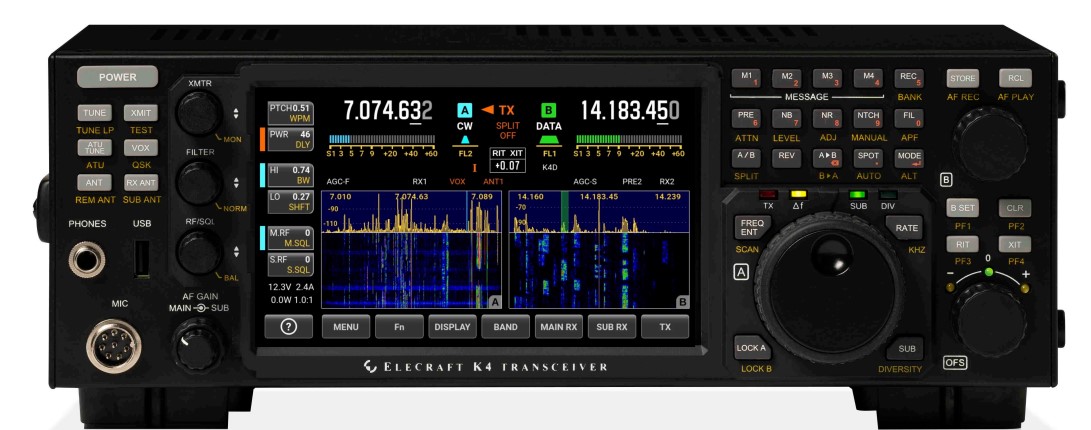
When Elecraft in 2019 Hamvention introduced the K4, the reaction of the amateur radio community was immediate. Hundreds of interested parties placed pre-orders even before the device entered mass production. The pandemic and supply chain outages postponed actual deliveries until spring 2021, but interest did not wane. The K4 was presented not as an ordinary successor to the K3S, but as a new generation transceiver - modular, direct sampling SDR with a 7-inch color touchscreen and an architecture that allows for gradual upgrades without a soldering iron.
In the article you will read
Development of the Elecraft series towards K4
Elecraft has been synonymous with high-performance transceivers in kit form since its inception in 1998. The K2, K3 and K3S series have earned a firm place in the DX community and in contesting thanks to their excellent receiver parameters and compact design. The K3S has been a top-ranking Sherwood Engineering chart for many years and has been the standard choice for DXpeditions and multi-operator stations. The K4 was intended as a logical step forward: to maintain the K3S philosophy – controllability, reliability, travelability – and to add to it a direct-sampling SDR architecture with a modern user interface. The transceiver has been designed from the ground up as a modular transceiver, allowing for configuration according to specific operational needs.
Three models, one platform
The K4 comes in three basic configurations. The basic K4 model has one set of receive bandpass filters and one 16-bit A/D converter. Dual-receive is present in all variants, but in the basic K4 both receivers share common filters and antenna. The K4D model adds a second set of bandpass filters and a separate ADC module (KDIV4), allowing truly independent dual-receive operation on different bands and with different antennas, including diversity reception. The K4HD model complements the KHDR4 dual superheterodyne module with narrow-band crystal filters at 8 MHz intermediate frequency, which is intended for stations with extreme signal environments. Each model can be upgraded to a higher configuration at any time later by installing the appropriate module - no soldering, no calibration.
Overview of main functions
Prednému panelu K4 dominuje 7-palcový farebný LCD s kapacitným dotykovým ovládaním. Displej zobrazuje VFO A and VFO B with S-meters, individual filter settings and band indicators, while the rest of the area is occupied by panadapter with waterfall. There is a dual pan adapter (A+B), a mini-pan tuning tool with a resampling bandwidth of up to ±1 kHz, as well as support for an external monitor via video output. Control is achieved by a combination of physical switches and buttons on the front panel with contextual softkeys on the display, which ensures comfortable work even without using the touchscreen.

Standard features include dual reception in the frequency range of 100 kHz to 54 MHz, all basic modes (SSB, CW, AM, FM, DATA), built-in text decoder and encoder for CW, PSK31/63 and RTTY, as well as an 8-band graphic equalizer for both reception and transmission. The macro system allows you to program command sequences on the PF1–PF4 or Fn.F1–F8 switches. The internal CW Keyer operates in the range of 8 to 100 WPM with adjustable weight and Iambic A/B support. DVR (digital voice recorder) provides recording and playback of received and transmitted audio. PIN-diode T/R switching ensures silent QSK operation without mechanical relays.
The connectivity on the rear panel is extremely rich: three SO-239 antenna connectors (when using ATU KAT4), BNC for RX ANT input/output, XVTR IF input/output, Ethernet 1 Gbps, three USB-A ports, one USB-B (sound card + virtual COM ports), RS-232, video output, 10 MHz reference input, Line in/OUT (600 ohms), external speaker, PTT IN, KEY OUT, connectors for Paddle and CW key and 15-pin ACC for controlling amplifiers and transverters.

Technical parameters
| Parameters | Value |
|---|---|
| Frequency range (TX) | 1.8 – 54 MHz (amateur bands) |
| Frequency range (RX) | 100kHz - 54MHz |
| Output power | 0.1 - 100 W nominal (1.8 - 54 MHz); 10 W version also available |
| Frequency stability | ±0.25 ppm (TCXO) |
| Modules | SSB (USB/LSB), CW, CW-R, AM, FM, DATA, AFSK, PSK, FSK |
| A/D converter | 16 bit, sampling ~122 MHz |
| Receiver sensitivity (MDS, BW 500 Hz, Preamp off) | –118 dBm (0.1–23 MHz); -118 dBm (23-54 MHz) |
| Receiver sensitivity (MDS, preamp 1) | –128 dBm typical |
| Receiver sensitivity (MDS, preamp 2) | –135 dBm typical |
| SSB carrier suppression (TX) | > 50 dB |
| Harmonic suppression (TX) | > 50 dB (> 60 dB at 6 m) |
| Supply voltage | 11-15V DC |
| Current consumption (RX) | 2 – 3 A typically |
| Current consumption (TX) | 4 – 25 A typically |
| ATU (optional CAT4) | 10:1 on 80–10 m, 5:1 on 160 m and 6 m |
| Display | 7-inch color LCD, touch + mouse |
| Dimensions (cabinet only) | 114 × 343 × 280 mm (H×W×D) |
| Weight | approx. 4.5 kg |
| Working temperature | 0 - 50°C |
Sensitivity values are from measurements published in the RadCom review (January 2022) and manufacturer documentation. For the K4D with dynamic range optimization (dithering) enabled, IMD3 values at 500 Hz bandwidth are consistently in the range of 99-100 dBc at 2 kHz and higher signal spacings.
Video: Elecraft K4 – demonstration and Q&A with Eric Swartz WA6HHQ
Receiver features
The direct sampling architecture gives the K4 several advantages over a traditional superhet. The DSP sees the full bandwidth of the RF input signal, allowing for more sophisticated noise reduction algorithms, noise blanking, and automatic signal tracking. The result is an extremely flat passband frequency response – beneficial in both digital modes and monitoring. The panadapter covers selectable bandwidths from 5 kHz to 368 kHz with the option of displaying in S-units or dBm.
Reviewer Peter Hart G3SJX at RadCom (January 2022) popísal výkon prijímača ako výnimočný a tichý: žiadne nežiadúce odozvy signifikantnej úrovne sa mu počas testovania nameraných nepodarilo nájsť. AGC systém bol dobre nastavený s minimálnym overshootom. Intermodulácia (IMD) with dynamic optimization enabled reached 99-100 dBc in a 500 Hz bandwidth at all spacings above 2 kHz and on all bands – parameters comparable to other direct-sampling receiver lines with 16-bit ADCs. Reciprocal phase noise was measured to be significantly better than the K3S.

The new Spectral Subtraction Noise Reduction (SSNR) feature, available from firmware R38, removes most atmospheric and industrial noise in real time. In voice modes, it preserves speech while suppressing noise and hiss, and in CW it can completely silence the background on an empty channel. The feature is especially useful when DXing from an urban QTH with high levels of electromagnetic interference.
Miscellaneous income (dostupný v K4D a K4HD) využíva dve rôzne prijímacie antény a stereofonné slúchadlá na priestorové rozloženie signálu – technika, ktorá pomáha pri kopírovaní signálov v ťažkých QSB Pitch mapping in CW mode distributes the audio signal from left to right according to pitch, making it easier to decode signals in pile-ups.
Transmitter features
The output power is continuously adjustable from 100 mW to 100 W, with separate settings for each band. When used with the Elecraft KPA500 or KPA1500 amplifier, separate power settings are stored for operation with and without the amplifier. The transmission chain is also digitally controlled - the amplifier chain signal is generated from a digitized source, which guarantees the same flat passband characteristic as on the receive side.

T/R switching is handled by PIN diodes, which eliminates mechanical relays and allows for true CW QSK operation without audible clicks. The QSK delay is adjustable from 5 to 25 ms for the linear amplifier sequence. The TX meter displays four bargraph indicators simultaneously: RF power, SWR, ALC and compression, and automatically moves below the active VFO in split mode - which, according to G3SJX's review, greatly increases the operator's awareness of the SPLIT state.
Hlasový procesor (speech Compressor) works with a built-in 8-band TX audio equalizer, which allows fine-tuning the sound profile for a specific microphone. ESSB (extended SSB) support is available by activating it in the TX menu. Outputs are available for both reception and transmission Line out so 600-ohmovou impedanciou, čo uľahčuje prepojenie s externým softwarom pre digitálne módy ako WSJT-X, MMTTY or others.
User reviews and experiences
A review in RadCom (January 2022, by Peter Hart G3SJX) rates the K4 as a very capable radio with excellently implemented features and a modern display. Hart praises the smoothness of the controls, the visual clarity of the display, and the receiver's performance in real-world conditions. He cited transmission composite noise and some firmware delays as areas where the K4 currently lags behind the K3S at the time of the review.
On the platform eHam.net je K4 hodnotený dlhodobo pozitívne; používatelia opakujúco vyzdvihujú kvalitu audio výstupu, efektívnosť noise reductionу, flexibilitu prijímacej antény a aktívnu odozvu výrobcu na firmvérové požiadavky komunity. Skupiny na Groups.io a QRZ.com forums document the intensive development of the firmware – from basic operation through the gradual implementation of advanced features to SSNR in 2024. Elecraft founders Wayne Burdick N6KR and Eric Swartz WA6HHQ are personally active in discussion groups, which users consider to be a significant added value compared to mass-produced manufacturers.
„The K4 is indeed a very impressive radio. An excellent performer with very well implemented functions and a superb display, it is destined to take over from the K3S as the radio of choice for many DX enthusiasts, DXpeditioners and contest stations.“
— Peter Hart, G3SJX, RadCom, January 2022
Sherwood Engineering's objective measurements confirmed that the K4D achieves performance comparable to other top-tier direct-sampling transceivers; a discussion of its placement relative to the K3S on the Sherwood chart revealed that different architectures favor different metrics and that in typical antenna environments the differences are minimal.
How to purchase
The K4 is available directly from Elecraft (elecraft.com) in a factory-assembled version. Current list prices in USD (as of elecraft.com, July 2025):
| Model | Description | Price (USD) |
|---|---|---|
| K4/10-F | K4 QRP, 10 W, assembled | 5,488.95 |
| K4-F | K4 100 W, assembled | 6 148.95 |
| K4D-F | K4D 100 W, assembled (dual ADC, diversity) | 7,248.95 |
| K4toK4D Upgrade | Upgrade kit from K4 to K4D | 1,264.95 |
| CAT4-K | Antenna tuner CAT4, kit | 648.95 |
European customers can purchase through official Elecraft distributors in the EU, which will ensure a 24-month warranty and local technical support. The current list of distributors is available at elecraft.com/pages/international-distribution-repair-centersDirect orders from the USA are also possible, but do not include the EU warranty and may incur customs duties and VAT upon import.
Summary
The Elecraft K4 represents a well-thought-out technical solution for operators who are not satisfied with the current performance. Modular architecture, direct-sampling SDR with full-duplex DSP chain, waterfall touch panadapter and rich connectivity form the foundation on which Elecraft continuously builds with firmware updates. The 2024 SSNR algorithm is an example of this: a major improvement delivered as a free update to existing owners.
The K4 is not without its limitations. The price puts it at the upper end of the market, and the learning curve is steep at first – especially when using macros, diversity reception and setting up band antenna configurations. However, for the contestman, DX-operator or remote station builder, this is a transceiver that will meet the requirements for years to come – and will grow with them.