
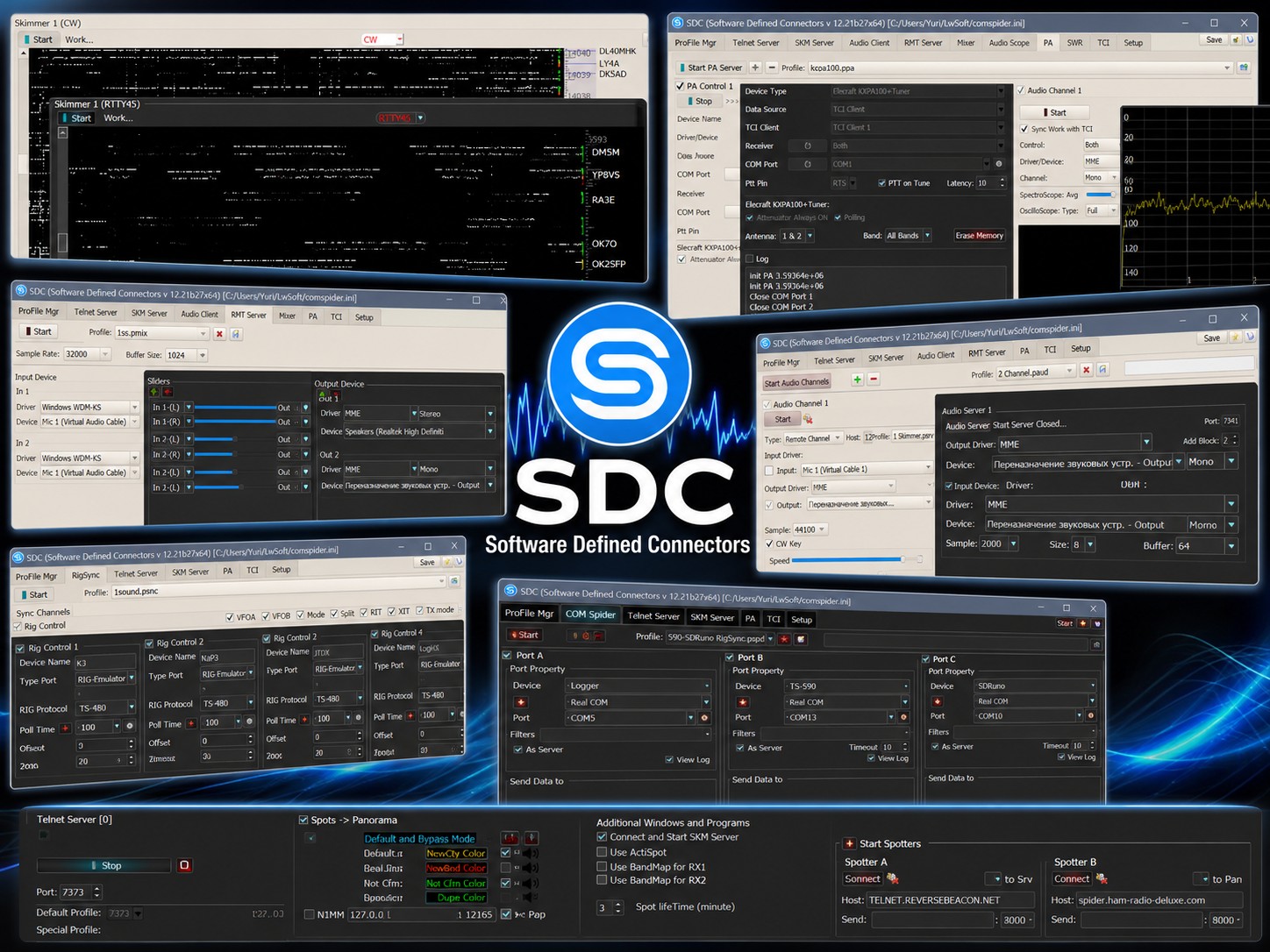
In the era of software-defined radio (SDR) the amateur radio workplace has changed dramatically. Hardware no longer forms a separate world, but is closely interconnected with software logging programs, digital decoders, panadapters, control of power amplifiers and antenna switches. This creates a demanding ecosystem of data streams, where it is necessary to distribute flawlessly CAT rozhrania, skimmerové dáta, audio signály a CW kľúčovanie medzi rôznymi aplikáciami.
This is precisely the area addressed by the SDC (Software Defined Connectors) software package, authored by Yuri Pavlov, UT4LWSDC is a modular Swiss Army knife for the digital infrastructure of a modern amateur radio station. The software was originally developed as a support tool for the SunSDR2 transceiver and the ExpertSDR platform, but over time it has grown into a universal solution usable with any modern SDR or classic transceiver supporting the CAT protocol or TCI (Transceiver Control Interface).
In the article you will read
Composition and architecture of SDC
The SDC application is designed as a multi-threaded system consisting of several independent but interconnected modules. Each module performs a specific function in data or signal processing, eliminating the need to install numerous third-party utilities.
| SDC module | Main function and purpose |
|---|---|
| SKM Server | Multi-channel CW skimmer with high decoding speed for IQ signals. |
| Telnet Server | Aggregation, filtering and distribution of DX spots from various sources into logs. |
| COM Spider | Virtual matrix for connecting, forwarding and branching COM ports and CAT data. |
| RIG Sync | Synchronization of frequency, mode of operation and status between multiple devices and logs. |
| Remote Audio & COM port | Transmission of audio and control data over a local LAN or the Internet without loss of quality. |
| Audio Mixer | Flexible routing and mixing of audio channels between amateur radio applications. |
| Audio Scope | Spectral and temporal visual analysis of the audio signal for precise modulation adjustment. |
| PA Control | Automated control and monitoring of power amplifiers (e.g. Expert 1K-FA, 1.3K-FA). |
| Contest | Integrated racing module supporting ESM logic, keying and decoding. |
SKM Server (CW Skimmer)
SKM Server is probably the most powerful part of the entire SDC package. It is a high-speed, multi-channel CW decoder that processes the wideband IQ signal from the SDR receiver directly. Unlike classic solutions, it uses algorithms optimized for multi-core processors, which allows parallel analysis of hundreds of signals simultaneously with minimal system load.

Key features of the SKM Server include the ability to decode CW signals even in conditions of strong interference and high bandwidth jamming during races. The decoded marks are supplemented in real time with accurate frequency and signal level (SNR). The SKM Server can cooperate with the TCI interface, thereby obtaining IQ data without the need to set up virtual audio channels (VAC), which significantly reduces latency and configuration complexity.
Example of using SDC
Telnet Server
The Telnet Server module acts as a central hub for working with DX spots. It collects data from the local SKM Server, from network DX clusters and from the control race logs. It combines all this data into a single stream, which is then distributed to connected clients (e.g. N1MM+, DXLab, Logger32 or transceiver interface).

An important feature is advanced spot filtering. Telnet Server can eliminate duplicate tags, filter spots by bands, working modes, custom rules or geographical location. In conjunction with its own SKM Server, the operator gets an immediate overview of the stations broadcasting on the band without being dependent on an external Internet connection.
Configuring Telnet Server in SDC Environment
The video shows the process of connecting the Telnet Server to logging programs and setting filters for effective reception of spots.
COM Spider
Virtual COM port connections are often the weakest link in a ham radio setup in a Windows environment. COM Spider in SDC replaces classic VSPE or LP-Bridge hubs. It allows you to create complex connection matrices between physical and virtual serial ports.

COM Spider handles bidirectional forwarding of CAT commands, splitting one physical port for multiple applications simultaneously, modifying the baud rate per flight, and creating custom rules for CW keying (DTR/RTS) or PTT switching. The system operates with high time accuracy, thus preventing collisions on the CAT bus.
RIG Sync
The RIG Sync module is used to synchronize two or more transceivers or receivers. In practice, it is mainly used in SO2R (Single Operator 2 Radios) operation, in measurements, or when using a separate SDR as a companion receiver to a classic analog radio.

RIG Sync can transmit information about frequency, operating mode (MODE), filter width and PTT status. Synchronization can be one-way or two-way, supporting various protocols including OmniRig, Hamlib, Kenwood CAT and TCI. The system responds without noticeable delay, allowing for smooth jumps of the aiming point on the panadapter.
Remote Audio & COM port
For operators who operate their station remotely, the SDC includes a Remote Audio & COM port module. This module provides high-quality audio and serial data transmission over a TCP/IP network environment.

The audio stream is compressed by modern encoders with the ability to adjust the sampling rate and bit rate with respect to the line bandwidth. Control serial data (CAT, PTT, CW keying) are transmitted with the highest priority, which guarantees low response latency when keying telegraphy or controlling VFO.
Audio Mixer
The Audio Mixer in the SDC package replaces the complex setup of Windows system sound cards. It provides matrix routing of audio between physical sound cards, virtual audio cables (VACs), and internal SDC modules.

It allows independent adjustment of signal levels for reception and transmission, separation of left and right channels for work in Diversity Receive mode, as well as insertion of auxiliary tones or voice prompts. The mixer prevents decoder inputs from waking up, thereby increasing the success of decrypting weak digital signals in FT8, FT4 or RTTY modes.
Audio Scope
Properly setting up your own transmitted signal is the foundation of amateur radio ethics. The Audio Scope module provides tools for monitoring and analyzing low-frequency signals in real time.

It contains two main tools: an oscilloscope for monitoring the time course of the signal envelope and a spectrum analyzer (FFT) for checking the frequency spectrum. With the Audio Scope, it is possible to detect unwanted harmonics, wake-up of the microphone preamplifier, hum from the mains supply or incorrect setting of the dynamic compressor before entering the modulator.
PA Control
The PA Control module provides automated communication between the transceiver, SDC interface and power amplifiers (primarily the SPE Expert series). It displays amplifier operating states such as output power, reflected power (SWR), heatsink temperature, voltage and current draw.

In addition to monitoring, PA Control enables automatic switching of antenna inputs and bandpass filters depending on the VFO frequency, thus protecting the output stage from transmitting into an unmatchable load. In case of exceeding critical parameters, the module can immediately disconnect the PTT line.
Contest
The racing module in SDC is not a full-fledged replacement for specialized logs such as N1MM+ or DXLog, but it forms a highly effective core for specific types of plants or for ESM-style work.
Modul Contest úzko spolupracuje s SKM Serverom a TCI rozhraním. Dokáže automaticky vyťahovať volacie značky priamo z CW skimmera a vkladať ich do okna okna spojenia. Podporuje vygenerované CW správy, automatické číslovanie spojení, práce v štýle Run aj S&P (Search and Pounce) a dokáže plynule kľúčovať vysielač priamo cez rozhranie TCI bez potreby externých kľúčovačov.
User insights and operational experience
Based on discussions in the sdc-ut4lw community group and the experiences of active racers, the following practical insights resonate when using SDC:
The stability of the SKM Server under high load during contests is incomparably higher than that of a classic CW Skimmer. Thanks to direct processing of the TCI stream, problems with dropping virtual audio cables and frequency synchronization are eliminated.
Users particularly praise the dramatic reduction in CPU load when processing multi-band IQ streams. While a combination of other external applications can keep system load to a minimum, SDC runs smoothly even on older PCs.
The disadvantages include the higher initial configuration requirements. The number of tabs, parameters, and connection options can cause problems for a less experienced operator at first. However, after the correct settings and saving of the profile, the system runs autonomously and without the need for intervention.
Download links and SDC price
The SDC software package is available for download in a shareware / freemium model for non-commercial amateur radio use. The basic control and routing modules (COM Spider, RIG Sync, Audio Mixer, PA Control) are completely free. The most powerful module – SKM Server (CW Skimmer) – operates in a free mode with a time limit and for unlimited operation requires the purchase of a one-time license from the author (UT4LW).
Author Yuri Pavlov, UT4LW, is constantly developing the system and providing regular updates for Windows (both 32-bit and 64-bit) and Linux operating systems.
Official sources and documentation:
| Source / Document | Link |
|---|---|
| Official project website | www.lw-sdc.com |
| English manual in PDF draft | SDC User Guide (PDF) |
| Section for downloading current versions | SDC Downloads |
| Developer and user discussion group | Google Group sdc-ut4lw |
Summary
UT4LW's Software Defined Connectors (SDC) is an extremely comprehensive and sophisticated software ecosystem that addresses almost all digital connectivity needs in the modern amateur radio workplace. With a cutting-edge CW skimmer, a stable serial port splitter, and native support for the modern TCI protocol, it is a key tool for anyone serious about SDR technology, contesting, or remote operation.
The application effectively eliminates the need to install many unstable third-party tools and combines signal and data processing into one clear unit. Although it requires an initial study of the documentation, the reward for the effort is an extremely fast, flexible and reliable workplace ready for the most demanding conditions on the bands.