
When using special receiving antennas on low HF bands, radio amateurs often encounter the problem of low received signal levels. Beverage, Flag, Pennant, EWE or K9AY antennas provide excellent directional properties and significantly suppress interference, but their output level is significantly lower than that of classic transmitting antennas. Larry Molitor's W7IUV Preamplifier was created for these applications, which over the years has become one of the most famous low-frequency preamplifiers for DX reception on the 160 m and 80 m bands.
In the article you will read
Why are preamplifiers used on HF?
Many radio amateurs wonder whether a preamplifier is even necessary on shortwave. Modern transceivers are usually sensitive enough and their own noise is usually lower than the external noise picked up by the antenna. However, the situation changes when using very low-gain receiving antennas or long power lines.
The preamplifier in this case does not work to "create" new signals. Its task is to increase the level of the received signal before losses in the coaxial line or before entering the receiver. At the same time, it must have a sufficiently low noise figure so as not to deteriorate the signal-to-noise ratio. More important than the noise figure itself, however, is the ability to process very strong signals at low frequencies without intermodulation. Atmospheric noise, industrial interference and powerful radio transmitters create conditions at the receiver input that can overwhelm a poor-quality preamplifier.
That is why Larry W7IUV emphasizes in the original documentation that the most important parameter of a preamplifier for the 160m band is not the noise figure, but the OIP3 value, i.e. the third-order output intercept. This determines the resistance to intermodulation products arising in the presence of strong out-of-band signals.
Unique features of the W7IUV concept
The W7IUV preamplifier was created as a result of many years of development intended for DX operation on 160 m. The author gradually abandoned solutions using JFET transistors, MMIC amplifiers and other popular concepts, because they did not achieve the desired dynamic range. Instead, he used a bipolar power transistor 2N5109 operating in linear mode with significant negative feedback.
The feedback is one of the main reasons for the exceptionally good linearity of the circuit. The preamplifier is not designed as an extremely low-noise laboratory amplifier. The priority is the ability to operate in a real antenna system without the formation of unwanted products while maintaining sufficient sensitivity.
Another advantage is its simple construction. The active part consists of only a single transistor, several resistors, capacitors and a transformer on a ferrite toroidal core. Despite its simplicity, it achieves parameters that still keep it among the most used preamplifiers for Beverage and similar receiving antennas.
Technical parameters
| Transistor | 2N5109 (alternatively 2N3866 or DCP68) |
| Power supply | 12.6 to 13.6 V |
| Profit | approximately 18 to 21 dB |
| Working range | approximately 1 to 30 MHz |
| Noise figure | better than 4 dB, typically around 2 dB |
| OIP3 | approximately +42 dBm |
Measurements published by Karel OK2ZI confirmed a gain of approximately 18 dB and very good impedance matching. In practice, these values are fully sufficient for most receiving antennas used on HF bands.
Wiring diagram
The basis of the circuit is a 2N5109 transistor in a common emitter configuration. The collector is connected to the power supply via an autotransformer and also forms the output circuit. Resistors R2 and R3 provide feedback, which significantly improves linearity and input impedance. The emitter combination of resistors 4.7 Ω and 10 Ω stabilizes the operating point of the transistor.

The T1 transformer provides a 1:4 impedance transformation. The original versions used a FT50-43 toroid with 10 bifilar turns. Later modifications by the author recommend a type 75 core, which provides better intermodulation properties.
The schematic image published by OK2ZI uses an FT50-43 with ten bifilar turns, which corresponds to the original version of the design. This version is still used among radio amateurs today and provides very good results, especially with Flag and Beverage antennas.
Printed circuit boards from OK2ZI

Karel OK2ZI contributed to the feasibility of the preamplifier, as he prepared professionally designed printed circuit boards. These significantly simplify construction and minimize the risk of errors in component placement.
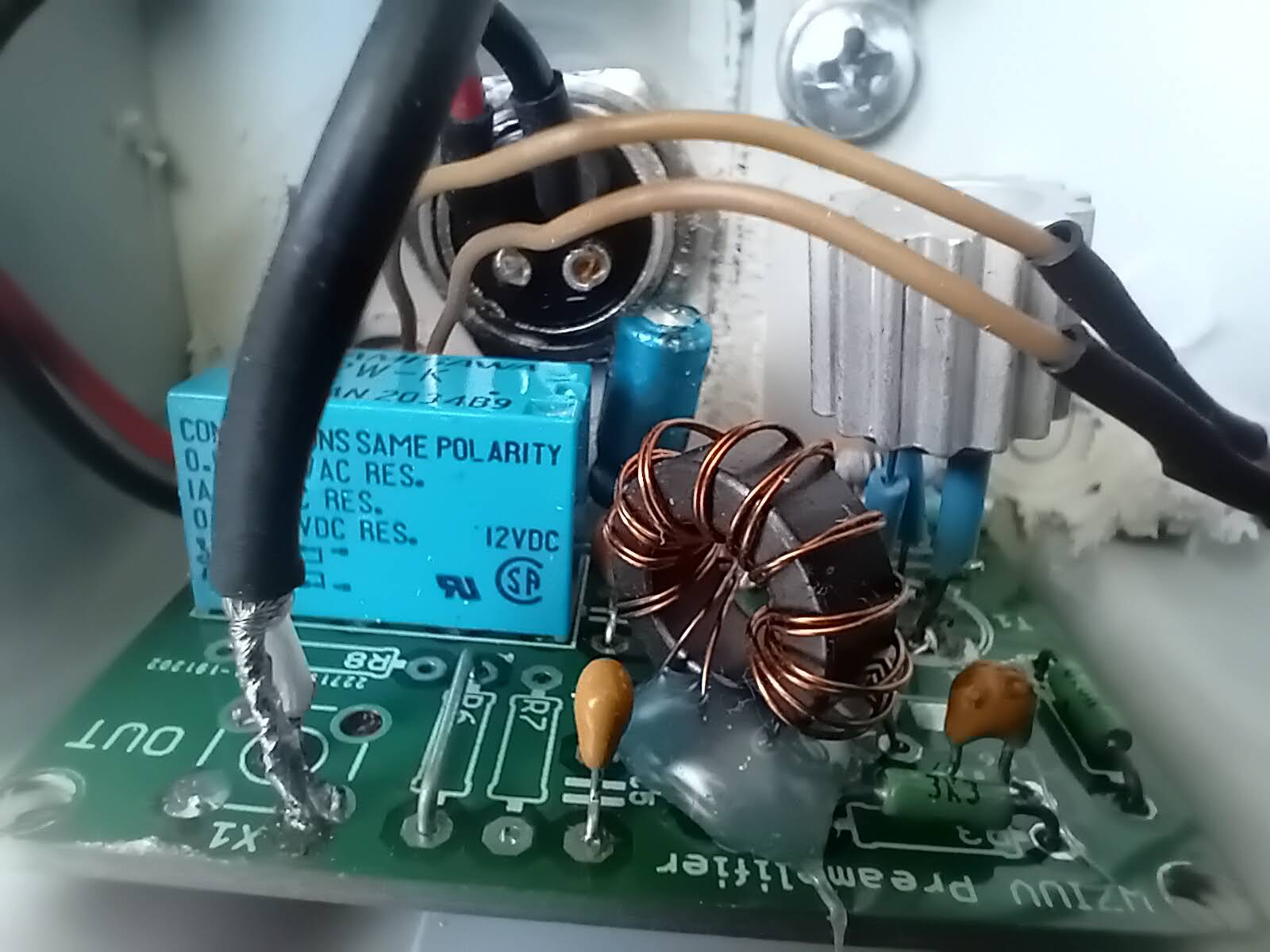
I built the preamplifier on a printed circuit board from Karel OK2ZI. First, I installed the resistors, capacitors and a protective diode. The most work was winding the transformer on a toroidal core. A beginner may have problems with bifilar winding at first, but an experienced designer can handle it without any major complications.
Last I installed the relay and transistor with a heat sink. Cooling should not be underestimated. The preamplifier is often placed in an outdoor box near the antenna and during summer days it can be exposed to direct sunlight. The transistor must therefore have a sufficient heat sink.

Zapojenie fungovalo na prvé zapnutie. Stačilo skontrolovať odoberaný prúd a následne vykonať meranie pomocou nanoVNA. The measured gain in the HF bands corresponded to the values published by other authors. I also added a preamplifier output choke according to the design of Honza OK2ZAW to suppress common current along the coaxial line.
I am currently using it with a Flag receiving antenna and the results are very good especially on 160m and 80m.
Measurements and practical experience
Karel OK2ZI published two series of measurements. The results confirm a very low insertion loss in bypass mode and a gain of approximately 18 dB in active mode. At the same time, good impedance properties and connection stability were verified.
Similar results were also published by Tobias DH1TW, who measured approximately 20 dB gain in the range 1 to 30 MHz with very good input matching using a VNWA analyzer.
YouTube videos
For those interested in practical measurements and construction, the following videos are of interest:
The video presents a gain measurement using a nanoVNA, with the author reporting approximately 21 dB of gain.
The second video shows the use of the W7IUV preamplifier with a magnetic loop antenna in receive operation.
Where to buy and price
The original preamplifier is normally sold as a kit only exceptionally, however printed circuit boards from OK2ZI They have been available on eBay for a long time. The price of the PCB itself is around .70, plus shipping.
Complete assembly including transistor, relay, connectors and the box usually costs several tens of euros depending on the components used. The most problematic item is the original 2N5109 transistor, which is less available today than at the time of the design.
Conclusion
The W7IUV preamplifier is one of the proven designs for lowband DX reception. Its greatest advantage is not its extremely low noise figure, but its high dynamic range and excellent resistance to intermodulation. This is precisely why it has become the standard for antennas. Beverage, Flag, Pennant or K9AY.
Even after more than two decades since its inception, this is a circuit that has a lot to offer modern radio amateurs. Using a quality printed circuit board from OK2ZI and following the recommended construction procedures, this is a project that most intermediate designers can handle and which can significantly improve the characteristics of the receiving system on the low HF bands.
Dobrý článek. Je třeba podtrhnout že se týká o předzesilovač pro loop anteny a anteny který dávají slabý signál. Architektura se společným emitorem toho víc neumí.
Pokud si sestavíte IP3 nebo IM3 měřák, přijdete na to, co lidi neustále publikují za kraviny. Neznám důvod zblbnutí. Možná chtějí být kopírováním článků zajímavý, zajímavý svými pa-vědeckými leštěnými prdy. Tím mířím mimo tento článek do jiných končin.
Měřit IP3 chce dva kmitočty. Dostatečný výkon aspoň 100mW sloučený na jeden výstup. Filtr na harmonické, protože nebudu měřit harmonické a všechno dohromady. Potom utlumový článek po 1dB. Mechanický stačí, dost dobré jsou některé military GaAs s FET uvnitř. Ovšem musíte si útlumový člen naprogramovat nebo cvakat BCD vypínačem. To je jedno.
Spektrální analyzátor se vstupním atenuátorem ukáže rostoucí, pohyb IP3 produktů.
Přidáním 1dB signálu vzrostou IP3 produkty o 3dB. Tak to chodí správně.
Produkty IP4 podle mého nemá cenu měřit, protože to uvaříte.
A jak vlastně měřit?
Měřít IP3? Měřit něco jiného? Měřit 1dB kompresi? Měřit 1dB kompresi vezme i pár dní, podle teploty okolí, kvality oběda, když si někdo vypůjčí kabely, a tak. SMA.
Lepší je měřit ůroveň IP3 produktú proti nosným, třeba na -50dBc nebo -30dBc. Měření je jednoznačné, opakovatelné, nic neodpálíte. Můžete srovnat různý tranzistory.
Různý ferity taky. Žádný ferit není kouzelný, jenom má Bsat saturation level a ztráty, a komplexní permeabilitu podle kmitočtu. Měřit v jednotkách Gauss. Jednotky Tesla jsou k prdu, to vám asi na škole neřekli, malý hnidy čísla. Motorola používala levná jádra z Indiany, dnes to je asi tak stejné. Linearita byla někde do B= 100 Gauss. Což je klíčové číslo.
Přesycené ferity znečistují spektrum. Pak slyšíte ten bordel na pásmu spojený s vyzařováním fázového šumu, což dřív nebývalo.
Kouzelné tranzistory taky neexistují, můžete jen konstatovat po přeměření že 2N2222 není moc jinačí a o 3dB horší než 2N5109, ovšem v té pravé konfiguraci. Můžete si takto přeměřit bázmeky z Číny, slučovače, symetrizátory, LNA, a vůbec. I rezavý šroub má své IP3.
Jestli má někdo volné ruské 6W JFETs dejte vědět. Stálo by za to je vyzkoušet. Zatím je prodávají lichváři z DDR. Rusové používali na „silicon die“ hliník místo zlata, takže po čase se struktura sam otrávila hliníkem. Možná se to změnilo, nevím.