
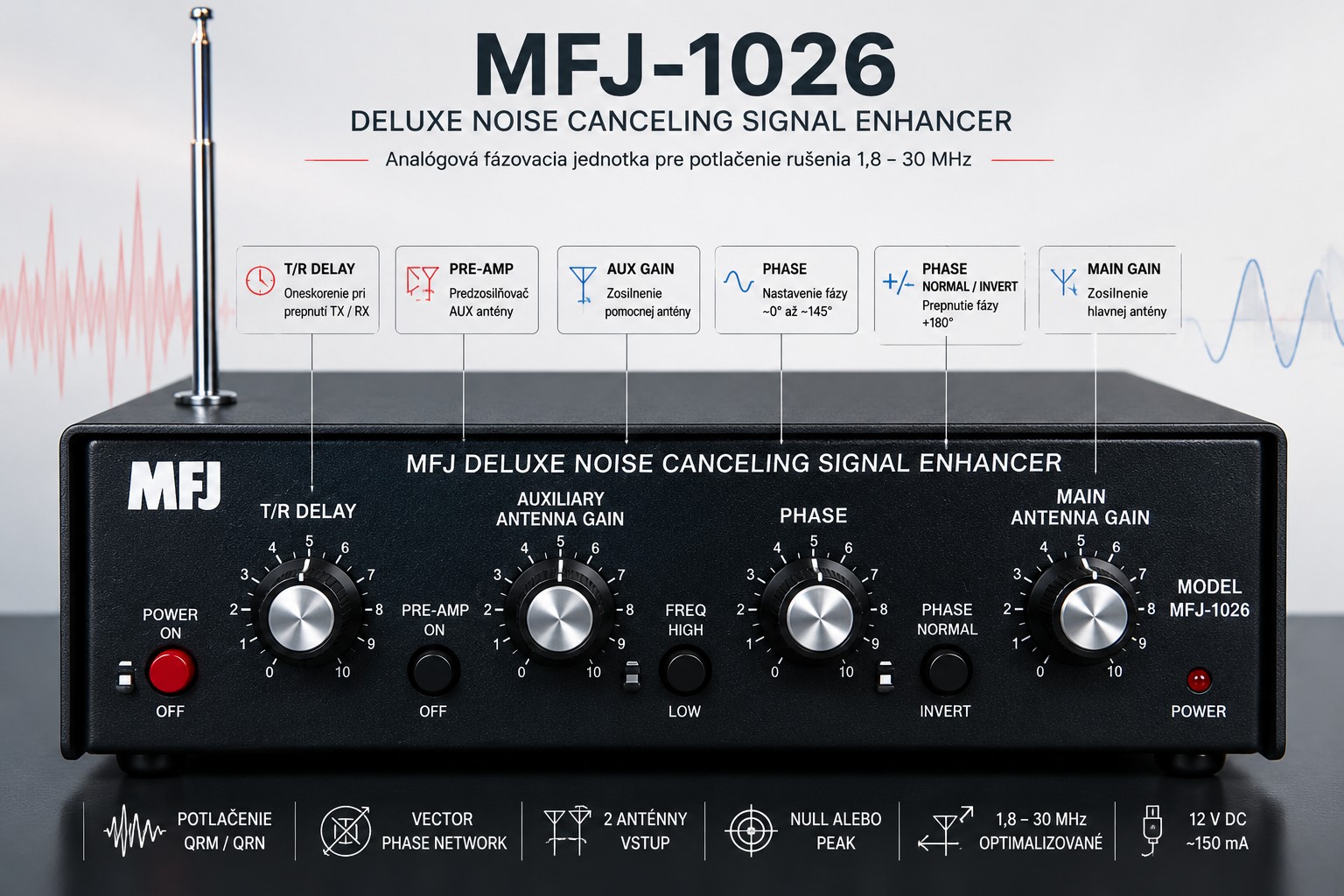
Každý rádioamatér, ktorý prevádzkuje KV stanicu v mestskom prostredí alebo v blízkosti priemyselných zdrojov rušenia, skôr či neskôr narazí na limity klasických metód potláčania rušenia. Moderné transceivery ponúkajú digitálnu redukciu šumu (DNR), Noise blanker (NB), nastaviteľné DSP filtre aj adaptívne algoritmy spracovania signálu. Napriek tomu existujú situácie, keď ani najlepšie DSP nedokáže odhaliť slabý DX signál ukrytý pod silným lokálnym QRM alebo QRN. Phasing units were created to solve such situations, and they work on a completely different principle than classic receiver filters. Instead of suppressing interference after the signal is received, they try to remove the unwanted component before it enters the receiver. One of the most famous commercial devices in this category is the MFJ-1026 Deluxe Noise Canceling Signal Enhancer. Although the manufacturer uses the designation "Noise Canceling Signal Enhancer", among experienced DX operators the MFJ-1026 is considered primarily a universal phasing unit that allows you to create an adjustable two-antenna receiving system. The device allows you to not only suppress local electrical interference, but also reduce the level of strong interfering stations or, conversely, emphasize the desired signal by vector addition of two received signals.
In the article you will read
What should the MFJ-1026 provide to the radio amateur?
At first glance, the MFJ-1026 may seem like another "noise canceler", similar to the digital filters built into modern transceivers. In fact, it works on a completely different principle. It does not analyze the audio signal or perform digital processing after demodulation. The entire operation takes place in the high-frequency part of the receiving chain, before the signal reaches the receiver's input circuits. The manufacturer states that the device is optimized for the frequency range of 1.8 to 30 MHz and allows you to adjust the amplitude and phase of the signal supplied from two separate antennas. The resulting signal is created by their vector addition or subtraction. If you manage to achieve the same amplitude of the interfering component and its opposite phase, there is a significant suppression of interference before it enters the receiver. Unlike the classic Noise Blanker, it is not just about impulse interference. The MFJ-1026 can be effective against a wide range of unwanted signals - from electrical interference from power grids to switching power supplies, LED lighting, electric motors to powerful neighboring transmitters or distant jamming stations. However, success depends on the correct antenna configuration and the nature of the interference itself.
Operating principle
The whole principle can be explained using elementary vector analysis. Let's imagine two antennas receiving the same interference. If the amplitude of both received interference signals is equalized and a phase shift of 180° is created between them, their resulting sum will approach zero. While the interference is significantly weakened or completely disappears, the desired signal may not be suppressed to the same extent, because it arrives at both antennas with a different amplitude or phase. It is this feature that makes the MFJ-1026 a much more versatile tool than conventional digital filters. DSP algorithms only work with the received signal and often cannot distinguish interference from the desired information if the two components overlap spectrally.
The MFJ-1026 tries to eliminate interference before it enters the receiver, so the receiver then processes a significantly “cleaner” RF signal. The manufacturer points out an important fact in the manual that is often misinterpreted. Electromagnetic interference behaves exactly the same as any other radio signal. There is no physical difference between “noise” and “useful signal” from the antenna’s perspective. The difference lies only in where they come from and what the amplitude and phase ratios are on the individual antennas. For this reason, the MFJ-1026 can not only suppress interference, but also, with appropriate settings, enhance the desired signal.
Auxiliary antenna – the most important part of the entire system
Beginners often assume that success depends primarily on the MFJ-1026 itself. However, practical experience shows that the auxiliary antenna (AUXILIARY ANTENNA) plays a decisive role. Its properties determine whether it will be possible to create a sufficiently deep phase null point. If the goal is to eliminate local interference, the auxiliary antenna should receive as much interference as possible and at the same time as little of the desired signal as possible. In such a case, it is advantageous to place it as close as possible to the source of interference. The polarization is not decisive and the distance between the main and auxiliary antennas can be chosen according to practical possibilities. A completely different situation occurs when suppressing distant interfering stations. In this case, the manufacturer recommends that both antennas have a similar polarization, a similar radiation pattern and be separated by no more than about half a wavelength. Such an arrangement allows you to create a more stable and wider null direction. Interestingly, the manual explicitly states that the antennas do not have to be resonant or large. Conversely, smaller antennas with a lower quality factor can in many cases provide more stable results. More important than absolute gain is the similarity of the received interference at both inputs of the device.
Why does it work immediately for some users and not at all for others?
The answer can be found not only in the manual, but also in the practical experience of users. The reviewer on the WorldwideDX portal very aptly describes that the telescopic rod antenna supplied with the device is sufficient only for very local sources of interference. In most cases, it is necessary to use a separate external receiving antenna connected to the AUXILIARY ANTENNA input. In his case, he achieved significantly better results only after using an approximately 80-meter loop receiving antenna. Frans Goddijn also describes a similar experience on the SWLing Post portal. In the first attempts, the device did not bring the expected effect and the DSP in the receiver worked more effectively. Only after experimenting with different antenna configurations did he find a connection in which the MFJ-1026 became a practically usable tool for improving reception. This example illustrates very well that the success of the device depends significantly more on the correct antenna configuration than on the actual setting of the controls.
Inside the MFJ-1026 – what's happening to the signal?
Unlike most receiver accessories, the MFJ-1026 does not contain any digital processor or algorithms for analyzing the received signal. The entire device is implemented as an analog vector phasing system. According to the service manual, it consists of several basic blocks: a low-noise preamplifier for the auxiliary antenna, a bridge phasing circuit, an active signal combiner, an output driver for the receiver, and automatic switching circuits when transmitting. The whole philosophy of the design is that the device does not change the character of the received signal using filters, but creates a new resulting RF signal from two separate inputs. If the amplitude and phase are set correctly, one signal component will be significantly suppressed while the other is preserved or even emphasized.

Auxiliary antenna preamplifier
The auxiliary antenna is usually much smaller than the main receiving antenna. It can be a short wire, a small loop, an active antenna, or the rod antenna supplied with the device. To equalize the amplitude of the signals from both antennas, the MFJ-1026 includes an adjustable preamplifier auxiliary antenna. The manual describes two transistors (Q9 and Q10) that form the amplification stage, while the internal jumpers JMP1 and JMP2 allow you to select different modes of operation depending on the external antenna used. The ability to precisely adjust the gain is one of the most important prerequisites for successful interference suppression. If the amplitudes of the interfering signal at both inputs are not approximately the same, even an ideal phase shift cannot create a deep zero point.
Bridge phasing circuit
The heart of the device is a bridge phasing circuit, which allows you to smoothly change the phase of the signal from the auxiliary antenna. The manufacturer emphasizes that the design was designed so that when the PHASE control is turned, the phase changes primarily, not the amplitude of the signal. In conventional phasing circuits, changing the phase often also results in significant changes in the signal level, which greatly complicates the adjustment. According to the manual, the amplitude of the MFJ-1026 changes during the rotation of the control typically by less than 1 dB and a maximum of approximately 3 dB. This makes it much easier to find the optimal setting and makes the entire process repeatable even when changing the frequency or antenna. The PHASE control itself provides a smooth phase change in the range of approximately 145°. In addition, there is a PHASE NORMAL/INVERT switch, which adds another 180°. By combining both controls, you can achieve the full range necessary to create a zero point in virtually any situation.
Active signal combiner
After adjusting the amplitude and phase, both signals are fed into an active combiner. This represents another difference compared to simple passive loops or hybrid loop phasers. The active combiner ensures stable impedance, minimizes the mutual influence of both inputs and creates the resulting signal intended for the receiver. The output transistor subsequently ensures sufficient excitation of the receiver input. Such a solution allows maintaining very good repeatability of the adjustment and at the same time reduces the sensitivity of the system to changes in the impedance of individual antennas.
Automatic switching when broadcasting
MFJ-1026 je určený nielen pre posluchových DX-istov, ale aj pre rádioamatérske transceivers. Therefore, it includes automatic switching between reception and transmission. The device can detect transmission using RF scanning, but the manufacturer strongly recommends using a separate T/R CONTROL input in the manual. The reason is to protect the internal circuits from very rapid ramp-up of transmission power or short-term power overshoots that can occur with some modern transmitters. The manual warns that some devices can briefly exceed the rated power by several times during startup, which can damage the internal relé alebo ďalšie súčiastky.
How do I set up the MFJ-1026 correctly?
The most common mistake of new users is trying to find the correct setting by just turning the PHASE knob. In fact, this is the last step of the entire process. First, it is necessary to set approximately the same level of the interfering signal on both antennas using the MAIN ANTENNA GAIN and AUXILIARY ANTENNA GAIN knobs. Only then does it make sense to change the phase. Several users on eHam describe a very practical procedure. First, the interference level is measured only on the main antenna, then only on the auxiliary antenna, and using the gain control, both levels are equalized as much as possible. Then, with both antennas connected, the PHASE knob is slowly turned and both positions of the PHASE switch are tested. The correct setting will be reflected in a significant decrease in interference with a minimal change in the level of the desired signal. Several users recommend simultaneously monitoring a spectrum analyzer or waterfall, because changes are often more visible on it than when listening.
It is not a plug and play device
One of the most frequently repeated observations in user reviews is the need for patience. Reviews on both eHam and WorldwideDX agree that the MFJ-1026 cannot automatically eliminate interference after connection to the receiver. It requires an understanding of the principle of operation, a suitably designed auxiliary antenna and some practice in setting up. On the other hand, if these conditions are met, users describe a decrease in local noise levels from approximately S7–S9 to S3–S4 or even lower, which allows you to receive stations that were previously completely hidden under the noise background. At the same time, practical experience confirms the manufacturer's claim that the MFJ-1026 cannot be considered a universal solution to all reception problems. It is a specialized tool, the success of which depends on the nature of the interference, the geometry of the antennas and the user's willingness to experiment with their placement. This is precisely why the device has become popular, especially among experienced DX operators and radio amateurs who are willing to spend time optimizing their receiving system.
Technical specifications MFJ-1026
| Parameters | Value |
| Device type | Analog Phaser (Noise Canceling Signal Enhancer) |
| Working frequency range | 1.8 to 30 MHz |
| Number of antenna inputs | MAIN + AUXILIARY + internal rod antenna |
| Setting | Independent amplitude control of both inputs and continuous phase adjustment |
| Phase switching | NORMAL / INVERT (+180°) |
| Preamplifier | Switchable for auxiliary antenna |
| T/R switching | Automatic RF Sense or external T/R Control |
| Power supply | 12V DC |
| Current consumption | approximately 150 mA |
| Optimized band | 160m to 10m |
| Use | Suppressing local QRM, QRN or emphasizing the desired signal |
Technical data is based on the user manual and manufacturer's product documentation. The manual also notes that the device can be adapted for lower frequency bands after modifications, but in the standard version it is optimized for the range of 1.8 to 30 MHz.
YouTube video – working principle
The following video very clearly shows the basic principle of adjusting amplitude and phase when suppressing local interference. It is advisable to watch it before connecting the device for the first time.
User experience
Recenzie používateľov sú v prípade MFJ-1026 mimoriadne zaujímavé. Na portáli eHam získalo zariadenie pri viac ako stovke hodnotení priemerné hodnotenie 4,3 z 5 bodov. Charakteristické je, že medzi pozitívnymi aj kritickými recenziami sa opakujú prakticky rovnaké poznatky. Najčastejšie chválenou vlastnosťou je schopnosť výrazne znížiť lokálne elektromagnetické rušenie spôsobené LED osvetlením, spínanými zdrojmi, priemyselnými zariadeniami alebo blízkymi elektronickými zariadeniami. Viacerí rádioamatéri describe a decrease in the noise background by several S-units, which in practice meant the possibility of receiving stations that were previously completely unreadable. Some users report successful deployment during large contests, where the auxiliary antenna was directed at the dominant source of interference and the main antenna remained oriented to the DX area. On the other hand, a warning is very often given that the MFJ-1026 is not a "plug and play" device. It requires experimentation with the placement of the auxiliary antenna, understanding the principle of phasing and some practice in setting up. Users who expected automatic noise removal after connecting the device were initially disappointed. However, those who took the time to optimize the antenna system, in most cases, describe very good results. An experiment by Frans Goddijn published on the SWLing Post portal is also interesting. In the first attempts, the MFJ-1026 proved to be less effective than the DSP noise reduction in the receiver. Only after changing the antenna configuration and thorough experimentation did he find a setup that made the device work as expected. This example very well documents that the correct design of the entire receiving system, not just the electronics itself, plays a decisive role.
YouTube video – practical setup
The second video is dedicated to the practical use of the MFJ-1026 during real reception on the 40m band:
Evaluation from a radio amateur's perspective
The MFJ-1026 is one of the devices that has built a very specific position over more than two decades. It is not intended to improve the sensitivity of the receiver or to digitally remove noise. Its task is to change the electromagnetic signal itself before it enters the receiver. That is why it can be significantly more effective in certain situations than any Noise Blanker or DSP algorithm. If you manage to create a suitable auxiliary antenna and correctly set the amplitude and phase, it can suppress interference that would otherwise completely make it impossible to receive weak DX stations. At the same time, however, it is not a universal solution. The MFJ-1026 cannot eliminate all types of interference and its effectiveness directly depends on whether both antennas receive the interfering signal with a suitable amplitude and phase ratio. This explains why some users achieve excellent results, while others observe almost no effect. The great advantage of the device is its analog simplicity. It does not require a computer, firmware or updates. All settings are instant and operátor ich môže meniť priamo počas prevádzky. Práve táto vlastnosť robí z MFJ-1026 stále aktuálny doplnok aj pre moderné SDR transceivery, ktoré už obsahujú pokročilé digitálne spracovanie signálu. Ak má rádioamatér If you have the ability to install a suitable auxiliary receiving antenna and are willing to spend time optimizing it, the MFJ-1026 is a very interesting way to combat local QRM. It is not a replacement for a quality receiver or a well-designed antenna, but an additional tool that can decide in a noisy environment whether a weak DX station will be picked up or will remain hidden under the noise background.
Conclusion
The MFJ-1026 Deluxe Noise Canceling Signal Enhancer is not a classic "noise canceler", but a sophisticated analog phasing unit using the principle of vector addition and subtraction of RF signals from two antennas. With a properly designed auxiliary antenna, it can significantly improve the signal-to-noise ratio before entering the receiver, which is a fundamental advantage over systems that process the signal after demodulation. Even years after its launch, it remains an interesting solution for radio amateurs, DXers and technical experimenters looking for an effective way to suppress local interference on the HF bands.