
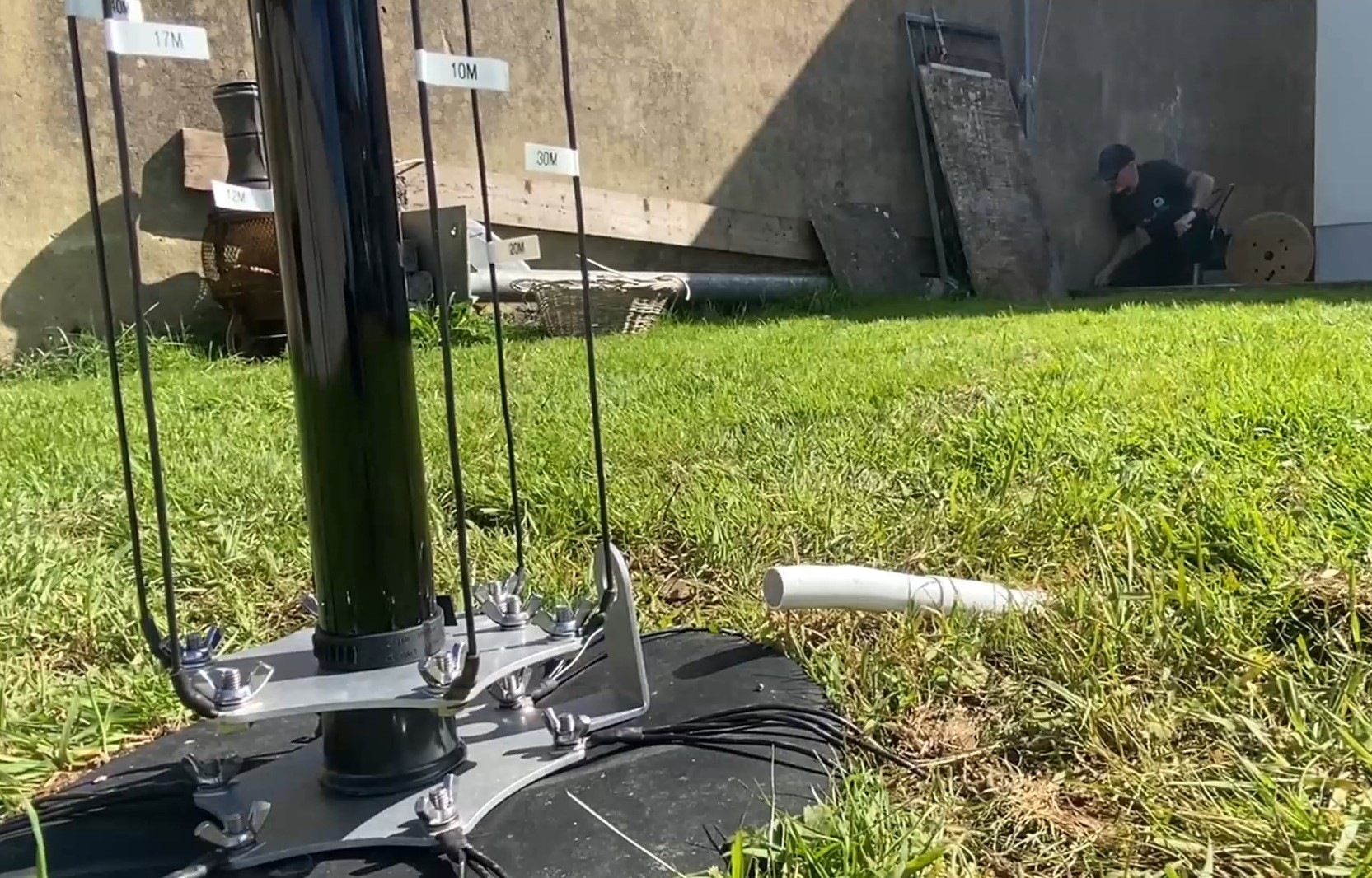
Over the past few years, the concept of multiband vertical antennas using separate quarter-wave radiators mounted on a common fiberglass telescopic mast has become increasingly popular among radio amateurs. One of the best-known representatives of this category is the system DX Commander, authored by British radio amateur Callum McCormick, MM0MCX. The antenna was created as a practical solution for operators requiring operation on multiple HF bands without the need for traps, mechanical switches or complex power systems.

DX Commander is not the only multi-band vertical antenna on the market, but it differs in that the individual bands are implemented by separate resonant radiators. Each driver is tuned to its operating band and all radiators are connected in parallel at a common feed point. The design therefore does not use traps or complex impedance transformers, but the classic principle of a quarter-wave vertical over a system of radials.
The entire antenna is mechanically simple. The laminate telescopic mast serves only as a supporting structure and is not an electrical part of the radiator. The individual wires are guided along the mast through plastic spacers, which ensure their even distribution and minimize mutual influence. The power supply is provided by an aluminum power plate (Driven Plate), while all radials are connected to a separate ground plate (Ground Plate). This principle is also described in detail in the manufacturer's assembly instructions.
In the article you will read
Principle of operation
From an electrical point of view, the DX Commander represents a system of parallel-connected quarter-wave vertical radiators. At any given moment, the conductor that is in resonance on the relevant band is the one that works the most. The other conductors behave as parasitic elements with a relatively small influence on the resulting impedance. The advantage is that, with proper tuning, an antenna tuner is not needed on most supported bands. This principle is also used, for example, by fan dipole antenna.

The manufacturer also warns that all radiators must be mounted simultaneously during tuning. A missing wire can affect the resonance of other bands and lead to incorrect tuning. The same recommendation can be found in the user manual.
An interesting solution is the use of harmonic resonances. For example, a radiator for the 40 m band also creates a resonance for the 15 m band, while some longer elements provide usable adaptation also for 6 m. However, the manufacturer explicitly states that the 6 m, 4 m and 2 m bands are not the primary design goal of the antenna and their usability depends on the specific configuration and installation conditions.
DX Commander system development
The author of the project, Callum McCormick, originally designed the antenna as a simple system suitable for both personal operation and DX expeditions. Gradually, a whole family of antennas was created using the same electrical principle, but different mechanical construction and mast height. The manufacturer today offers the Classic, Classic with 80 m support, Rapide, Rapide Plus, Expedition, Signature 9, Signature 12.4 m and Signature 18 m model lines. They all use the same philosophy of separate resonant radiators and a common system of radials.
DX Commander itself is a family business based in the UK. In addition to manufacturing antennas, it provides extensive technical documentation, assembly instructions and a number of free videos that explain individual construction steps, including tuning and maintenance of antennas. A significant part of the development is provided directly by Callum McCormick, who also prepares technical videos and answers user questions.
DX Commander antenna versions
The individual models are designed for different uses. The most famous Classic is a universal home multiband vertical antenna of approximately ten meters in height. The Rapide uses a shorter mast of approximately seven meters and is intended mainly where the height of the antenna is limited. The Expedition is optimized for quick deployment for portable operation and expeditions, while the Signature models use more robust masts and in some cases a self-supporting solution without classic anchoring ropes.
The electrical principle remains practically the same for all models. The difference lies primarily in the height of the mast, the number of supported bands, the mechanical design, the method of anchoring and the possibilities of expanding with additional emitters or bands.
DX Commander system design versions
Although all DX Commander antennas are based on the same electrical principle, the individual model lines are designed for different types of use. The differences lie mainly in the height of the telescopic mast, the mechanical solution, the anchoring options, the number of supported bands and whether they are intended for permanent or portable operation. The user manual devotes a separate chapter to each version with its own tables of radiator lengths, mounting methods and tuning recommendations.
| Model | Characteristics |
| Classic | Universal multiband antenna with an approximately 10 m high construction designed primarily for fixed home installations. |
| Expedition | Lightweight version optimized for portable operation, expeditions and quick field setup. |
| Rapid | A more compact solution for locations with limited mast height. |
| Rapid Plus | A variant of the Rapide using a solid ground beam instead of classic anchor ropes. |
| Signature 9 | Self-supporting version of the approximately 9 m high antenna with a fixed base. |
| Signature 12 | Higher construction designed for more demanding stationary installations. |
| Signature 18 | The largest model of the system with an 18 m mast for the maximum number of bands and higher mechanical reserve. |
Common to all models is the use of a telescopic laminate mast, an aluminum feed plate for the radiators, a separate plate for the radials, and plastic spacer plates that keep the individual conductors in a mutually defined position. This principle remains unchanged regardless of the size of the antenna.
Radials – a crucial part of a vertical antenna
In every quarter-wave vertical antenna, the radial array represents the other half of the antenna system. The DX Commander is no exception. The manufacturer pays special attention to this issue in the user manual and points out that questions related to radials are among the most common ones they receive from users.
Interestingly, the manual quite clearly refutes the widespread opinion that each radial must have a precisely calculated length. According to the manufacturer's long-term experience, the exact length of individual radials is not crucial, but rather their sufficient number and reasonable distribution around the antenna base. Even a few shorter conductors distributed approximately in a 90° sector will allow the antenna to work reliably, although maximum performance is achieved with a larger number of radials. The manufacturer also states that further increasing their number brings only a relatively small increase in gain, approximately up to 1.5 to 2 dB.
From a practical point of view, it is therefore more advantageous to pay attention to the quality contact of the radials with the power board, their even distribution and reliable mechanical fastening than to strive for mathematically precise lengths of each conductor.
Radial assembly
The radials are connected to a separate Ground Plate using fork connectors. The manual recommends preparing them in groups, usually four wires per connector, which greatly simplifies assembly and subsequent dismantling of the antenna in the field. After dismantling, the radials are spread out on the ground surface approximately evenly around the entire base of the antenna.
On permanent installations, the manufacturer recommends attaching them with biodegradable plastic pegs approximately every one meter. On concrete or paved surfaces, the radials can be left loose without a significant negative impact on the electrical properties of the antenna.
Installation on a flat roof
One of the frequent questions among radio amateurs is the use of the DX Commander on the roof of a family house or apartment building. The manufacturer addresses this issue quite openly. He states that he did not initially count on such an installation method at all, but many users successfully operate the antenna on flat roofs.
The experience includes both low garage roofs and multi-storey building roofs. However, the author of the manual warns that he himself has not tested or analyzed such a solution in detail, therefore he does not provide specific recommendations for solving possible problems. It is therefore more a confirmation of the practical experience of users than the result of systematic measurements.
From the perspective of amateur radio practice, several factors need to be paid increased attention to when installing on roofs. Metal roof structures, sheet metal, railings, air conditioning units or photovoltaic panels can change the impedance and radiation pattern of the antenna. It is equally important to ensure high-quality mechanical anchoring of the mast and safe placement of radials so that they do not pose a risk to the movement of people on the roof.
Mechanical construction

One of the characteristic features of the DX Commander system is the strict separation of the mechanical and electrical parts of the antenna. The laminated telescopic mast does not function as a radiator, but only as a supporting structure. All high-frequency energy is transmitted by individual copper wires running alongside the mast.
The conductors are arranged using plastic spacer plates with holes for individual radiators. Each spacer has a different inner diameter according to the respective section of the mast, so that they can be gradually inserted during assembly. Plastic clamps are used above the joints of the telescopic parts, which prevent the individual sections from sliding in during long-term operation. The entire mechanical system is designed so that the antenna can be repeatedly folded, unfolded and tuned without damaging the supporting structure.
An interesting detail is the use of elastic Dyneema cord to tension the emitters. Instead of a rigid attachment, it allows for flexible compensation of changes caused by wind or thermal expansion of the conductors. The manufacturer recommends leaving a certain tension reserve during tuning and only tightening the cords definitively after the final PSV adjustment.
Technical parameters of the system
The electrical characteristics of each model vary depending on the mast and radiator configuration used. However, the basic philosophy remains the same. Each supported band uses a separate resonant conductor. The longer bands use full-size quarter-wave radiators or their bent-top modifications, while some higher bands use Harmonic Resonances of longer conductors.
The manufacturer provides a precise table of production lengths of individual radiators for each model. The manual also emphasizes that these dimensions represent initial production values and that final tuning should be based on the actual measured PSV in a specific location. Any fine-tuning is done by shortening the conductor or adjusting the bent end part according to the type of the relevant band.
A great advantage of the DX Commander system is the possibility of simple replacement or addition of individual radiators without intervention in the entire antenna. The radio amateur can thus adapt the antenna to his own operational requirements, for example, replace the 30 m band with a radiator for 80 m or create a configuration intended only for selected competition bands. This modularity is one of the most striking design advantages of the entire system.
CLASSIC Multi-Band Antenna (40 m - 2 m HF Kit)
The most famous and most widespread model of the manufacturer is the Classic Multi-Band Antenna. This version is most often seen in user photos, DX expeditions and common home installations. It is a universal multi-band vertical antenna designed primarily for bands from 40 m to 10 m, while thanks to harmonic resonances it also allows use on higher bands. The design is designed so that the user can change or add individual radiators as needed.
The total height of the Classic model is approximately 9.2 to 9.3 meters. However, the manufacturer points out that the decisive factor is not the absolute height of the mast, but the correct extension of the individual telescopic sections and compliance with the prescribed lengths of the radiators. This ensures repeatability of the electrical properties after each re-positioning of the antenna.
Supported bands
In the standard configuration, the Classic uses separate resonant radiators for the 40m, 30m, 20m, 17m, 12m and 10m bands. The 15m band is created by using the harmonic resonance of the 40m radiator. The manufacturer also states that longer radiators can create usable resonance in the 6m band. Depending on the specific installation, some usability can be achieved on 4m, 2m or even 70cm, but these are not the bands for which the antenna was designed.
This solution is technically interesting because it minimizes the number of wires needed to cover multiple amateur radio bands. It also eliminates the need for traps or switching circuits, which are sources of loss or interference.
Possibility of extension to 80 m
One of the biggest advantages of the Classic model is its modularity. If the user prefers 80m operation over 30m, the original radiator can simply be replaced with a 19.5m long wire. This is routed like an inverted L from the top of the mast to a suitable anchor point. The manufacturer then recommends fine-tuning according to the actual measured PSV at the specific location.
Such a solution allows you to expand the usability of the antenna without major mechanical modifications to the entire structure.
Tuning the emitters
The manufacturer pays special attention to the tuning process. The basic rule is that all radiators must be mounted before any measurement. Their mutual electromagnetic coupling is not great, but in the complete absence of one conductor, the resonance of the other bands may shift.
The initial dimensions of the individual conductors are given in the manufacturer's tables. Subsequently, only small differences are fine-tuned. If the minimum PSV is below the desired frequency, the radiator is too long and must be shortened. If the minimum is above the desired frequency, the radiator is too short. The manufacturer simplifies this principle with the mnemonic "Long - Low", i.e. a long conductor means a too low resonant frequency.
The solution of the upper curved parts of some radiators is also interesting. For the 40 m or 20 m bands, the manufacturer recommends performing fine tuning by adjusting this curved part instead of shortening the entire conductor. Such a solution allows you to repeatedly fine-tune the antenna without interfering with the main part of the radiator.
Wind resistance and mechanical stress
Unlike traditional aluminum verticals, the DX Commander uses a flexible laminate mast. In strong winds, the antenna bends naturally without putting much stress on individual parts. Elastic tension cords also maintain constant tension on the radiators and compensate for their movement caused by the wind.
The manufacturer recommends leaving a slight tension reserve during the first tuning. Only after tuning is complete will the elastic cords finally reach approximately 180% of their original length. This ensures long-term mechanical stability even with changes in temperature or humidity.
Recommended official video
The manufacturer provides an extensive series of assembly videos. Among the most valuable for users of the Classic model is the detailed antenna assembly guide, in which Callum McCormick explains the assembly of the mast, the manufacture of the radiators, the placement of the radials and the final tuning. Practical demonstrations greatly facilitate the first assembly of the antenna and supplement the information provided in the written manual.
Recommended video: DX Commander Classic Build Guide (official DX Commander YouTube channel).
Other videos from the manufacturer are also worth watching, including how to properly deploy radials, tune individual bands, install flexible tension cords, or fold a telescopic mast repeatedly. These videos often answer questions that arise during the actual construction of the antenna.
User experience
The DX Commander is one of the antennas with a very active user community. Several common evaluations appear repeatedly on amateur radio forums, in reviews, and on YouTube.
Positively evaluated are mainly the simple construction without traps, the possibility of replacing individual radiators, easy repairs in the field, a low radiation angle suitable for DX contacts and relatively quick assembly. Also of great importance is the extensive technical documentation and a number of official videos, which make assembly easier even for less experienced radio amateurs.
Users also point out that the final results depend greatly on the quality of the radial system, local conditions, and the precise tuning of the individual radiators. As with other quarter-wave vertical antennas, identical parameters cannot be expected at every location.
It is these experiences that confirm that DX Commander should be perceived as a modular system, the resulting properties of which depend not only on the design itself, but also on the quality of installation and careful tuning according to the specific conditions of the workplace.
How to purchase DX Commander
All DX Commander antennas are sold directly through the manufacturer's official online store. The offer includes complete antenna kits, individual spare parts, telescopic fiberglass masts, mechanical components, wires, spacer plates, as well as accessories needed to maintain or expand an existing antenna.
The customer can order a complete kit or just individual parts. This is especially convenient for repairs after mechanical damage or when expanding the antenna to include additional bands. The manufacturer also offers a number of spare components, so in most cases it is not necessary to buy the entire antenna again.
Following the UK's withdrawal from the European Union, the manufacturer has adjusted the way it sells to customers from EU member states. Orders are processed through the IOSS (Import One Stop Shop) system, so VAT is usually paid at the time of ordering. As a result, in most cases, the shipment is not subject to additional VAT collection by customs upon arrival in the EU. However, customs procedures may depend on the value of the shipment and current regulations in individual countries, so the manufacturer recommends familiarizing yourself with local rules. Information on taxation and delivery is regularly updated on its website.
When ordering, it is advisable to check whether the kit contains all the required emitters for the planned bands. Some configurations allow you to choose between the 30 m and 80 m bands or order additional conductors as separate accessories.
Who is DX Commander intended for?
DX Commander is not an antenna intended only for experienced designers. Thanks to the detailed assembly instructions and extensive video library, even a radio amateur who has only built simple dipoles or GP antennas can handle the assembly. On the other hand, it offers enough space for experimenting with radiator lengths, radial configurations or expanding to other bands, which will also be appreciated by technically oriented radio amateurs.
The antenna finds application in normal home operation, during field days, in portable activations and on DX expeditions. The combination of simple mechanical construction, low weight and possibility of repeated folding is one of the reasons why it appears on many expeditions around the world.
Conclusion
The DX Commander is a modern interpretation of the classic multiband quarter-wave vertical antenna. Instead of the compromises typical of trap verticals, it uses separate resonant radiators connected to a common feed point. The result is a structurally simple system that can be relatively easily repaired, expanded, or adapted to specific operational requirements.
From a technical point of view, it is necessary to emphasize that the resulting properties of the antenna depend primarily on the quality of the installation. A sufficient number of radials, correct distribution of conductors, precise tuning of individual radiators and appropriate placement of the antenna have a greater influence on the resulting performance than the type of mast used. The manufacturer repeatedly emphasizes this fact in its technical documentation and installation instructions.
A significant advantage of the DX Commander system is also its extensive technical support. A detailed user manual, dozens of assembly videos and an active user community allow you to solve most technical questions without a lengthy search for information. This makes this antenna an interesting choice not only for radio amateurs building their first multiband vertical antenna, but also for experienced operators looking for a modular solution with easy maintenance and the possibility of further development.