
You know that feeling when you lean closer to the speaker and pick out the brand you've been looking for all evening out of the noise? That's exactly how two men felt on December 12, 1901, on the hill above the port of St. John's in Newfoundland. Guglielmo Marconi and his assistant George Kemp waited for three faint clicks. And they waited. 125 years later, Canadian occasional station XM9M is commemorating this moment.
You will read in the article
Three dots across the Atlantic
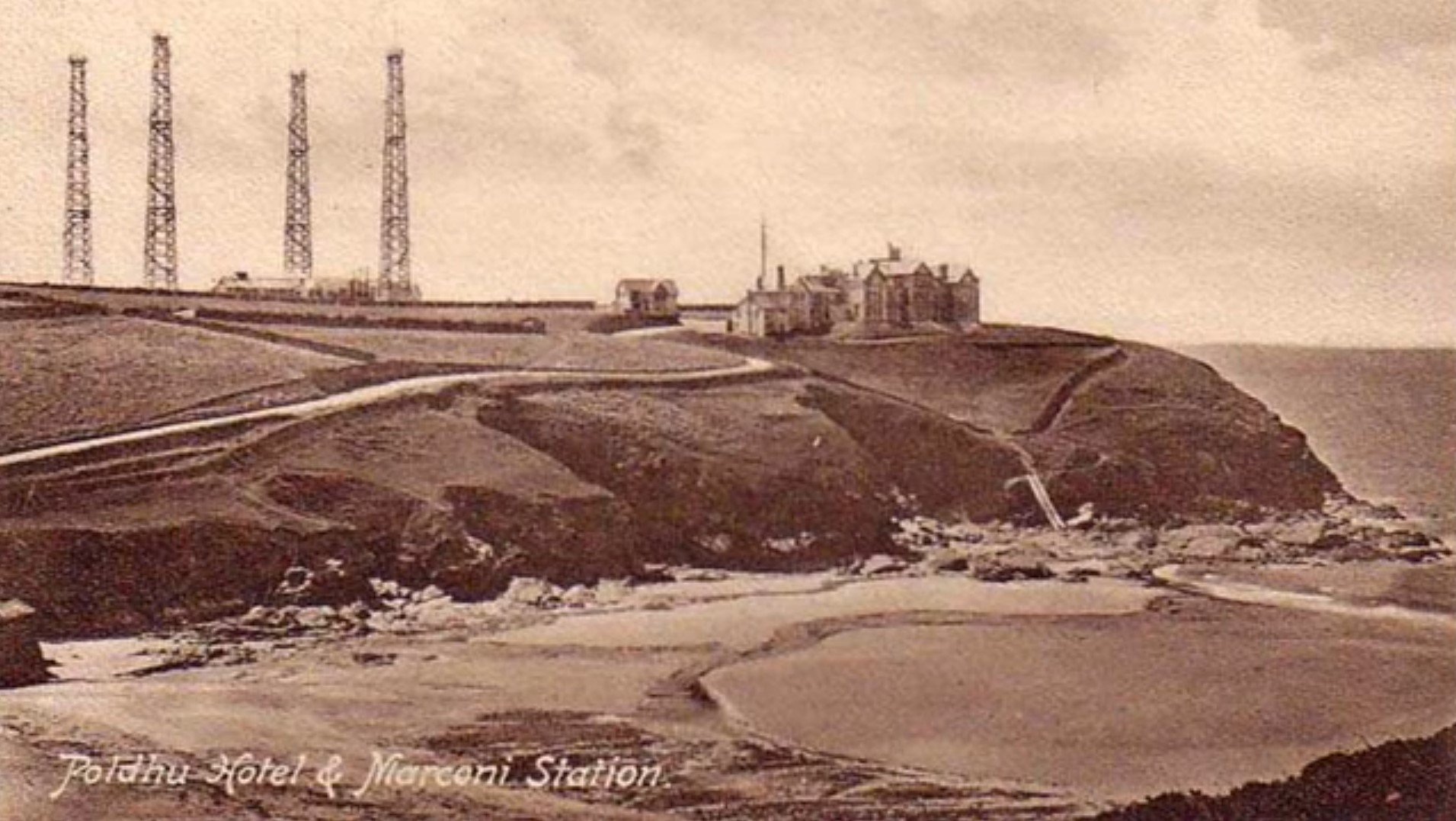
At Poldhu station in Cornwall, the crew had a clear order: to repeatedly transmit a single Morse code letter, S, meaning three dots. Across the ocean, on Signal Hill, the receiving wire was held in the wind by a kite. Marconi listened through the telephone receiver, then handed it to Kemp. Both confirmed that they heard the signal.
According to the site, the signal traveled more than 3,000 km. However, the other side of the story must also be told. The experiment had no independent witnesses or tape recording, and the scientific community was skeptical. Doubts about what Marconi really heard that day have not completely disappeared to this day.
However, this does not change the extent of the experiment's impact. Governments, navies, and commercial companies alike suddenly began to take wireless communications across the ocean seriously. This video shows what Signal Hill looks like today and what happened there.
Today, Signal Hill is a National Historic Landmark. Nearby is Cape Race, the first permanent Marconi station in North America, receiving transmissions from the Titanic in April 1912.
From Bologna to Poldha

Marconi was born in 1874 in Bologna to an Italian father and an Irish mother. In the autumn of 1894, the twenty-year-old read the obituary of Heinrich Hertz, who had proved the existence of electromagnetic waves just a few years earlier. From there came the question that did not let him go: can these waves be used to transmit messages where the wire cannot reach?
He made his first experiments on the family farm in Pontecchio near Bologna. With a modified Hertzian oscillator, a coherer as a detector and increasingly large antennas, he extended the range from meters to kilometers. The Italian government was not interested in his work, so in 1896 he moved to London with the help of his mother.
It turned out to be a decisive step. Britain, with its huge maritime empire, needed a connection between ships and the mainland, and immediately understood what Marconi had to offer.
It went fast there. He filed the first patent in June 1896, demonstrated the device to the British Post Office, and in 1897 founded the company that later became the Marconi Company. He was then twenty-three years old. Demonstrations followed across the Salisbury Plain, across the Bristol Channel, between Royal Navy ships and, in 1899, across the English Channel. An attempt across the Atlantic two years later was to show how far the signal would reach over the horizon.
The equipment for Poldha came from the Marconi factory on Hall Street in Chelmsford, England, which the second video describes as the world's first wireless factory. The video is also devoted to the Poldhu station, the memorable Marconi Center and the signal that radio amateurs sent in 2001 for the centenary.
The Poldh transmitter was a spark plug and was designed by John Ambrose Fleming. A balloon was first tested in Newfoundland, and the antenna was finally carried by a kite. Poldhu remained an important place even later. Marconi's collaborator Charles Samuel Franklin experimented with short-wave directional antennas and coaxial feeding there in the 1920s.
On the shoulders of giants
Marconi did not work in a vacuum. He built on Maxwell's theory, Hertz's experiments, Branly's coherer, and Lodge's circuit tuning patents, which Marconi later obtained. Nikola Tesla also has his claim to part of the merit. Decades later, the dispute over primacy was also resolved by the US Supreme Court, but it did not provide a clear answer.
His real strength was not a single invention, but the ability to combine existing knowledge, quickly try out hardware, demonstrate it convincingly, and turn a laboratory curiosity into a working technique. Today we would say that he was a systems integrator with an unusually high tolerance for risk.
In 1909, he received the Nobel Prize in Physics together with Karl Ferdinand Braun, whose loop transmitter greatly improved transmission efficiency. He accepted the shared prize without obvious bitterness, which was not obvious in the era of sharp disputes for the championship. In his Nobel lecture, he returned to the question that brought him to Newfoundland: how far away can a distant station be heard?
Marconi died in Rome on July 20, 1937. Radio stations around the world fell silent for two minutes.
Why it matters to radio amateurs
Physicists in 1901 claimed that radio waves travel in a straight line like light and end beyond the horizon. Marconi made the attempt anyway. Only later did it become clear that long waves follow the curvature of the Earth by surface wave and reflection from the ionosphere. Experiment preceded theory.
Every KV connection across the ocean, every weak signal on 40m in the gray zone, and every EME attempt has a piece of what Marconi accomplished on the hill above St. John's. From sea and air communication to satellites and our bands.
In addition, Marconi's company trained the first professional radio telegraphers, and many of them later became radio amateurs. Marconi did not discover the radio, but he repeatedly and publicly demonstrated that it was useful. And that may have meant more in the end.
XM9M: bidirectional this time

The difference between 1901 and today is summed up by the XM9M page in one thought. The experiment on Signal Hill was one-way: on one side they were broadcasting, on the other they were listening intently to one letter. When you call XM9M today and an operator picks up your tag, they can answer you. Just what the crew at Signal Hill in December 1901 could only wait for.
the XM prefix belongs to the Canadian block of brands, which is used mainly for occasional stations. The motif of the station resembles an old postage stamp: a mast on a cliff, a kite over the sea, the years 1901 to 2026 and a maple leaf. For collectors of QSL cards with history, this is a nice piece.
QSL via Club Log
Špeciálny QSL lístok XM9M si vyžiadate cez Club Log. There is a log search on the station page where you enter your brand and find your connection. As of this writing, the XM9M has yet to record any connections, so please wait a while to verify. You can find more at the XM9M page on QRZ.com.
Frequently asked questions
What does XM9M remember?
125th anniversary of the first transatlantic radio transmission. On December 12, 1901, Marconi and George Kemp at Signal Hill in Newfoundland intercepted the letter S sent from Poldh in Cornwall.
How do I get a QSL from XM9M?
Through the Club Log, where you search for your connection and request a special QSL ticket. The station has not yet uploaded the diary to the Club Log.
Why the letter S?
V morzeovke sú to tri bodky, jednoduchý a ľahko rozpoznateľný znak. Posádka v Poldhu ho mala vysielať opakovane, aby ho na druhej strane oceánu mohli zachytiť.
Is Marconi really the inventor of the radio?
Not alone. Staval na práci Maxwella, Hertza, Branlyho a Lodgea a Nobelovu cenu za fyziku v roku 1909 zdieľal s Karlom Ferdinandom Braunom. Jeho prínosom bolo premeniť poznatky na prakticky použiteľnú techniku.
Is the transfer from 1901 reliably documented?
Not completely. Pokus nemal nezávislých svedkov ani záznam na páske a pochybnosti pretrvávajú. Jeho vplyv na rozvoj bezdrôtovej komunikácie je však