
If you're going to be shooting VFOs on 15 or 20 meters over the weekend of November 28th and 29th, keep an eye out for the FR/G3TXF tag. Behind her is Nigel, G3TXF, this time broadcasting from Reunion Island in the Indian Ocean. In the CQ WW DX Contest CW 2026, he will enter the single band category.
This is an interesting opportunity for European stations: Africa, CQ zone 39 and 3 points per connection. In the article, we summarize what we know about the operation, how the station will be built and how to confirm the connection.
You will read in the article
One band, but which one?
In the list of announced stations, FR/G3TXF is in the SOSB 15M category, i.e. one operator on one band. In the recording, however, there is a note that the single-band category will be either 20 or 15 m. The selection will probably be decided by the distribution conditions just before the competition.
This means only one thing for you: during the contest, look for it only on one of these two bands. Those who want Réunion on another band should try their luck before the competition. According to QRZ, Nigel was also active by telegraphy on 17 m.
Réunion is in CQ Zone 39, along with Madagascar, Mauritius and Mayotte, according to the CQ WW zone list. So expect contest code 599 39 from FR/G3TXF.
What brings connection in CQ WW CW 2026
The telegraph portion begins on Saturday, November 28, 2026 at 00:00 UTC and ends on Sunday, November 29 at 23:59 UTC. The competition code consists of the RST report and the CQ zone. The diary in Cabrillo format must be sent within 48 hours after the end of the competition, which is new this year.
Spojenie so stanicou na inom kontinente má pre európsku stanicu hodnotu 3 bodov. Reunion will add a country multiplier and zone 39 a zone multiplier on the band you connect on, if you don't already have them there. Since the FR/G3TXF only competes on one band, you only get these two multipliers from it once. Detailed rules can be found in the article CQ WW DX contest CW 2026.
Vertical and 500 meters to the sea

The antenna is simple: a vertical with two raised radials, which is adjusted separately for 20, 17 and 15 m. So, every time you change the band, you have to adjust it manually. It doesn't matter in the contest on one band, outside of it it means a walk in the garden.
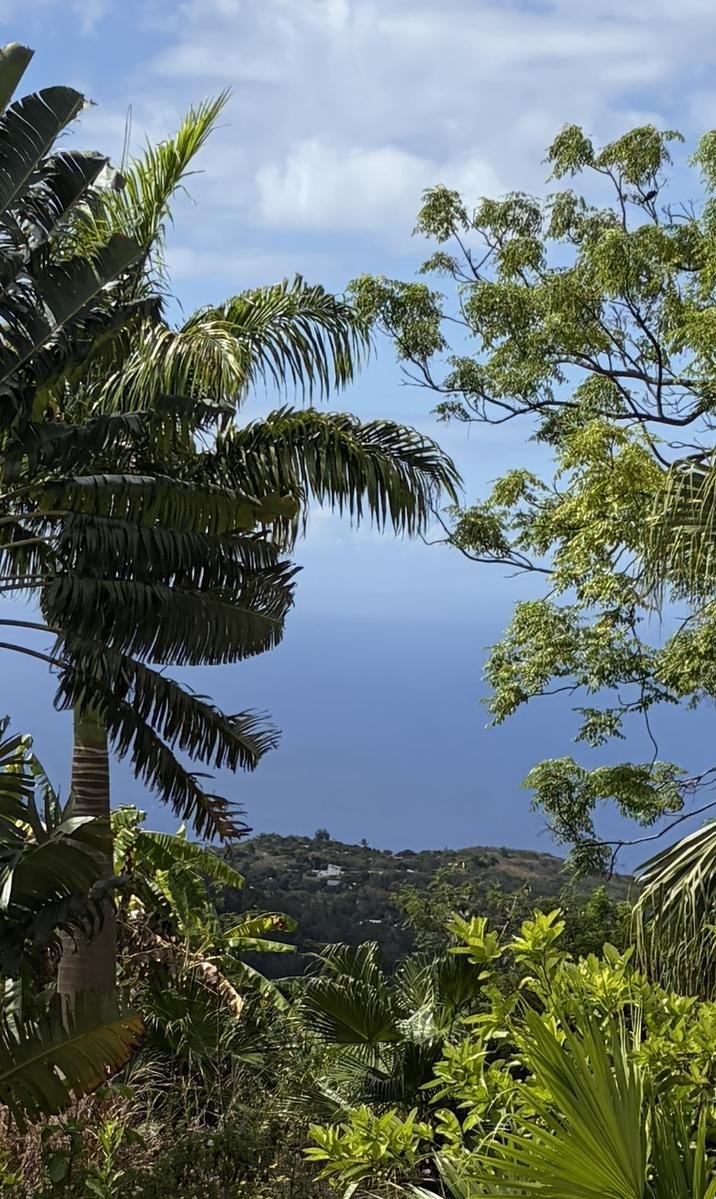
The real advantage is the location. It can be seen that the terrain descends from the QTH about 500 m (1,600 ft) towards the sea towards the northwest, that is, towards Europe and the USA. Such a view with a low radiation angle above the sea makes a simple vertical a very decent DX antenna.
There is another side to it. Behind the site is a steep hill that shadows the direction to the southeast. It will therefore be worse with Australia, New Zealand and the long journey to the USA. However, the geometry is ideal for stations from Europe.
New radio in old hands
G3TXF is a well-known DX expedition operator who has been riding with the set for years Elecraft K3s a zosilňovača KPA-500. Na Réunione podľa QRZ prvýkrát súťaží s novým transceiverom FlexRadio Aurora AU-510M. Ide o SDR a transceiver that has a 500 W output stage, a source and an antenna tuner in one box, so it replaces two boxes with one. This is a significant difference for traveling with a radio.
As G3TXF prepared for CQ WW CW in 2013, he caught on video G8DX.
The second video is from the other side of the pile-up. In it, Dongkyu, HL2WA, of Korea recorded a contact with 3B8/G3TXF of Mauritia on 30 m telegraphy. Mauritius is a neighboring island of Réunion and lies in the same CQ zone 39.
Réunion: volcanoes, valleys and tropics
Réunion is an overseas department of France in the Indian Ocean, east of Madagascar. The island is of volcanic origin and the relief reveals it at every step. In the southeast lies the active volcano Piton de la Fournaise, in the center is the highest peak of the island, Piton des Neiges.
Three large mountain basins spread around it, Cilaos, Salazie and Mafate. Mafate is famous for the fact that there is no road leading to it and you can only get there on foot or by helicopter. Popular with hikers looking for hiking trails and mountain views, the island also offers facilities for visitors who come with a radio.
The climate is tropical and the time is 4 hours ahead of UTC. When the contest starts at midnight UTC in Europe, it is four in the morning in Réunion.
How to do it in a pile-up
One operator on an island in the Indian Ocean means a CQ WW CW pile-up. Before you start calling, listen for a moment. Find out if it works simplex or split and how fast it gives connections. Send your mark once, in full, and at the pace he uses.
When it answers another station, don't call it. You're slowing everyone down, including yourself. And if you can barely hear him, don't leave right away. A single band station will stay on its band and you will have another chance when the spread to Europe opens.
How to confirm the connection
Links will go to LoTW. QSL tickets are arranged by G3TXF exclusively through Club Log OQRS, it does not send tickets through the QSL bureau. If you want a paper ticket, request it via OQRS in the Club Log after uploading the logbook.
Frequently asked questions
On which band will FR/G3TXF be in the contest?
On one, either 15 or 20 m. It is listed as SOSB 15M in the list of announced stations, with the note that the final selection between 20 and 15 m is not yet certain.
Which CQ zone is Réunion in?
In CQ zone 39 along with Madagascar, Mauritius and Mayotte. Contest code from FR/G3TXF will be 599 39.
How many points do I get for connecting?
The European station receives 3 points for the connection with Africa. On the given band, the multiplier of Réunion and the multiplier of zone 39 will also be obtained.
How do I get a QSL ticket?
Tickets do not go exclusively through Club Log OQRS, through the QSL bureau. Connections will also be in LoTW.
What equipment does G3TXF broadcast with?
With FlexRadio Aurora AU-510M transceiver and vertical with two increased radials for 20, 17 and 15 m. This is his first contest with this radio after years with Elecraft K3s and KPA-500.