
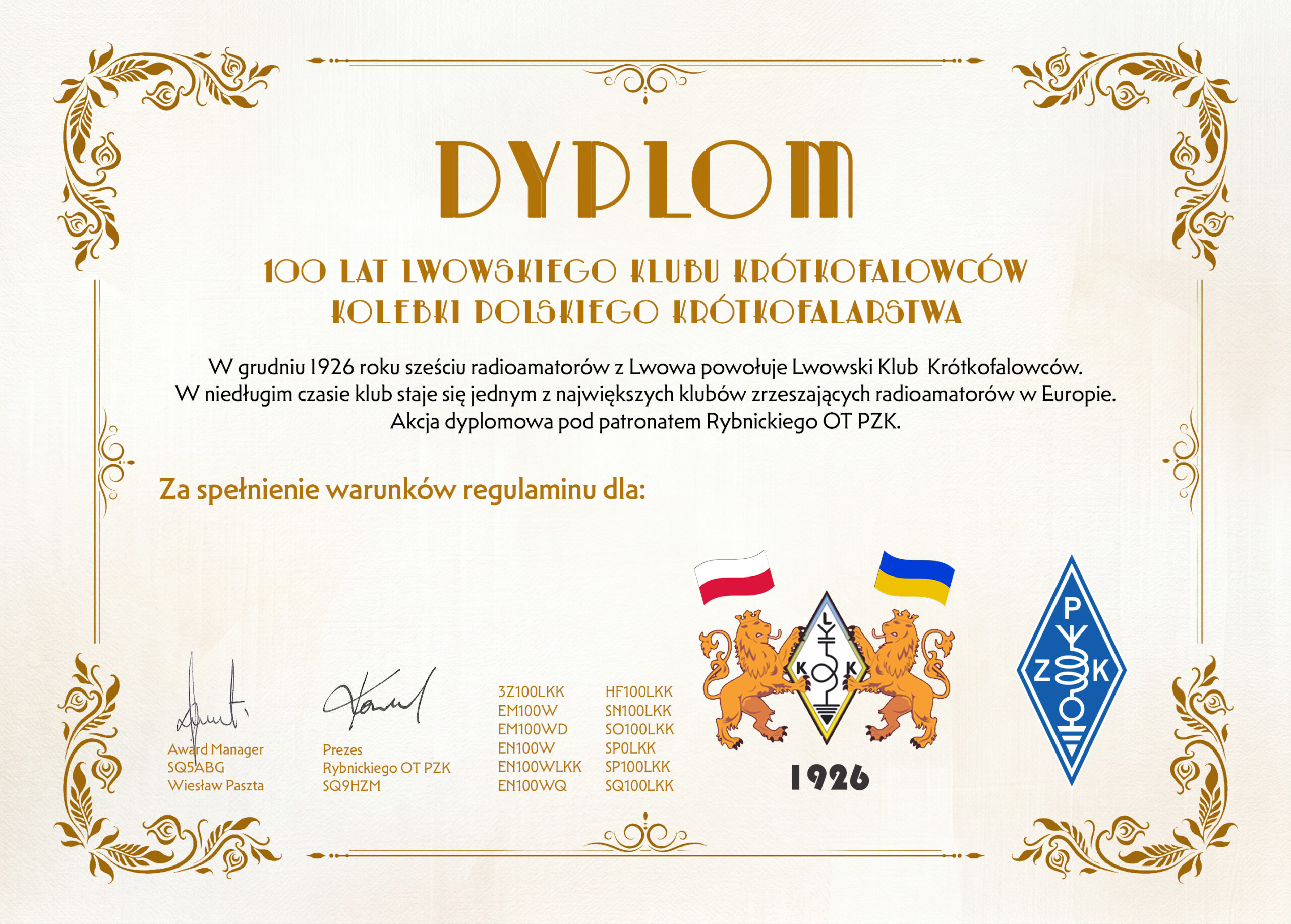
This year we commemorate the 100th anniversary of the founding of the Lviv HF club (historically known as the Lwowski Klub Krótkofalowców – LKK). The club is widely known and celebrated as the 'cradle of Polish amateur radio'.
LKK was founded in Poland in the city of Lwów (today's Lviv) in 1926 and was one of the largest and most active amateur radio clubs in Eastern Europe during the interwar period. Its members were not only engaged in radio communication and technical experiments but also organized amateur radio contests, undertook expeditions, and developed international contacts among amateur radio operators.
The rapid development of the club and its active involvement in community life led to LKK's admission to the International Amateur Radio Union (IARU) on September 30, 1928. In practice, the club represented Polish amateur radio operators on the international stage until February 1930 when the Polish Amateur Radio Union (PZK) was established, which still operates today.
In 1928, the club began publishing its own magazine 'Krótkofalowiec Polski' (KP). It was one of the first specialized magazines in Europe dedicated exclusively to amateur radio. The magazine continued to be published until the outbreak of World War II in 1939.
In 1929, LKK ranked fifth in Europe in the number of active radio stations (behind the USSR, England, France, and Belgium) and second in the number of DX enthusiasts, just behind England.
A special place in the club's history is occupied by the scientific expedition to Mount Hoverla in the Carpathians in 1930, which was a shining example of technical enthusiasm as well as the spirit of experimentation and discovery among Lviv amateur radio operators. The expedition relied on portable tube shortwave transmitters (for HF as well as VHF bands from radio amateurs, who were transported on horse-drawn carts. At that time, radio amateurs were often recruited for such expeditions since they possessed unique skills necessary for the construction, maintenance, and repair of lightweight battery-operated field stations in mountainous conditions. LKK helped ensure radio communication even during floods on the San River, demonstrating the practical significance of amateur radio in emergency situations.
In 1938, Jan Ziembicki, SP1AR – one of the leaders of the Lviv amateur radio community – applied for the DXCC award after establishing contacts with 100 different countries around the world. At that time, there were only 29 radio amateurs worldwide with confirmed contacts with at least 100 countries. Only six of them were from Europe.
An important place in the club's history also belongs to amateur radio contests. LKK was tasked with organizing the first international PZK contests in 1933. These contests continue to this day and are known as the SP DX contest.
Special event stations for the 100th anniversary of the Lviv Club

On the occasion of the 100th anniversary of LKK in 2026, stations in Ukraine and Poland will use special event call signs:
Ukraine: EN100WLKK, EN100WQ, EM100W, EN100W, EM100WD
Poland: 3Z100LKK, HF100LKK, SN100LKK, SO100LKK, SP0LKK, SP100LKK, SQ100LKK
Commemorative diplomas are also issued in Ukraine and Poland; details can be found here: https://radiodyplom.pl/ses/282
The culmination of the anniversary celebrations will be a ceremonial meeting on the occasion of the 100th anniversary of LKK in Lviv, which will take place in the main hall of Lviv Polytechnic – the largest university in Ukraine. The hall is equipped with a shelter, allowing for a safe course of the ceremony even in the event of an air alert.
The ceremonial meeting will take place as part of the International Conference on Advanced Trends in Radioelectronics and Infocommunications (ATRIC-2026), which will be held from October 15 to 17, 2026, at the National University of Lviv Polytechnic. Details can be found at https://science.lpnu.ua/uk/sprik-2026.
In the amateur radio section of the conference, Tom Ciepelowski, SP5CCC, will present on the history of LKK. Following him, Rich Assarabowski, K1CC, will share a brief history of his great-uncle and mentor SP2CC, one of the early members of LKK. To conclude, he will present his efforts in supporting youth in science and technology (STEM), including their involvement in amateur radio, through the Sci-Tech Amateur Radio Society (STARS) from Boston. It is particularly noteworthy that this year the STARS club, in light of the challenging times faced by the Ukrainian amateur radiocommunity, donated studio amateur radio equipment to the LKK club.
Over the century, technologies, states, and generations of radio amateurs have changed, but the spirit of LKK remains unchanged – a creative passion for technology, experimentation, competition, and international amateur radio brotherhood.
Nikolai UR5WHT