
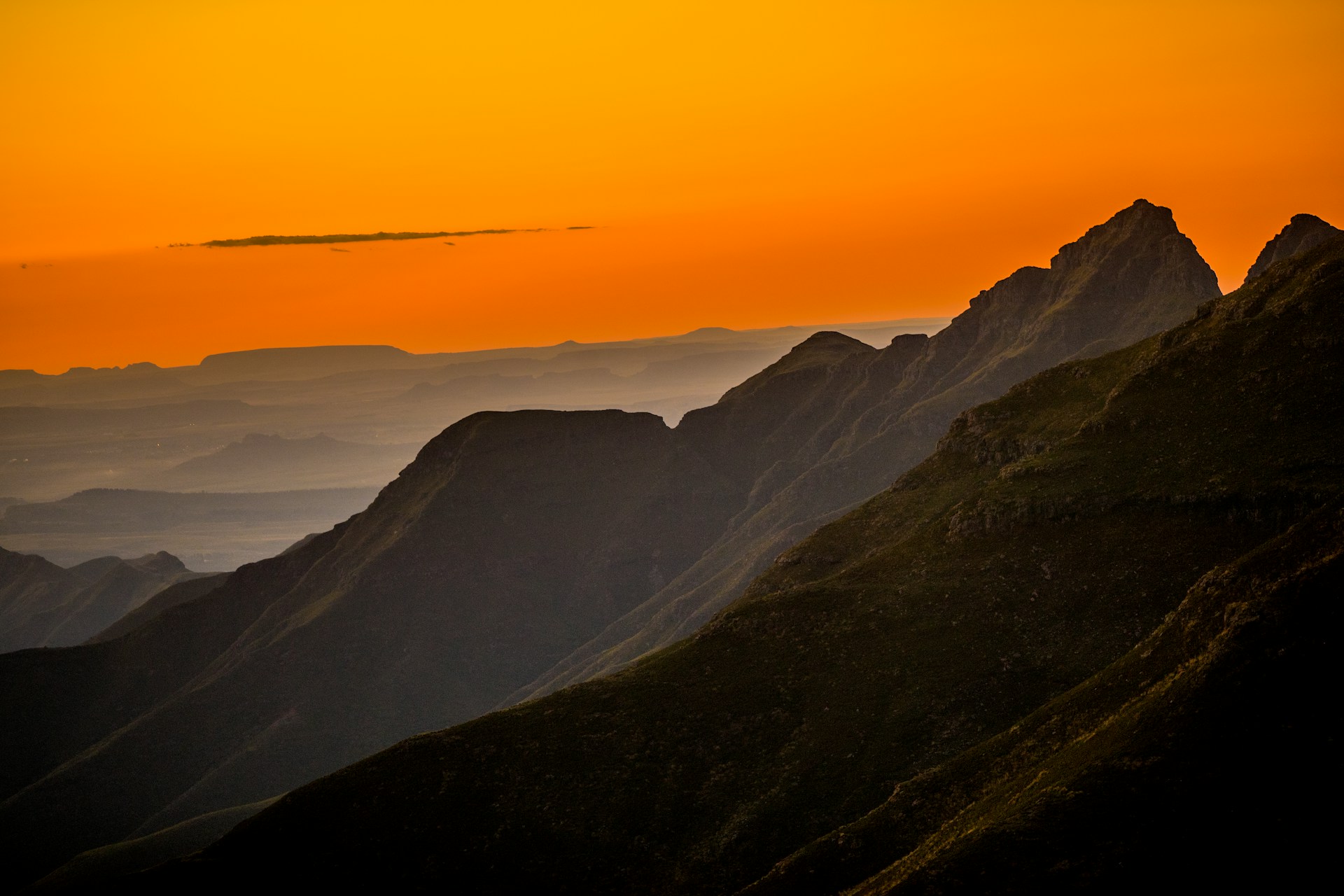
Lesotho is the only country in the world whose entire territory lies above 1,390 m above sea level. m. The landlocked country, completely surrounded by the Republic of South Africa, has an area of 30,355 km² and a population of approximately 2.3 million. The western part consists of the Highveld plateau at an altitude of 1,400 to 1,700 m, the eastern highlands exceed 2,000 m and are cut by deep river valleys. For radio amateur operation, such an altitude means a low level of industrial interference and a clear horizon, but at the same time limited access to infrastructure, unstable weather and demanding logistics.
You will read in the article
Team and organization
Under the brand 7P8GE a five-member German team will work from October 16 to 29, 2026: Manfred DK1BT, Wolf DL4WK, Annette DL6SAK, Tom DL7BO and Frank DL7UFR. The pilot of the expedition is Sigi Presch DL7DF, who has been organizing DX expeditions since 1993. Frank DL7UFR is also the QSL manager and administrator of the project website. The position is located in the locator KG30vo, v CQ zóne 38 a ITU zóne 57.
Technology and antennas
The equipment of the expedition consists of three transceivers Icom IC-7300 and two Icom IC-705s, complete with power amplifiers and bandpass filters. The combination of both types makes it possible to occupy up to five bands in parallel.
The antenna equipment is extensive and covers the entire KV range:
| Antenna | Bands |
|---|---|
| vertical | 160 m and 80 m |
| loop antenna | 60 m |
| loop antenna | 40 m |
| loop antenna | 30 m |
| spider beam | 20 m to 10 m |
| Spiderbeam | 30 m to 12 m |
| Loop antennas (loop) | 20, 15 and 10 m |
| HB9CV | 17 m and 12 m |
| beverage | reception on lower bands |

Two Spiderbeams cover bands from 30 to 10 m with an overlap, which allows simultaneous operation of two stations on higher bands without mutual interference. HB9CV are compact two-element directional antennas with good gain at WARC pásmach 17 a 12 m, kde sú pile-upy typicky menšie a šanca na spojenie vyššia. Beverage antenna serves for reception on lower bands, where the distance between the signal and the noise on the transmitting vertical is insufficient.
Note on the 160 m band
The antenna equipment includes a vertical for 160 m, but the official description of operation indicates a range of 80 to 10 m. operation on 160 m therefore depends on local conditions and is not guaranteed. The team publishes up-to-date information on the expedition website.
Operating modes and strategy
The expedition will work in CW, SSB and digital modes. With five stations operating simultaneously, a split by modes is likely: dedicated stations for CW and digital modes (FT8/FT4) and SSB rotation by openings. Five stations in thirteen days of operation is an ambitious plan that, with the right distribution of bands, can satisfy demand from several continents.
October is the beginning of spring in South Africa. The higher bands of 10 to 17 m should offer openings to Europe, especially in the morning UTC. Bands 40 and 80 m can be used at night, while the high altitude of the position and the low level of local interference are an advantage right here. Lesotho's time zone is UTC+2, identical to Central European Summer Time, which makes planning easier for European operators.
Logistics and field conditions
Lesotho does not have its own port or rail network connected to neighboring South Africa. Access to more remote locations requires all-terrain vehicles and precise planning. Climatically, October is changeable – in the lowlands around 20 °C, but in the highlands night temperatures can drop to freezing point. The power grid (220 V / 50 Hz) is unreliable outside the capital Maseru.
Challenging terrain conditions are also reflected in the budget. The team specifically asks for financial support to cover postage and shipping costs. Sponsors include Funkamateur magazine, QSL-Shop.com, South German DX Group (SDXG), Rudi DM2XO, Jan SP3CYY, Bernd DF3CB and Wolfgang HB9CCS.
QSL 7P8GE and connection confirmation
The QSL manager is Frank Rutter DL7UFR. The log will be uploaded to LoTW within six months of the expedition. The following routes are available for paper QSLs:
| Method | Details |
|---|---|
| Direct | SASE or SAE + US to: Frank Rutter, DL7UFR, Hallberger Zeile 14, 12437 Berlin, Germany |
| Bureau | Via the German QSL bureau DARC on DL7UFR |
| OQRS | Online request on the expedition website |
| LoTW | Complete diary within 6 months after the expedition |
The team warns that IRC does not accept coupons due to the growing problems with their exchange. When sending an envelope without sufficient postage or without SASE, the QSL will be sent through the bureau. They only accept one envelope per envelope - others go through the bureau.
Lesotho as a DXCC entity
prefix 7P patrí medzi menej aktivované africké DXCC entity. The local radio amateur community is practically non-existent and traffic from Lesotho is almost exclusively expeditionary. In April 2026, the Italian MDXC team operated from this entity under the brand 7P8WR, so 7P8GE is the second major expedition in 2026. For many operators, this is an opportunity for new DXCC - and with five stations and thirteen days of operation, the chance of a connection is real even with more modest equipment on the other side of the route.